
Skip to content
The Encyclopedia of Horology

Tool · Arabic-inscribed astrolabe, Iran

Astrolabe by Muḥammad Mahdī

Partially verified

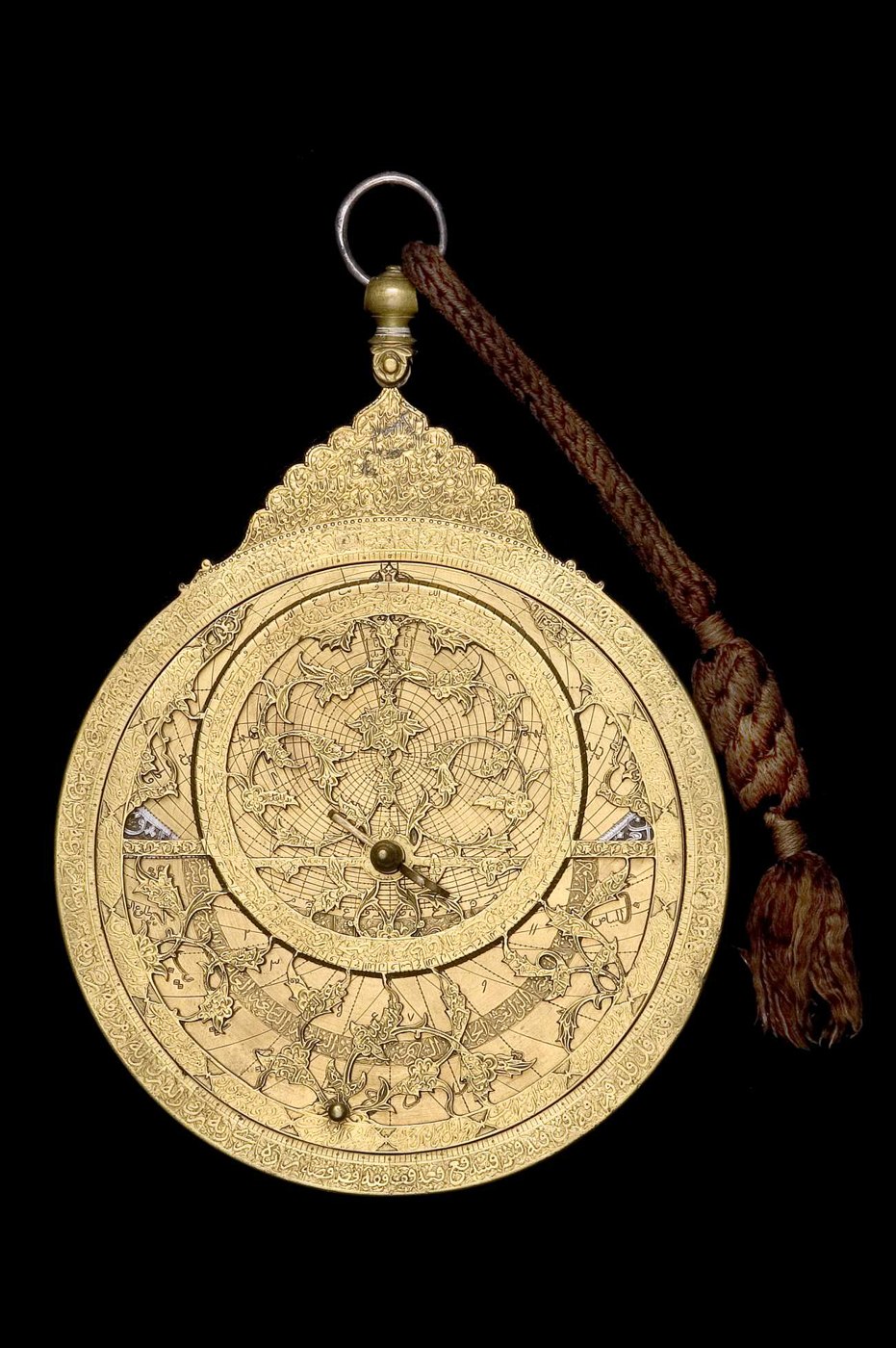
This brass astrolabe, inventory number 46886, is attributed to the maker Muḥammad Mahdī and dated to approximately 1660. The instrument features an Indo-Persian type engraved throne with an integrated base, attached to a simple, round cross-section silver ring via an eye-bolt type brass shackle. The mater and limb are constructed from one piece of brass. The back of the instrument contains 16 scales, including those for altitude, declination, the azimuth of the Qibla, sine/cosine, and lunar mansions. It is signed in a cartouche: "Embellished by Muḥammad Mahdī son of Muḥammad Amīn al-Yazdī." The rete is of a foliate, single-knob design without marked stars. The instrument includes six plates with latitudes ranging from 22° to 66° and a double-ended alidade. It was acquired by the History of Science Museum after being presented by J. A. Billmeir in 1957.

Full view of the astrolabe, showing the intricate foliate rete and the suspension shackle, with a brown braided cord attached.
Full view of the astrolabe, showing the intricate foliate rete and the suspension shackle, with a brown braided cord attached. — History of Science Museum, University of Oxford. Rights pending — permission not yet requested. Original source

Catalogue identity

Source
www.mhs.ox.ac.uk
Category
Tool · Arabic-inscribed astrolabe, Iran
Maker / attribution
Muḥammad Mahdī
Reference
Not recorded
Catalogue / lot identifier
46886
Source-reported date
ca. 1660
Source-reported place
Persia

Source-reported attribution and specifications are not independent authentication. A listing does not establish present ownership, current display, availability or permission to reproduce.

Object description

Construction and Design

The astrolabe is crafted primarily from brass, featuring an Indo-Persian style throne that is engraved and attached via an integrated base. The suspension system consists of a simple silver ring with a round cross-section, connected to the throne by an eye-bolt shackle that pivots on a pin. The mater and limb are fashioned as a single piece, with the tympan tab positioned at the bottom, 180 degrees from the throne.

The rete is designed with complex foliate patterns and a single knob, though it lacks individual star markings. It is secured using a simple, undecorated pin and horse mechanism. The instrument includes six separate plates, providing coverage for latitudes ranging from 22 to 66 degrees. A double-ended, rigid alidade completes the set of components.

Evidence for this section
  • “The throne is of the indo-persian, engraved type made of brass attached with integrated base made of brass”
  • “The mater and limb are of one-piece construction.”
  • “The rete is of the foliate (single knob) type.”
  • “There are 6 plates with latitudes ranging from 22°0' to 66°0' .”

Inscriptions and Markings

The astrolabe is extensively inscribed with both functional and decorative text. The front throne area displays an ornate, embossed Qur'anic verse. On the back, the instrument is signed by the maker in a cartouche, identifying him as Muḥammad Mahdī, the son of Muḥammad Amīn al-Yazdī. Additionally, an inscription at the bottom edge conveys the maker's sentiment regarding the longevity of his work.

The back surface is highly detailed, containing 16 distinct scales, such as those for the Azimuth of Qibla, sine/cosine, and zodiacal signs. These are arranged in concentric circles or arcs within the various quadrants. The limb is also engraved with a degree scale, numbered every 5 degrees, which occupies the outer circular edge of the instrument.

Evidence for this section
  • “The front bears an ornate, embossed inscription.”
  • “The back is inscribed: with a maker's signature marked as نمقه محمد مهدي ابن محمد أمين البزدي”
  • “The back contains 16 scales of the following types”
  • “The limb is inscribed: with a marked as [along edge].”

Provenance and Acquisition

The object was acquired by the History of Science Museum, University of Oxford, through a presentation by J. A. Billmeir in 1957. The instrument is recorded under the accession number 1957-84/162.

Prior to its arrival at the museum, the astrolabe was part of the Chadenat collection. It was purchased by Billmeir during a public auction held at the Hotel Drouot in Paris on May 24, 1956. Charles Chadenat, the previous owner, was recognized as a collector and dealer based in Paris.

Evidence for this section
  • “Presented by J. A. Billmeir in 1957”
  • “Billmeir bought it at the auction sale of the Chadenat collection at the Hotel Drouot, Paris, on 24 May 1956.”
  • “Accession 1957-84/162”

Open research questions

  • What is the specific historical significance of the bird-shaped compass needle found on this instrument?
  • Why does the rete lack individual star pointers despite the otherwise high complexity of the instrument's engraving?

Source evidence

Recorded claims and source quotations for Astrolabe by Muḥammad Mahdī
FieldSource-reported valueSource quotation
Inventory number46886“Inventory no. 46886”
MakerMuḥammad Mahdī“Maker Muḥammad Mahdī”
Dateca. 1660“Date ca. 1660”
PlacePersia“Place Persia”
MaterialBrass“Material Brass”
ProvenancePresented by J. A. Billmeir in 1957“Presented by J. A. Billmeir in 1957”
SignatureMuḥammad Mahdī son of Muḥammad Amīn al-Yazdī“نمقه محمد مهدي ابن محمد أمين البزدي (Embellished by Muḥammad Mahdī son of Muḥammad Amīn al-Yazdī.)”
Throne styleIndo-Persian, engraved“The throne is of the indo-persian, engraved type”

Visible details

  • The compass needle on the throne is shaped like a bird.
  • The rete features elaborate foliate cutwork.
  • The shackle pivots on a pin affixed to the throne.
  • The back contains a prominent shadow square and triplicities box.

Research qualifications

  • The exact reading of the inscriptions marked as [along edge] and [along tropic of capricorn] remains pending.
  • The star names, mediation, and declination on the rete are not currently marked or measured.

Photograph identity and source facts were screened before import; rights clearance remains pending.

Consulted source

Astrolabe, inventory 46886 (Persia, ca. 1660)

Reviewed 2026-10-26 · Record 48a3b5e203

Terms in this record

Glossary explanations for terms named in this object’s record.