
Skip to content
The Encyclopedia of Horology

Tool · Arabic-inscribed astrolabe, Iran

Brass Astrolabe

Partially verified

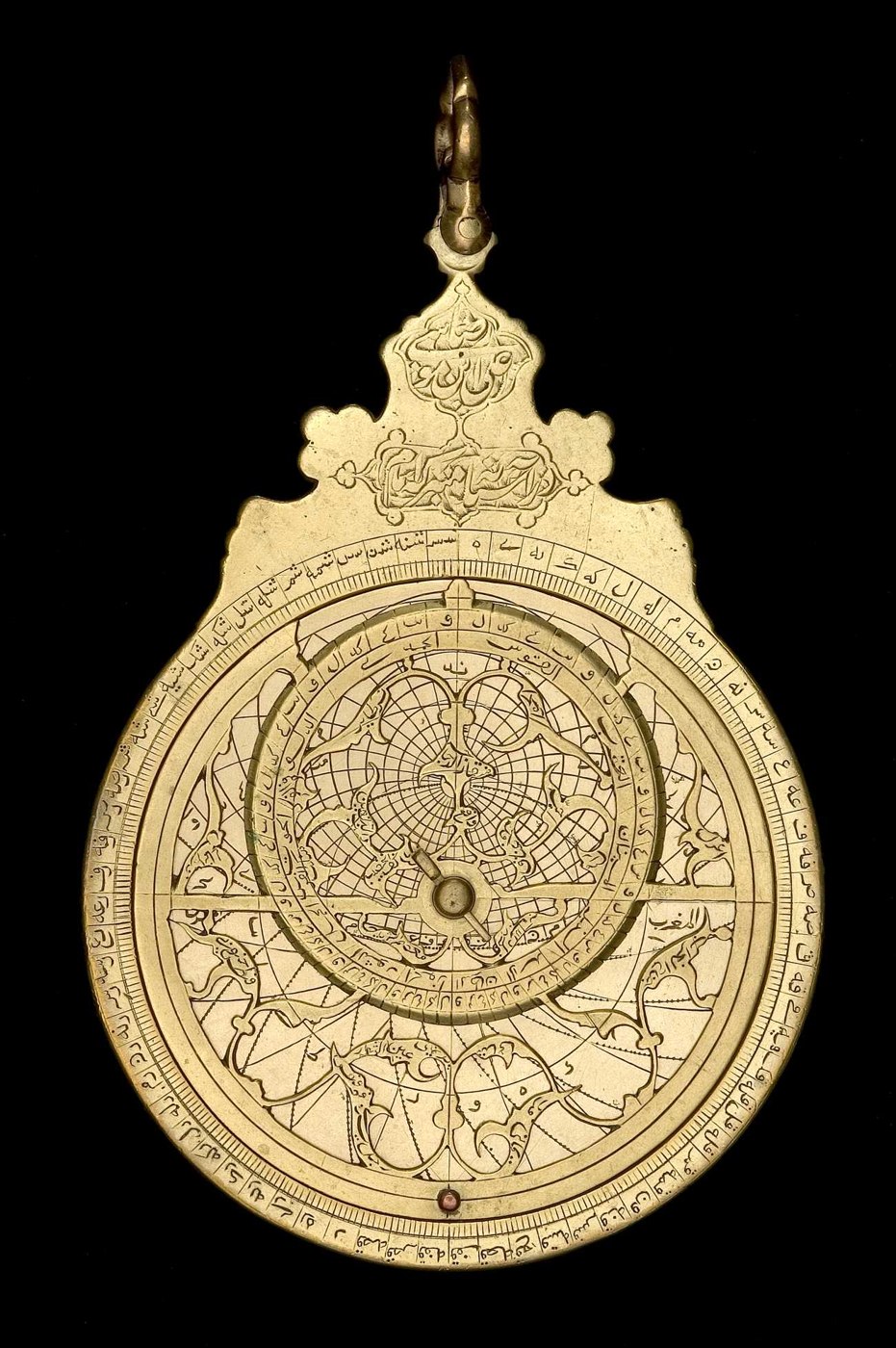
This brass planispheric astrolabe, inventory number 43148, was created in 1641 (A.H. 1051) by the maker Ibrāhīm ibn Sharaf ad-Dīn Ḥusain. The instrument features an Indo-Persian style engraved throne with trefoil-type shackle and an integrated base. The construction comprises a mater and limb of one-piece design, with the plate tab positioned 180 degrees from the throne. The instrument includes four plates with latitudes between 21 and 66 degrees, and a foliate-type rete with a single rotational copper knob and no marked stars. The back displays ten varied mathematical and astronomical scales, including altitude, declination, cotangent, and shadow squares, alongside a specific inscription commissioned by the Shāh for ʿAbd al-Razzāq Gilānī in Mashhad. Provenance records indicate the instrument was acquired by Lewis Evans in Paris in 1905, who noted significant bruising to the rim consistent with use as a hammer.

Front view of the brass astrolabe showing the rete, throne, and limb scales.
Front view of the brass astrolabe showing the rete, throne, and limb scales. — History of Science Museum, University of Oxford. Rights pending — permission not yet requested. Original source

Catalogue identity

Source
www.mhs.ox.ac.uk
Category
Tool · Arabic-inscribed astrolabe, Iran
Maker / attribution
Ibrāhīm ibn Sharaf ad-Dīn Ḥusain
Reference
43148
Catalogue / lot identifier
1924-0/2004
Source-reported date
1641 (A.H. 1051)
Source-reported place
Persia

Source-reported attribution and specifications are not independent authentication. A listing does not establish present ownership, current display, availability or permission to reproduce.

Object description

Construction and Design

The astrolabe is constructed primarily of brass, featuring an Indo-Persian style throne with integrated base and trefoil decorations. The mater and limb are integrated as a single piece, with the retention tab for the plates located at the 180-degree position relative to the throne.

The rete is a foliate, single-knob design made of copper. The instrument is equipped with four plates covering latitudes from 21 to 66 degrees. A double-ended alidade is present, though it is currently damaged.

Evidence for this section
  • “The throne is of the indo-persian, engraved type made of brass attached with integrated base made of brass and trefoil type shackle made of brass”
  • “The mater and limb are of one-piece construction”
  • “The rete is of the foliate (single knob) type. The single rotational knob is made of copper.”

Inscriptions and Mathematical Scales

The instrument contains complex astronomical functions, including ten distinct scales on the back. These include altitude, declination, sine/cosine, cotangent, and shadow squares, which are arranged in concentric and box-format geometries.

The astrolabe is inscribed with a Persian dedication commissioned by the Shāh for ʿAbd al-Razzāq Gilānī in Mashhad. The text specifies the month and year of completion as Shaʿbān 1051.

Evidence for this section
  • “The back contains 10 scales of the following types: Altitude; Declination; Sine/Cosine; Cotangent; Shadow square; Terms.”
  • “By command of the Shāh, our master, the excellent ʿAbd al-Razzāq Gilānī in Mashhad in the month of Shaʿbān in the year 1051.”

Provenance and Condition

Acquired by Lewis Evans in Paris in 1905, the astrolabe was later presented to the museum in 1924. The provenance notes detail the physical state of the instrument upon acquisition.

Evans explicitly recorded that the instrument had sustained substantial damage due to misuse, specifically noting its history as a makeshift hammer, which accounts for the present bruised condition of the outer rim.

Evidence for this section
  • “Evans bought it in Paris in 1905.”
  • “He records that 'The instrument has been used as a hammer and its rim is much bruised'.”

Open research questions

  • What is the definitive reading of the final, unclear characters in the dedication inscription?
  • Does the specific nature of the 'bruising' indicate impact points consistent with the reported use as a hammer?

Source evidence

Recorded claims and source quotations for Brass Astrolabe
FieldSource-reported valueSource quotation
MakerIbrāhīm ibn Sharaf ad-Dīn Ḥusain“Maker Ibrāhīm ibn Sharaf ad-Dīn Ḥusain”
Date1641 (A.H. 1051)“Date 1641 (A.H. 1051)”
Place of originPersia“Place Persia”
MaterialBrass“Material Brass”
ProvenancePresented by Lewis Evans in 1924“Presented by Lewis Evans in 1924”
Physical conditionBruised rim“The instrument has been used as a hammer and its rim is much bruised”
Accession number1924-0/2004“Accession 1924-0/2004”
Inscription translationBy command of the Shāh, our master, the excellent ʿAbd al-Razzāq Gilānī in Mashhad“By command of the Shāh, our master, the excellent ʿAbd al-Razzāq Gilānī in Mashhad in the month of Shaʿbān in the year 1051.”

Visible details

  • The alidade arm is broken at the left sighting vane.
  • The rim shows heavy surface bruising.
  • The throne displays distinct trefoil-shaped decorative elements.

Research qualifications

  • The inscription includes a terminal '?' suggesting possible uncertainty in the reading of the final words.
  • The function of the instrument as a hammer, while reported in the provenance, is anecdotal.

Photograph identity and source facts were screened before import; rights clearance remains pending.

Consulted source

Astrolabe, inventory 43148 (Persia, 1641 (A.H. 1051))

Reviewed 2026-10-26 · Record 3ed5cdbdad

Terms in this record

Glossary explanations for terms named in this object’s record.