
Skip to content
The Encyclopedia of Horology

Clock · Bracket clock

Bracket clock

Partially verified

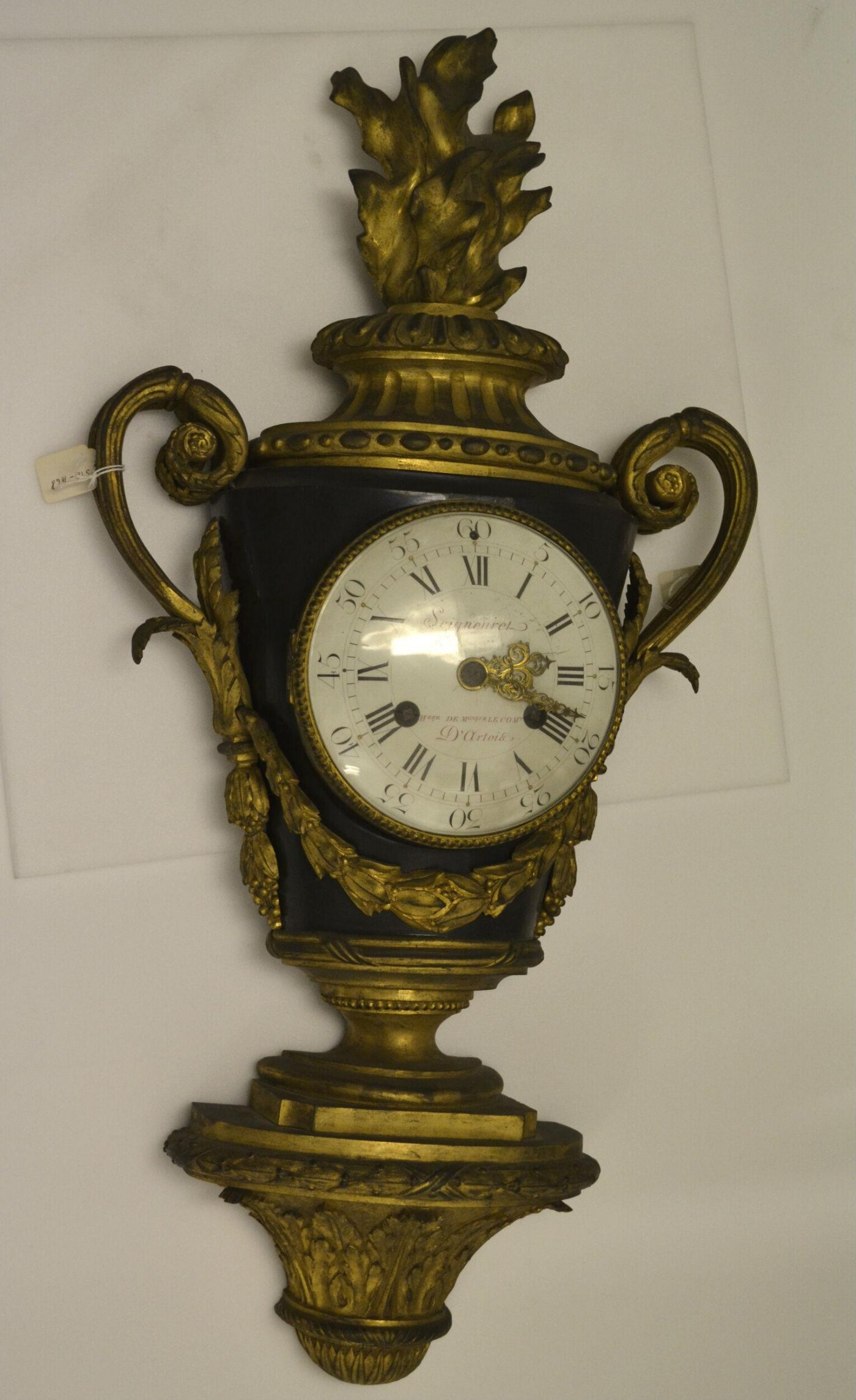
This bracket clock, attributed to Pierre Seigneuret, is a mid-to-late 18th-century French timepiece housed in an urn-shaped case. The construction features an iron body painted black, decorated with cast and chased ormolu elements including flame-shaped top ornamentation and scrolled handles. The white-enamel dial, protected by a hinged glazed cover, displays Roman hours and a five-minute outer ring. It is signed by the maker, who held the title of clockmaker to the Comte d’Artois. The circular movement, measuring 12.7 cm in diameter, utilizes two going barrels, an anchor escapement, and a locking plate striking train. It operates with a steel rod pendulum featuring a brass-covered lens bob. The entire assembly is displayed on a corresponding wall bracket. Acquired by the museum in 1868 from M. Duchochais,

Urn-shaped bracket clock by Pierre Seigneuret featuring a black-painted iron body and ormolu mounts.
Urn-shaped bracket clock by Pierre Seigneuret featuring a black-painted iron body and ormolu mounts. — Victoria and Albert Museum. Rights pending — permission not yet requested. Original source

Catalogue identity

Source
collections.vam.ac.uk
Category
Clock · Bracket clock
Maker / attribution
Pierre Seigneuret
Reference
Not recorded
Catalogue / lot identifier
518:1 to 3-1868
Source-reported date
1750-1800
Source-reported place
France

Source-reported attribution and specifications are not independent authentication. A listing does not establish present ownership, current display, availability or permission to reproduce.

Object description

Case and Dial Construction

The clock is housed in an urn-shaped case primarily constructed from iron, which has been painted black. This central body is accented by cast and chased ormolu decorations, most prominently a flame-shaped finial situated at the top of the urn. The profile of the clock is extended by two scrolled handles located on either side of the main body, providing a balanced silhouette. The design is complemented by decorative ormolu foliage elements.

The clock face features a white-enamel dial covered by a hinged, glazed door. The dial displays a sequence of Roman numerals for the hours and an outer ring marked for five-minute intervals. The winding holes are cut into the dial, noticeably encroaching upon the IIII and VIIII markers, while a regulation hole is placed at the 60-minute position. The hands are fashioned from pierced and gilt metal.

Evidence for this section
  • “Clock set in urn-shaped enamelled copper case.”
  • “The main body of the clock of iron, painted black, surmounted by a flame-shaped top of cast and chased ormolu.”
  • “domed white-enamel dial with outer ring of 5 minutes; set of Roman hours within.”
  • “Elaborately pierced and gilt hands without tails.”

Movement and Escapement

The internal mechanism is a circular plate movement measuring 12.7 cm in diameter, exhibiting a slight flattening at the bottom edge. It is powered by two going barrels. The going train is located on the right side and employs an anchor escapement, utilizing an escape wheel with 30 teeth and pallets that span four teeth.

For timekeeping regulation, the clock utilizes a 5.2 cm pendulum consisting of a steel rod and a brass-covered, lens-shaped bob. The regulation is achieved through a wound-up cord mechanism. The striking train is located on the left and follows a locking plate configuration. It includes an outside count-wheel, which allows the mechanism to signal a single stroke at the half-hour marks.

Evidence for this section
  • “Circular movement plates 12.7 cm diameter, slightly flattened at the bottom.”
  • “Going train at right, with anchor escapement, escape wheel of 30T, pallets spanning 4T.”
  • “Striking train to left, of locking plate type, the outside count-wheel permitting also a single stroke at the half-hours.”

Signature and History

The dial bears the signature of Pierre Seigneuret, who served as clockmaker to the Comte d'Artois.

The clock was acquired by the museum in 1868. The entry is recorded in the museum's catalogue under the accession number 518:1 to 3-1868.

Evidence for this section
  • “Signed on the dial: SEIGNEURET HGER DE MGNEUR LE COMTE D'Artois.”
  • “The Museum purchased the clock for £20 from M. Duchochais.”

Open research questions

  • What is the specific composition of the urn-shaped case, given the source mentions both enamelled copper and iron?
  • Are there archival records detailing the specific commissions Seigneuret performed for the Comte d'Artois?

Source evidence

Recorded claims and source quotations for Bracket clock
FieldSource-reported valueSource quotation
MakerPierre Seigneuret“Pierre Seigneuret (Maker)”
Accession number518:1 to 3-1868“518:1 to 3-1868”
Dimensions80 cm (H) x 34 cm (W) x 13.5 cm (D)“Height: 80 cm; Width: 34 cm; Depth: 13.5 cm”
SignatureSEIGNEURET HGER DE MGNEUR LE COMTE D'Artois“SEIGNEURET HGER DE MGNEUR LE COMTE D'Artois.”
Movement typeCircular plate movement with anchor escapement“Circular movement plates 12.7 cm diameter, slightly flattened at the bottom. Two going barrels. Going train at right, with anchor escapement”
Striking trainLocking plate system with half-hour strike“Striking train to left, of locking plate type, the outside count-wheel permitting also a single stroke at the half-hours.”

Visible details

  • White-enamel dial features winding holes positioned at the IIII and VIIII numerals.
  • Flame-shaped ormolu finial mounted atop the central urn-shaped body.
  • Elaborately pierced and gilt metal clock hands.

Research qualifications

  • The dating range 1750-1800 is broad and reflects the cataloguing period rather than a precise year of manufacture.
  • The specific functional state of the movement is not detailed in the source.

Photograph identity and source facts were screened before import; rights clearance remains pending.

Consulted source

Bracket clock

Reviewed 2026-10-26 · Record 273a1d7806