
Skip to content
The Encyclopedia of Horology

Clock · Bracket clock

François-Justin Vulliamy bracket clock

Partially verified

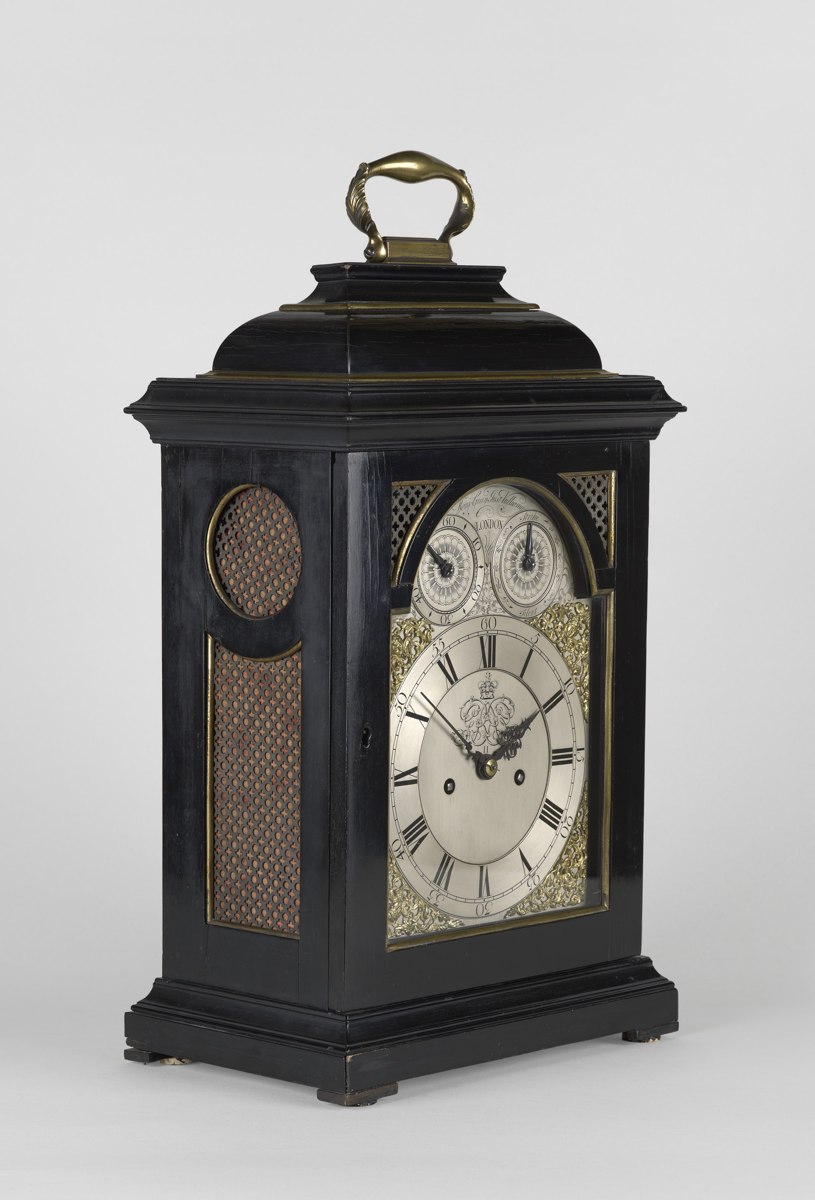
This bracket clock is held by the Royal Collection Trust and attributed to clockmaker François-Justin Vulliamy (1712–98). The object features an ebonised or dark-finished wooden case topped with a stepped bell top and a metal carrying handle. The arched front door encloses an engraved dial displaying Roman hours, outer Arabic minute numerals, and two winding apertures. The upper arch incorporates twin subsidiary dials flanked by pierced spandrels and an engraved crest motif above the centre arbor. Additional pierced sound fretwork is mounted in the side panel.

Three-quarter view of the François-Justin Vulliamy bracket clock showing the dial and side fretwork
Three-quarter view of the François-Justin Vulliamy bracket clock showing the dial and side fretwork — Royal Collection Trust. Rights pending — permission not yet requested. Original source

Catalogue identity

Source
www.rct.uk
Category
Clock · Bracket clock
Maker / attribution
François-Justin Vulliamy
Reference
Not recorded
Catalogue / lot identifier
Source URL identifies the listing
Source-reported date
Not established
Country
United Kingdom

Source-reported attribution and specifications are not independent authentication. A listing does not establish present ownership, current display, availability or permission to reproduce.

Object description

Institutional Attribution and Classification

The Royal Collection Trust documents this object as a "Bracket clock" associated with "François-Justin Vulliamy (1712-98)". The institutional record provides a concise catalogue listing without published dimensions, provenance history, or movement specifications.

The collection's online index identifies the item under URL path "/collection/2872/table-clock", categorising it as a bracket or table clock.

Evidence for this section
  • “François-Justin Vulliamy (1712-98) - Bracket clock”

Case Architecture and Exterior Appointments

Visible observation shows a rectangular dark wood or ebonised case surmounted by a stepped bell top with a metal carrying handle. The case base is formed by a stepped moulded plinth supported by shallow bracket feet.

The side panel features circular and rectangular pierced acoustic fret screens lined with a fabric backing, while the front presents an arched glazed door framing the dial.

Evidence for this section
  • “Rectangular dark wood or ebonised case with a stepped bell top surmounted by a metal carrying handle.”
  • “Side panel fitted with circular and rectangular pierced acoustic fret screens lined with fabric backing.”
  • “Stepped moulded plinth supported by shallow bracket feet.”

Dial Configuration and Indications

The face presents an arched dial plate fitted with an engraved silvered chapter ring featuring Roman numerals for hours and Arabic numerals for minutes. Two winding arbors are positioned on the central dial plate, flanking an engraved crest or royal cypher motif.

The upper arch accommodates twin subsidiary dials accompanied by engraved maker signature details and pierced corner spandrels. Detailed movement escapement and striking train configurations are not described in the institutional source.

Evidence for this section
  • “Arched dial plate with an engraved silvered chapter ring featuring Roman numerals for hours and Arabic numerals for minutes.”
  • “Two winding arbors visible on the central dial plate, flanking an engraved royal cypher or crest.”
  • “Twin subsidiary dials positioned within the upper arch, accompanied by engraved maker signature details and pierced corner spandrels.”

Open research questions

  • What specific functions are served by the twin subsidiary dials in the arch (such as strike/silent selection or regulation)?
  • What type of escapement, train configuration, and striking mechanism does the internal movement utilise?
  • What are the precise physical dimensions and primary case woods of the clock?
  • Does the engraved crest or cypher between the winding arbors identify an original royal commission or ownership?

Source evidence

Recorded claims and source quotations for François-Justin Vulliamy bracket clock
FieldSource-reported valueSource quotation
MakerFrançois-Justin Vulliamy (1712-98)“François-Justin Vulliamy (1712-98)”
Object TypeBracket clock“Bracket clock”

Visible details

  • Rectangular dark wood or ebonised case with a stepped bell top surmounted by a metal carrying handle.
  • Arched dial plate with an engraved silvered chapter ring featuring Roman numerals for hours and Arabic numerals for minutes.
  • Two winding arbors visible on the central dial plate, flanking an engraved royal cypher or crest.
  • Twin subsidiary dials positioned within the upper arch, accompanied by engraved maker signature details and pierced corner spandrels.
  • Side panel fitted with circular and rectangular pierced acoustic fret screens lined with fabric backing.
  • Stepped moulded plinth supported by shallow bracket feet.

Research qualifications

  • The institutional record provides minimal catalogue description, lacking explicit dimensions, movement escapement details, or a precise year of manufacture.
  • The internal movement and back plate are not visible in the photograph.

Photograph identity and source facts were screened before import; rights clearance remains pending.

Consulted source

François-Justin Vulliamy (1712-98) - Bracket clock

Reviewed 2026-10-21 · Record 2d9224e1e5

Terms in this record

Glossary explanations for terms named in this object’s record.