
Skip to content
The Encyclopedia of Horology

Clock · Turret clock movement

Benjamin Louis Vulliamy striking turret clock movement no. 1711

Partially verified

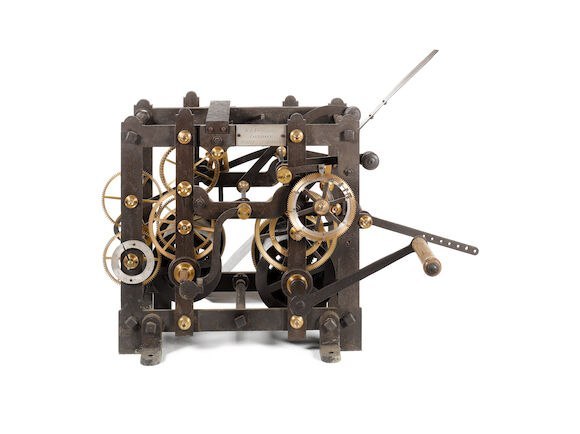
This is a mid-19th-century striking turret clock movement by Benjamin Louis Vulliamy of London, catalogued under number 1711 and dated 1845. The mechanism is mounted in an open iron frame with shouldered arched upright terminals and an applied silvered signature plaque. Front-facing indicators include a silvered Roman countwheel and an Arabic minute chapter ring. The weight-driven movement features maintaining power and a pinwheel escapement, alongside a striking train with a large fly. The auction lot is catalogued as including a 91-inch wooden rod pendulum with a signed double-sided bob, weights, and a crank handle.

Front view of the turret clock movement showing the frame, gearing, and silvered dials
Front view of the turret clock movement showing the frame, gearing, and silvered dials — Bonhams. Rights pending — permission not yet requested. Original source

Catalogue identity

Source
www.bonhams.com
Category
Clock · Turret clock movement
Maker / attribution
Benjamin Louis Vulliamy
Reference
Not recorded
Catalogue / lot identifier
32
Source-reported date
1845
Country
United Kingdom
Source-reported serial
1711

Source-reported attribution and specifications are not independent authentication. A listing does not establish present ownership, current display, availability or permission to reproduce.

Object description

Frame and Physical Structure

The movement is constructed within a dark, open frame resting on bolted feet. The catalogue text describes the structure as 'the very substantial frame with shouldered arched terminals to the uprights and applied silvered signature plaque', measuring 71cm by 39cm (2ft 4in by 1ft 3in).

Visible within the framework are brass wheels, arbors, winding barrels, and a crank handle projecting from the lower right side. The applied silvered signature plaque is positioned horizontally across the upper front crossmember.

Evidence for this section
  • “the very substantial frame with shouldered arched terminals to the uprights and applied silvered signature plaque”
  • “71cm x 39cm (2ft 4 in x 1ft 3in)”
  • “Substantial dark open frame with shouldered arch terminals on the uprights and bolted feet.”
  • “Brass wheels, arbors, winding barrels, and a crank handle projecting from the lower right side.”

Dial Indicators and Train Mechanics

Two silvered rings are mounted directly to the movement front for regulation and setting. The auction description lists a 'silvered Roman countwheel and silvered Arabic minute chapter ring mounted to the front', visible respectively on the lower left and upper right front of the mechanism.

The movement is catalogued as a weight-driven turret mechanism featuring maintaining power and a 'pinwheel escapement'. The striking train is regulated by an aerodynamic brake described in the source as a 'large fly'.

Evidence for this section
  • “silvered Roman countwheel and silvered Arabic minute chapter ring mounted to the front”
  • “the weight driven movement with maintaining power to the pinwheel escapement, the strike train with large fly”
  • “Silvered countwheel ring visible on the lower left and silvered Arabic chapter ring on the upper right front.”

Associated Equipment and Recorded Condition

The cataloguing specifies that the lot is 'complete with 91-inch long wooden rod pendulum terminating in a signed double sided bob, weights and crank handle'. The pendulum rod, signed double-sided bob, and weights are described in the text but are not depicted in the primary auction photograph.

A footnote in the auction catalogue notes that 'This clock was fully overhauled in the late 1990s and is in remarkably good condition.' The record does not identify the restorer, original tower installation location, or current mechanical running order.

Evidence for this section
  • “complete with 91-inch long wooden rod pendulum terminating in a signed double sided bob, weights and crank handle”
  • “This clock was fully overhauled in the late 1990s and is in remarkably good condition.”

Open research questions

  • What building, estate, or institutional turret was movement number 1711 originally manufactured for in 1845 according to Vulliamy's workshop records?
  • What specific inscription or serial numbering appears on the signed double-sided pendulum bob catalogued with this lot?
  • Which horologist or workshop carried out the overhaul in the late 1990s reported in the auction footnote?

Source evidence

Recorded claims and source quotations for Benjamin Louis Vulliamy striking turret clock movement no. 1711
FieldSource-reported valueSource quotation
MakerBenjamin Louis Vulliamy, London“Benjamin Louis Vulliamy, London”
Serial Number1711“number 1711”
Date1845“date 1845”
Dimensions71cm x 39cm (2ft 4 in x 1ft 3in)“71cm x 39cm (2ft 4 in x 1ft 3in)”
EscapementPinwheel escapement“pinwheel escapement”
Pendulum Length91 inches“91-inch long wooden rod pendulum”
Striking Train RegulatorLarge fly“the strike train with large fly”
Pendulum Bob SpecificationSigned double-sided bob“signed double sided bob”
Auction ResultSold for £5,040 inc. premium“Sold for £5,040 inc. premium”

Visible details

  • Substantial dark open frame with shouldered arch terminals on the uprights and bolted feet.
  • Central applied silvered rectangular plaque mounted on the upper front crossmember.
  • Silvered countwheel ring visible on the lower left and silvered Arabic chapter ring on the upper right front.
  • Brass wheels, arbors, winding barrels, and a crank handle projecting from the lower right side.

Research qualifications

  • The 91-inch pendulum, bob, and weights mentioned in the catalogue entry are not shown in the primary photograph.
  • The overhaul in the late 1990s is source-reported by the auction house.

Photograph identity and source facts were screened before import; rights clearance remains pending.

Terms in this record

Glossary explanations for terms named in this object’s record.