
Skip to content
The Encyclopedia of Horology

Clock · Turret clock movement

Thomas Tompion eight-day turret clock movement

Partially verified

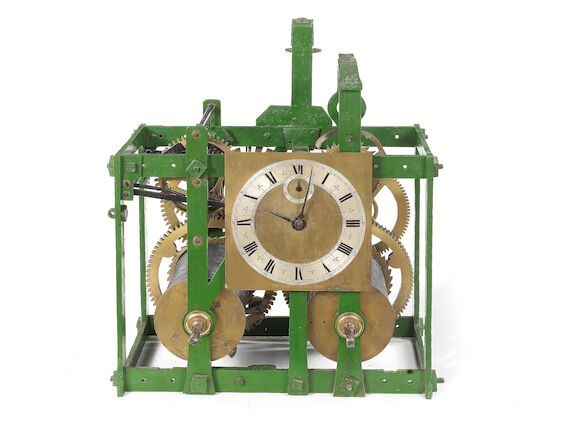
This late 17th-century turret clock movement is attributed to Thomas Tompion and reported as being of eight-day duration. Constructed from forged iron bars painted green, the frame accommodates side-by-side three-wheel trains with eight-inch grooved wooden winding barrels. The going train incorporates an anchor escapement configured for a two-second pendulum. Mounted at the front is a 12.5-inch square brass setting dial featuring a silvered chapter ring with Roman hours, steel hands, and a subsidiary seconds dial cutting into the chapter ring below XII. Provenance documented by the source links the movement to Brome Hall, Suffolk.

Front view of the Thomas Tompion turret clock movement in its green-painted iron frame with square setting dial
Front view of the Thomas Tompion turret clock movement in its green-painted iron frame with square setting dial — Bonhams. Rights pending — permission not yet requested. Original source

Catalogue identity

Source
www.bonhams.com
Category
Clock · Turret clock movement
Maker / attribution
Thomas Tompion
Reference
Not recorded
Catalogue / lot identifier
71
Source-reported date
late 17th century
Country
United Kingdom

Source-reported attribution and specifications are not independent authentication. A listing does not establish present ownership, current display, availability or permission to reproduce.

Object description

Frame and Structural Construction

The movement is constructed within a heavy open rectangular iron frame, reported to consist of eighteen forged iron bars and painted green. The frame is formed by two upright rectangular end frames featuring splayed lower ends, united by four rectangular-section crossbars threaded at each end and fastened with heavy square nuts.

Internal train components, motion work, and lead-off bearings are mounted between three sets of nutted vertical pivot bars. The bars supporting the going train extend above the frame outline to accommodate the escapement wheel arbor and the pendulum suspension point, while a strike-train bar is shaped as a stylised Y to provide a secure mounting point for the lower left dial foot.

Evidence for this section
  • “Open rectangular iron frame painted green housing brass gearing and dual wooden winding barrels”
  • “Of 8-day duration the clock is made up from eighteen forged iron bars”
  • “The heavy frame (now painted green) consisting of two upright rectangular frames with splayed lower ends united by four rectangular-section bars threaded at each end and secured by heavy square nuts.”
  • “the going-train bars extending above the outline of the frame to accommodate the 'scape wheel arbor and the pendulum suspension point; the strike-train bar cast in the form of a stylised Y to offer a secure point of fixing for the lower left hand dial foot”

Dial and Setting Features

Mounted at the front of the frame is a 12.5-inch square brass setting dial secured by four substantial pinned dial feet. The plate has a coarsely matted centre without spandrel drillings and carries an 11.5-inch diameter silvered chapter ring with Roman hours, an inner quarter-hour track, Arabic minute numbers, and meeting-arrowhead half-hour markers.

A silvered subsidiary seconds ring intersects the chapter ring at XII, with numbers at intervals of six and engraved lines indicating every other second. Time is displayed by steel hands, and the lower edge of the plate is inscribed with the signature recorded as 'Thomas Tompion, Londini Fecit' (or 'Thõ Tompion Londini Fecit' in the footnote description).

Evidence for this section
  • “Square brass dial plate with silvered chapter ring, Roman numerals, and intersecting subsidiary seconds dial”
  • “Signed along the lower edge of the 12.5 inch square brass dial 'Thomas Tompion, Londini Fecit', the silvered chapter ring with single line border and Arabic numerals framing the minute band, Roman hours and inner quarter hour track, the half hour markers of the meeting arrowhead variety, with steel hands”
  • “the subsidiary seconds dial intersecting the chapter ring at XII and numbered 6,12,18 etc with every other second marked by an engraved line, secured to the frame via four substantial pinned dial feet.”
  • “The 12½" setting-dial signed Thõ Tompion Londini Fecit has four feet, a coarsely matted centre and a silvered chapter-ring two inches wide and of 11½" diameter. It is otherwise plain and was never drilled for spandrels.”

Provenance and Historical Documentation

The clock is historically linked to Brome Hall in Suffolk, where it was later positioned in a stable-block turret before being sold from the estate in 1953. Source commentary suggests an approximate production date of 1686–1688 based on comparisons between the dial styling and Tompion's numbered domestic clocks.

Direct documentation confirming the original acquisition is absent due to missing estate accounts from 1665 to 1689. Later records document payments to local clockmakers for repairing a 'Great Clock' at Brome Hall in 1699, although whether those references designate this Tompion mechanism or an earlier clock is not resolved in the record.

Evidence for this section
  • “The turret clock from Brome Hall, Suffolk, of eight-day duration, is one of just two examples by Thomas Tompion to survive”
  • “This might fit in with the clock's suggested date of 1686-8 - this based on the style of the chapter-ring and signature when compared with those of numbered domestic clocks.”
  • “Two payments were made that year for repairs to the 'Great Clock' - to Richard Page in January, and John Kett in November, but it is not known whether this was Tompion's clock, or an earlier movement.”

Open research questions

  • What specific functions did the spare holes in the iron frame serve, and do physical traces support the source's suggestion of former maintaining-power and stop-work assemblies?
  • Do archival records outside the Brome Hall household papers document the commission or delivery of Tompion's eight-day turret clocks?
  • What are the precise physical measurements and gear ratios of the framed motion work components marked 'F', 'Y', and 'S'?

Source evidence

Recorded claims and source quotations for Thomas Tompion eight-day turret clock movement
FieldSource-reported valueSource quotation
Dial SignatureThomas Tompion, Londini Fecit“Signed along the lower edge of the 12.5 inch square brass dial 'Thomas Tompion, Londini Fecit'”
Duration8-day“Of 8-day duration the clock is made up from eighteen forged iron bars”
Frame FinishPainted green“The heavy frame (now painted green)”
EscapementAnchor escapement“The going train with anchor escapement”
Provenance LocationBrome Hall, Suffolk“The turret clock from Brome Hall, Suffolk, of eight-day duration, is one of just two examples by Thomas Tompion to survive”
Movement Dimensions56.5 cm high x 69 cm wide x 38.5 cm deep (source also notes 39 in high x 29 in wide x 21 in deep)“The frame 56.5cms high 69cms wide and 38.5cms deep (max height to top of motion work 83cms”
Countwheel Diameter9.5 inches“the strike train with a 9.5 inch diameter brass countwheel mounted to the rear”
Pendulum Rod Length12 feet, 10.5 inches“a two-part pendulum rod of heavy flat steel measuring 12 feet, 10.5 inches in length”

Visible details

  • Open rectangular iron frame painted green housing brass gearing and dual wooden winding barrels
  • Square brass dial plate with silvered chapter ring, Roman numerals, and intersecting subsidiary seconds dial
  • Vertical bars extending above the top horizontal frame member to support train arbors and escapement components

Research qualifications

  • Associated pendulum rod, massive lead bob, hands, lead-off rods, and winding accessories are described in the source text but not shown in this photograph

Photograph identity and source facts were screened before import; rights clearance remains pending.

Terms in this record

Glossary explanations for terms named in this object’s record.