
Skip to content
The Encyclopedia of Horology

Clock · Turret clock movement

Forged iron quarter-striking turret clock movement with verge pendulum regulation

Partially verified

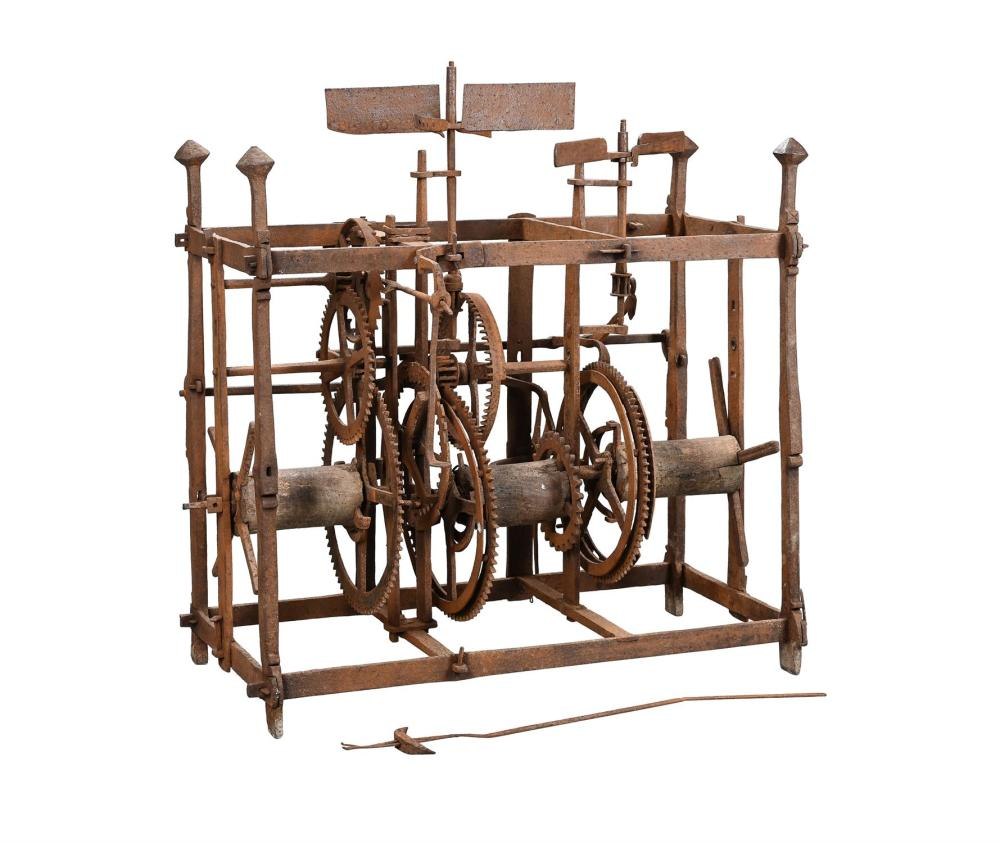
According to the auction catalogue, this unsigned English turret clock movement dates to circa 1660–1670 and is constructed from forged wrought iron with end-to-end wheel trains and wooden winding barrels. It retains an early verge escapement with a horizontal crownwheel and perpendicular pallet arbor regulated by a forged iron pendulum with a fluke-shaped bob. The three-wheel trains employ forged wheels and lantern pinions within an open rectangular frame joined by tenons and wedges. Corner posts feature Gothic ogee mouldings and polyhedral finials over buttress feet. Countwheel regulation and hoop wheels cut with contrate teeth govern the striking trains, though the quarter-train fly is noted as lacking.

Forged iron quarter-striking turret clock movement with wooden barrels and detached pendulum
Forged iron quarter-striking turret clock movement with wooden barrels and detached pendulum — Dreweatts 1759. Rights pending — permission not yet requested. Original source

Catalogue identity

Source
www.invaluable.com
Category
Clock · Turret clock movement
Maker / attribution
Not established
Reference
Not recorded
Catalogue / lot identifier
1223
Source-reported date
circa 1660-70
Country
England

Source-reported attribution and specifications are not independent authentication. A listing does not establish present ownership, current display, availability or permission to reproduce.

Object description

Frame Architecture and Construction

The clock movement is housed within an open rectangular frame of forged wrought iron measuring 100 cm long, 52 cm wide, and 91 cm high, reaching an overall height of 107 cm including the strike train fly. Its corner posts feature forged Gothic ogee mouldings and stand on decorated buttress feet, terminating at the top in integral raised polyhedral finials.

Joinery of the iron framework uses swollen circular recessed lapped joints where the corner posts join the upper and lower end rails. The upper and lower cross rails are tenoned through the same joints, with vertical pivot bars joined in a similar manner, and the frame is secured using tenons and wedges.

Evidence for this section
  • “The frame 100cm (39.5ins) long, 52cm (20.5ins) wide, 91cm (36ins) high; 107cm (42ins) high overall including the strike train fly.”
  • “the frame with corner posts forged with Gothic ogee mouldings and with swollen circular recessed lapped joints for the upper and lower end rails, the upper and lower cross rails tenoned through the same joint with the various vertical pivot bars joined in a similar manner between, the corner posts surmounted by integral raised polyhedral finials and with decorated buttress feet.”
  • “and the frame itself is also joined with tenons and wedges.”

Train Configuration and Striking Mechanism

The movement incorporates three-wheel trains arranged in an end-to-end layout, utilizing forged wheels, lantern pinions, and wooden barrels. According to the catalogue description, winding was originally arranged with indirect winding for the centre train and capstans on the two outer barrels. The going greatwheel arbor extends through the frame and is squared to facilitate take-off for an external dial.

Striking operations comprise a centrally positioned hour-strike train and a quarter-strike train. Both operate with single-arbor warnless lifting and hoop wheels cut with contrate teeth on their rims to drive vertically pivoted air vanes (flies). The quarter train is lifted via a nag's head engaging one of four pins on the going greatwheel, while the hour train is lifted by a pin on the quarter train greatwheel to strike following the quarters. The hour countwheel has internally cut rim teeth located in the space behind the adjacent going train pivot bar.

Evidence for this section
  • “The three-wheel trains with forged wheels and lantern pinions set end-to end with wooden barrels originally with indirect winding for the centre train flanked by capstans for the two outer barrels”
  • “both the hour and quarter trains with overlift enabled by hoop wheel each also serving as contrate wheels to drive vertically pivoted flies (lacking on quarter train)”
  • “the going greatwheel arbor passing through the frame and squared to facilitate take-off for a dial and the side opposing the pendulum with pivoted bell-hammer linkages”
  • “the centrally positioned hour-strike train with countwheel cut with teeth to the inside of the rim set in a space behind the adjacent going train pivot bar, with single-arbor warnless lifting via a pin on the quarter train greatwheel to enable the hours to sound after the quarters on the hour only, the quarter train also with single-arbor warnless lifting this time enabled via a nag's head engaging with one of four pins fitted to the going greatwheel”

Escapement and Stated Condition

The going train employs a verge escapement regulated by a horizontally pivoted escape crownwheel and a perpendicular pallet arbor. It is regulated by an unattached forged pendulum with a stated effective length of approximately thirty inches, terminating in a fluke-shaped bob that the auctioneer notes resembles illustrations in Christiaan Huygens' 1673 Horologium Oscillatorium.

Although catalogued as surviving in untouched forged wrought ironwork, the auction description notes that the movement is missing some components, specifically recording that the fly for the quarter train is lacking. Furthermore, the geographic origin ('probably Central England') and dating ('circa 1660-70') are unsigned cataloguer attributions rather than maker inscriptions.

Evidence for this section
  • “the going train with horizontally pivoted escape crownwheel and perpendicular pallet arbor regulated by the original forged pendulum with an effective length of around thirty inches and with distinctive fluke-shaped bob”
  • “An interesting detail is the fluke-shaped bob to the pendulum which echoes that illustrated in Huygens' 1673 work Horologium Oscillatorium.”
  • “both the hour and quarter trains with overlift enabled by hoop wheel each also serving as contrate wheels to drive vertically pivoted flies (lacking on quarter train)”
  • “Although the present movement is missing some components it does, however, survive in essentially untouched condition with beautifully executed forged wrought ironwork throughout.”
  • “UNSIGNED, PROBABLY CENTRAL ENGLAND, CIRCA 1660-70”

Open research questions

  • What specific components beyond the quarter-train fly are missing from the movement?
  • Can the distinctive lapped corner joint construction and ogee mouldings be tied to documented churchwarden accounts or known ironwork clocks in Central England?

Source evidence

Recorded claims and source quotations for Forged iron quarter-striking turret clock movement with verge pendulum regulation
FieldSource-reported valueSource quotation
Attribution and DateUnsigned, probably Central England, circa 1660-70“UNSIGNED, PROBABLY CENTRAL ENGLAND, CIRCA 1660-70”
Train LayoutThree-wheel trains with forged wheels and lantern pinions set end-to-end with wooden barrels“The three-wheel trains with forged wheels and lantern pinions set end-to end with wooden barrels”
Escapement and PendulumVerge escapement with horizontal escape crownwheel and forged pendulum with fluke-shaped bob“the going train with horizontally pivoted escape crownwheel and perpendicular pallet arbor regulated by the original forged pendulum with an effective length of around thirty inches and with distinctive fluke-shaped bob”
Frame Dimensions100 cm long, 52 cm wide, 91 cm high (107 cm high overall including fly)“The frame 100cm (39.5ins) long, 52cm (20.5ins) wide, 91cm (36ins) high; 107cm (42ins) high overall including the strike train fly.”
Condition NoteFly lacking on quarter train“both the hour and quarter trains with overlift enabled by hoop wheel each also serving as contrate wheels to drive vertically pivoted flies (lacking on quarter train)”
Quarter Train CountingCounts via a slotted rim set next to the greatwheel fitted with pins for two hammer levers“and counting via a slotted rim set next to the greatwheel also fitted with pins for the two hammer levers”
Bell-Hammer LinkagesFitted with pivoted bell-hammer linkages on the side opposing the pendulum“the side opposing the pendulum with pivoted bell-hammer linkages”

Visible details

  • Open rectangular forged iron frame with corner posts topped by faceted polyhedral finials and resting on buttress feet.
  • Wooden winding barrels mounted transversely along the lower level of the frame.
  • Prominent horizontally oriented iron air vane (fly) mounted centrally above the upper rail.
  • Detached forged iron pendulum rod with a fluke-shaped bob positioned in front of the base.

Research qualifications

  • The auction house notes that the fly is lacking on the quarter train and some components are missing.
  • Origin ('probably Central England') and date ('circa 1660-70') are cataloguer attributions rather than maker signatures.

Photograph identity and source facts were screened before import; rights clearance remains pending.

Terms in this record

Glossary explanations for terms named in this object’s record.