
Skip to content
The Encyclopedia of Horology

Pocket watch · Split-seconds chronograph pocket watch

Baume & Company London Split Seconds Chronograph Pocket Watch

Partially verified

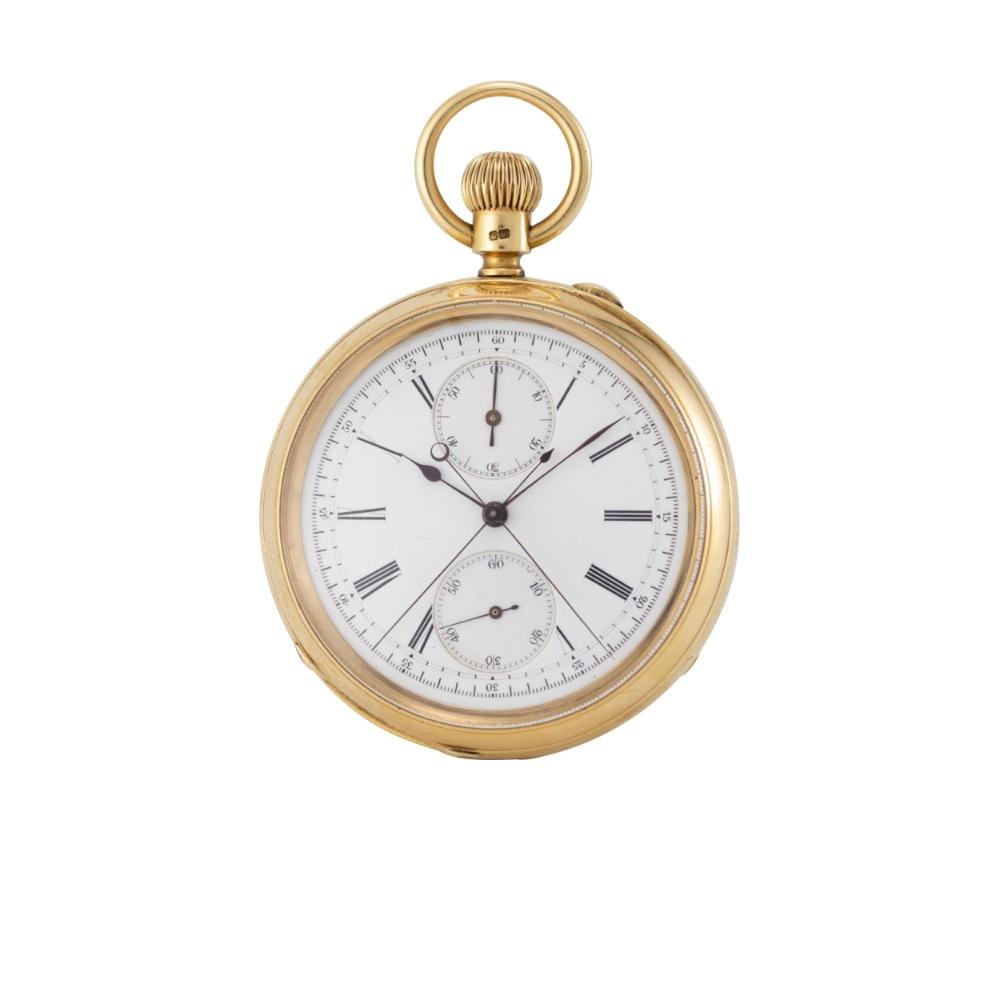
Catalogued under Lot 366 by Auktionen Dr. Crott, this open-face pocket watch features a split-seconds chronograph and a 60-minute counter. The auction house dates the piece to circa 1890 with origin given as England/Schweiz. It is housed in a polished 18-karat gold 54 mm case bearing the 'AB' punch mark attributed to case maker Arthur Baume. The white enamel dial is configured with Roman numerals, central split-seconds hands, a 30 or 60-minute counter register at 12 o'clock, and subsidiary seconds at 6 o'clock. The internal bridge movement is reported to feature a lever escapement and a gold screw compensation balance.

Dial and case front of the Baume & Company split-seconds chronograph pocket watch
Dial and case front of the Baume & Company split-seconds chronograph pocket watch — Auktionen Dr. Crott. Rights pending — permission not yet requested. Original source

Catalogue identity

Source
www.invaluable.com
Category
Pocket watch · Split-seconds chronograph pocket watch
Maker / attribution
Baume & Company
Reference
Not recorded
Catalogue / lot identifier
366
Source-reported date
circa 1890
Country
England/Schweiz
Source-reported serial
2500

Source-reported attribution and specifications are not independent authentication. A listing does not establish present ownership, current display, availability or permission to reproduce.

Object description

Case Construction and Identity

This pocket watch is presented in a polished 18-karat gold open-face case measuring 54 mm in diameter. The exterior architecture includes a fluted pendant crown and a bow, with a chronograph pusher positioned near 1 o'clock.

The case features a hallmark punch mark of 'AB', which is attributed by the source to the case maker Arthur Baume. The piece, catalogued with both movement and case number 2500, has an approximate weight of 144 grams and is dated to circa 1890.

Evidence for this section
  • “Case: 18 K gold, polished, case maker's punch mark "AB" (Arthur Baume).”
  • “Dimensions 54 mm, circa 1890, Weight 144 g”
  • “Open-face yellow gold case with fluted pendant crown, bow, and chronograph pusher near 1 o'clock.”
  • “Movm. No. 2500, Case No. 2500”

Dial Configuration

The watch features a white enamel dial designed for timing. It displays black Roman numeral hour markers set against an outer track graduated into fifths-of-a-second.

The functional layout includes vertically aligned subsidiary dials situated at the 12 and 6 o'clock positions. Timekeeping and timing are indicated by a spade-tipped hour hand and central blued steel split-seconds chronograph hands.

Evidence for this section
  • “White enamel dial displaying black Roman numeral hour markers and an outer fifths-of-a-second track.”
  • “Vertically aligned subsidiary dials at 12 and 6 o'clock.”
  • “Central blued steel split-seconds hands and spade-tipped hour hand.”

Mechanism and Origin

The watch is powered by an internal bridge movement described as featuring a lever escapement and a gold screw compensation balance. The source identifies the manufacturer as Baume & Company, an entity established in London in 1844 as a branch of the Swiss firm Baume Frères.

The auction catalogue lists an origin of 'England/Schweiz'. The movement is reported by the source to be currently capable of running, though cleaning is recommended.

Evidence for this section
  • “Movm.: Bridge movement, lever escapement, gold screw compensation balance.”
  • “Origin England/Schweiz”
  • “Baume & Company was founded in London in 1844 as a branch of Baume Frères, a company based in the Swiss Jura.”
  • “Movm.: very good, capable of running, cleaning recommended.”

Open research questions

  • What is the specific nature of the 'England/Schweiz' attribution regarding which components were manufactured in the Swiss Jura versus assembled in London?
  • Does the lack of visible movement hallmarks in photographic records suggest the movement was sourced from a third party rather than manufactured in-house by Baume & Company?

Source evidence

Recorded claims and source quotations for Baume & Company London Split Seconds Chronograph Pocket Watch
FieldSource-reported valueSource quotation
Case Number2500“Case No. 2500”
Movement Number2500“Movm. No. 2500”
Dimensions54 mm“Dimensions 54 mm”
Weight144 g“Weight 144 g”
Case Material18 K gold“Case: 18 K gold, polished”
Case Maker Punch MarkAB (Arthur Baume)“case maker's punch mark "AB" (Arthur Baume)”
DialEnamel“Dial: Enamel.”
Movement DetailsBridge movement, lever escapement, gold screw compensation balance“Movm.: Bridge movement, lever escapement, gold screw compensation balance.”

Visible details

  • Open-face yellow gold case with fluted pendant crown, bow, and chronograph pusher near 1 o'clock.
  • White enamel dial displaying black Roman numeral hour markers and an outer fifths-of-a-second track.
  • Vertically aligned subsidiary dials at 12 and 6 o'clock.
  • Central blued steel split-seconds hands and spade-tipped hour hand.

Research qualifications

  • Movement and interior case hallmarks are not visible in the provided photograph; mechanism details rely entirely on source reporting.
  • Dual country origin is stated as 'England/Schweiz' in the auction catalogue without distinction between movement manufacture and casing.

Photograph identity and source facts were screened before import; rights clearance remains pending.

Consulted source

At Auction: Baume & Company London - Split Seconds Chronograph

Reviewed 2026-10-25 · Record f84b146638