
Skip to content
The Encyclopedia of Horology

Clock · Tabernacle clock

Astronomical tabernacle clock

Partially verified

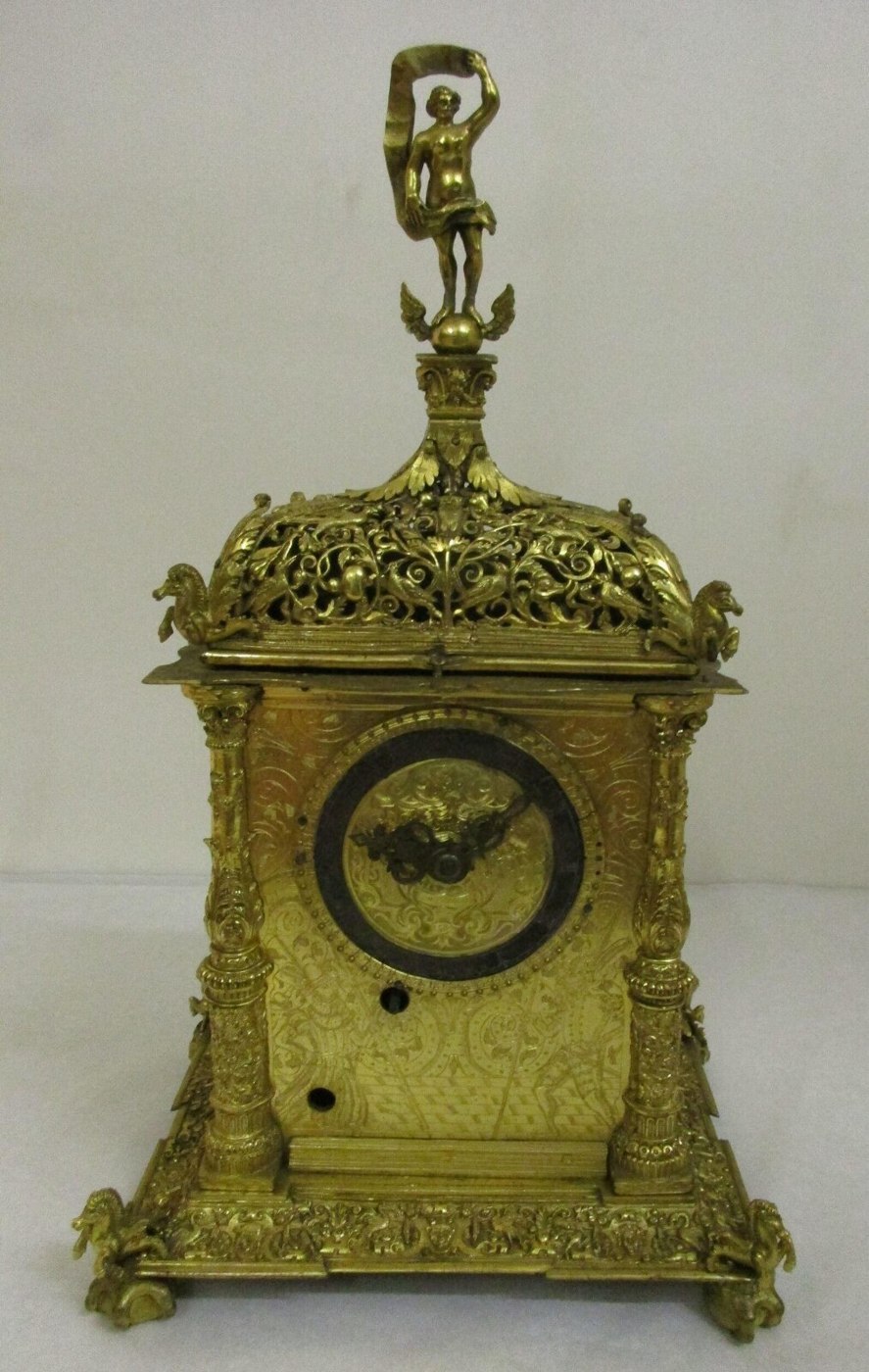
This astronomical tabernacle clock, dated 1587, features a rectangular gilt-copper alloy case of architectural design. It stands on four ball-and-claw feet and incorporates decorative elements including applied hippocamps, Corinthian-style columns, and an ogee-shaped cupola pierced with birds and foliage, surmounted by a finial figure of Fortune. The front dial contains a silver chapter ring with Roman numerals I-XII and minute markings, surrounding a brass disc engraved with 'Friede En Munich 1587'. The internal mechanism features a going train, a striking train, and a chime train, all mounted transversely. The clock, acquired in 1855 from the collection of Ralph Bernal, shows evidence of historical modification, including replacement escapement components and a potentially composite case structure.

Front view of the astronomical tabernacle clock, showing the dial, finial, and architectural case detail.
Front view of the astronomical tabernacle clock, showing the dial, finial, and architectural case detail. — Victoria and Albert Museum, London. Rights pending — permission not yet requested. Original source

Catalogue identity

Source
collections.vam.ac.uk
Category
Clock · Tabernacle clock
Maker / attribution
Not established
Reference
Not recorded
Catalogue / lot identifier
2379-1855
Source-reported date
1585-1600
Source-reported place
Southern Germany / Austria

Source-reported attribution and specifications are not independent authentication. A listing does not establish present ownership, current display, availability or permission to reproduce.

Object description

Case and External Features

The clock is housed in a rectangular, architectural gilt-copper alloy case positioned on a flanged base with four ball-and-claw feet. The corners are flanked by baluster-shaped columns with Corinthian capitals. The exterior surfaces are elaborately decorated with relief casting, including foliage, strapwork, birds, masks, and grotesque figures.

An ogee-shaped cupola surmounts the cornice, pierced with intricate foliage and birds. The current finial, a cast figure representing Fortune, is believed to be a later addition to the original assembly. The case sides feature engravings of figures in arches, including depictions of Landsknechts and figures potentially representing the quadrivium of the Liberal Arts.

Evidence for this section
  • “Rectangular gilt copper alloy case of architectural form on flanged base supported by four ball-and-claw feet (probably later additions).”
  • “The finial figure of Fortuna is a later marriage as it is too large in proportion to the case.”
  • “Above the cornice, a rectangular ogee-shaped cupola is pierced with interlaced foliage and birds.”

Dials and Inscriptions

The front dial measures 8.9 cm in diameter. It features an outer ring equipped with touch pins and an inset silver chapter ring with Roman numerals I-XII. The central brass disc is signed with the inscription 'Friede En Munich 1587', which is translated as 'Peace in Munich 1587'. The dial exhibits ornate engravings and uses pierced brass hands.

The rear dial is 10.2 cm in diameter, featuring an outer ring with Roman numerals I-XII and inner Arabic numerals 1-24. The central disc of this dial is missing, and the clock currently lacks hands on this side. The configuration suggests the original intent for an astronomical display.

Evidence for this section
  • “The Front dial is 8.9 cm in diameter. The outer minute ring with a touch pin for each number; inside this; an inset silver chapter-ring 0.6 cm broad with Roman numerals I-XII and minute marks (a later replacement).”
  • “The central brass disc signed 'Friede En Munich 1587'.”
  • “The rear dial is 10.2 cm diameter. The outer ring with I to XII in Roman numerals with touch points 1 to 24 in arabic inside.”

Movement and Mechanical Details

The movement is arranged with a central going train, currently featuring brass wheels and an anchor escapement. The original pendulum and crutch are missing. A fusee and chain drive mechanism is used, with a step-up drive for the minute hand and reduction gearing for the hour hand.

Striking and chiming trains are mounted transversely within the frame. These systems utilize iron fusees and chains, with brass count wheels that are suspected to be later replacements. The mechanism includes provisions for striking and quarter chimes, with external winding holes marked 'S' and 'V'. The clock shows clear evidence of mechanical adaptation and repair over time.

Evidence for this section
  • “The going train in the centre, now with brass wheels and anchor escapement.”
  • “The fusee and chain wound through a gearing through a hole in the front plate.”

Open research questions

  • What is the nature of the missing astronomical display on the rear dial?
  • What was the original configuration of the pendulum and escapement before the current anchor escapement installation?

Source evidence

Recorded claims and source quotations for Astronomical tabernacle clock
FieldSource-reported valueSource quotation
InscriptionFriede En Munich 1587“'Friede En Munich 1587'”
MaterialGilt metal“gilt metal, cast, pierced and engraved”
Accession number2379-1855“2379-1855”
ProvenanceRalph Bernal Collection“ed at the sale of the collection of lawyer and politician Ralph Bernal in 1855”

Visible details

  • The front dial features an outer minute ring with touch pins for each number.
  • The case includes Corinthian-style columns decorated with acanthus leaf relief.
  • The cupola is pierced with designs of foliage and birds.
  • The dial inscription 'Friede En Munich 1587' is clearly visible in the central brass disc.

Research qualifications

  • The ball-and-claw feet are identified as likely later additions.
  • The silver chapter-ring on the front dial is documented as a later replacement.
  • The finial figure of Fortune is suggested to be a later marriage to the case due to proportional mismatch.

Photograph identity and source facts were screened before import; rights clearance remains pending.

Consulted source

Clock, astronomical tabernacle, Munich, 1587

Reviewed 2026-11-02 · Record 3ad2a94776

Terms in this record

Glossary explanations for terms named in this object’s record.