
Skip to content
The Encyclopedia of Horology

Clock · Tabernacle clock

German (?) Tabernacle Clock

Partially verified

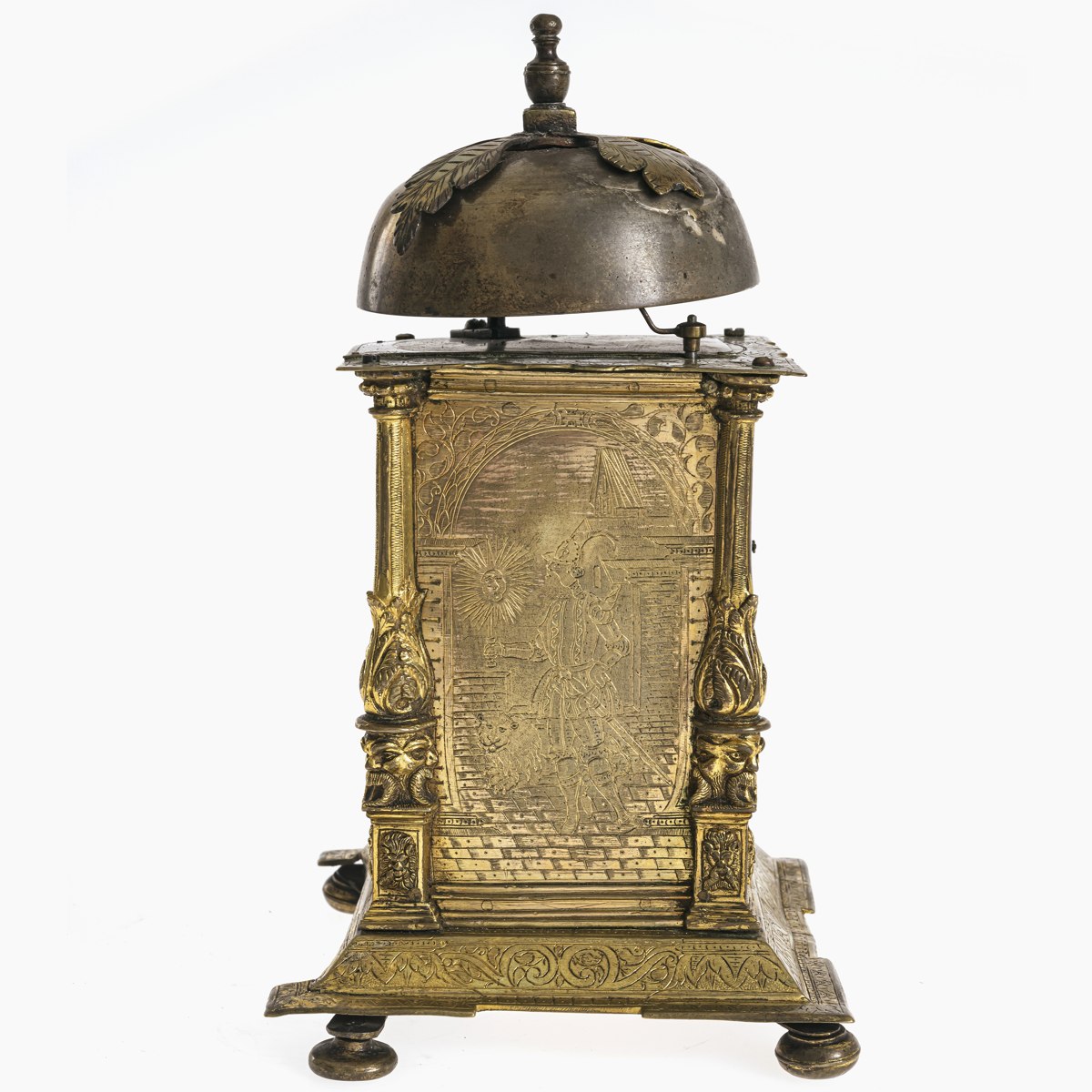
Catalogued tentatively as German from the late 16th century and later, this tabernacle clock features an engraved metal case embellished on all sides, architectural corner columns, and an open top bell. The visible panel shows a standing warrior in armour beneath an archway, framed by foliate columns on figural bases over flattened bun feet. According to the auction house, the timepiece is fitted with an added 8-day plate movement with an attached escapement, strikes the half hours on the external bell, and features a dial with Roman numerals. The lot is recorded as repaired and damaged.

Side panel view of the tabernacle clock showing engraved figurative decoration, corner columns, and upper bell
Side panel view of the tabernacle clock showing engraved figurative decoration, corner columns, and upper bell — NEUMEISTER Münchener Kunstauktionshaus. Rights pending — permission not yet requested. Original source

Catalogue identity

Source
www.neumeister.com
Category
Clock · Tabernacle clock
Maker / attribution
Not established
Reference
Not recorded
Catalogue / lot identifier
66
Source-reported date
late 16th century and later
Country
Germany

Source-reported attribution and specifications are not independent authentication. A listing does not establish present ownership, current display, availability or permission to reproduce.

Object description

Identity and Attribution

This timepiece is recorded by the auction house under the provisional classification of 'German (?), late 16th century and later'. The attribution to Germany is explicitly questioned in the catalog record, and the date span reflects later alterations to the piece.

The object is described as a tabernacle clock measuring 21 x 12 x 12 cm. No maker's mark or signature is recorded in the source text.

Evidence for this section
  • “German (?), late 16th century and later”
  • “21 x 12 x 12 cm.”

Case Design and Visible Decoration

The catalog records 'Engraved decoration on all sides' across the exterior of the case. In visual observation, the corner uprights are configured as Corinthian-style corner columns featuring acanthus and relief masks, positioned above a moulded base resting on turned bun feet.

The central engraved side panel depicts an armoured figure standing within an architectural arched perspective. Mounted on top of the case, a dome-shaped metal bell sits decorated with leaf appliques and a finial.

Evidence for this section
  • “Engraved decoration on all sides.”
  • “Corinthian-style corner columns featuring acanthus and relief masks flank the sides above a moulded base resting on turned bun feet.”
  • “The central engraved side panel depicts an armoured figure standing within an architectural arched perspective.”
  • “A dome-shaped metal bell sits mounted on top of the case, decorated with leaf appliques and a finial.”

Movement, Striking, and Condition Caveats

The source describes the mechanism as an '8-day plate movement with attached escapement' configured for 'Striking the half hours on an open bell'. The dial is recorded as having Roman numerals, though it is located on an alternate face and is not visible in the provided side-angle photograph.

The source reports the condition as 'Damaged, repaired, movement added', documenting that the movement is a later addition to the earlier structure.

Evidence for this section
  • “8-day plate movement with attached escapement.”
  • “Striking the half hours on an open bell.”
  • “Dial with Roman numerals.”
  • “Damaged, repaired, movement added.”

Open research questions

  • What specific workshop or regional origins can be identified to clarify the tentative 'German (?)' attribution?
  • What are the precise technical details, period, and origin of the added 8-day plate movement and attached escapement?
  • What alterations were made to the case or pillar mountings to accommodate the replacement movement?
  • What is the design and appearance of the dial face featuring Roman numerals?

Source evidence

Recorded claims and source quotations for German (?) Tabernacle Clock
FieldSource-reported valueSource quotation
Dimensions21 x 12 x 12 cm“21 x 12 x 12 cm.”
Dial descriptionDial with Roman numerals“Dial with Roman numerals.”
Movement8-day plate movement with attached escapement“8-day plate movement with attached escapement.”
Striking mechanismStriking the half hours on an open bell“Striking the half hours on an open bell.”
ConditionDamaged, repaired, movement added“Damaged, repaired, movement added.”
Case decorationEngraved decoration on all sides“Engraved decoration on all sides.”
Auction result€ 1.950 (incl. 30 % buyer's premium)“result: € 1.950 (incl. 30 % buyer's premium)”

Visible details

  • A dome-shaped metal bell sits mounted on top of the case, decorated with leaf appliques and a finial.
  • The central engraved side panel depicts an armoured figure standing within an architectural arched perspective.
  • Corinthian-style corner columns featuring acanthus and relief masks flank the sides above a moulded base resting on turned bun feet.

Research qualifications

  • The auction house marks the geographic attribution to Germany with a question mark.
  • The catalog record specifically notes that the movement has been added later, and the clock is damaged and repaired.
  • The Roman numeral dial mentioned in the source description is on another face and not visible in this side-angle photograph.

Photograph identity and source facts were screened before import; rights clearance remains pending.

Consulted source

A tabernacle clock - German (?), late 16th century and later | MARCH-AUCTION

Reviewed 2026-10-21 · Record 68bcbd537b

Terms in this record

Glossary explanations for terms named in this object’s record.