
Skip to content
The Encyclopedia of Horology

Clock · Tabernacle clock

Tabernacle clock with hour striking and alarm movement

Partially verified

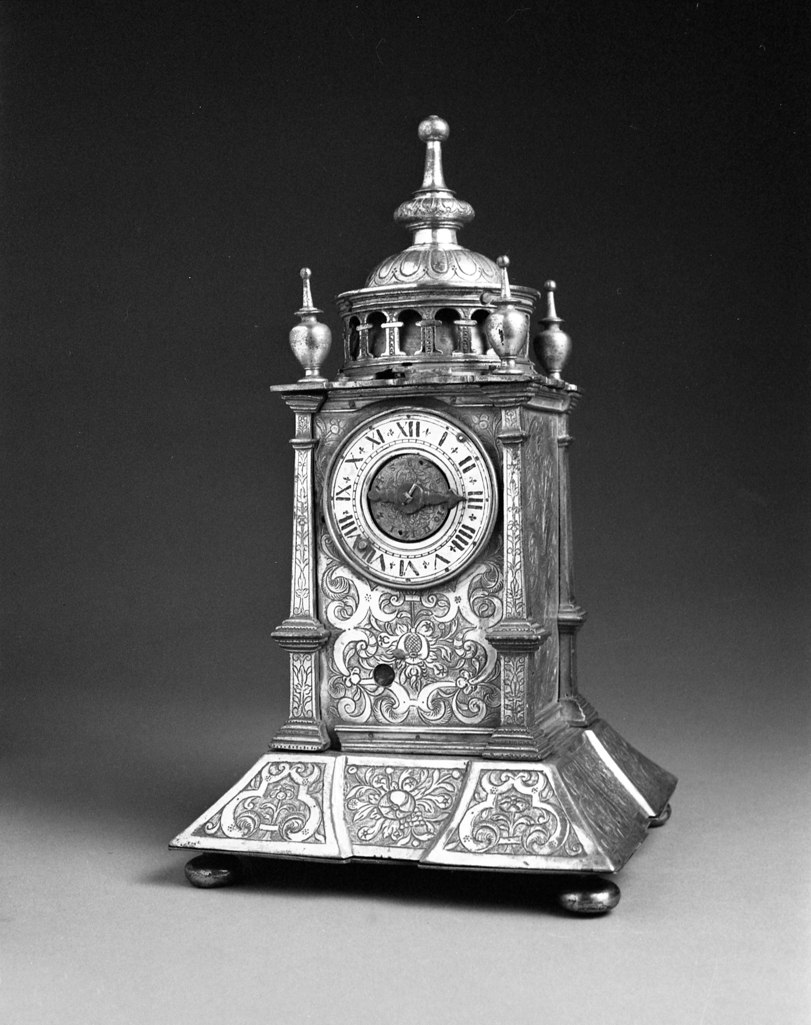
According to the Fitzwilliam Museum, this German tabernacle clock features an hour striking and alarm movement housed in a case constructed primarily of copper gilt, accented with gilt brass feet, finials, and a pierced dome enclosing the bell. The front face displays a replaced silver chapter ring with Roman numerals I to XII surrounding a gilt brass alarm disc with Arabic numerals. The 30-hour movement employs an iron frame, brass fusees cut for gut, and end-to-end trains. Originally regulated by a balance, it was converted to a verge escapement with a bob pendulum around 1700 or later; the museum notes the pendulum is currently broken off short.

Frontal view of the German tabernacle clock in copper gilt and gilt brass, accession M.16-1940, at The Fitzwilliam Museum.
Frontal view of the German tabernacle clock in copper gilt and gilt brass, accession M.16-1940, at The Fitzwilliam Museum. — The Fitzwilliam Museum, Cambridge. Rights pending — permission not yet requested. Original source

Catalogue identity

Source
data.fitzmuseum.cam.ac.uk
Category
Clock · Tabernacle clock
Maker / attribution
Not established
Reference
M.16-1940
Catalogue / lot identifier
Source URL identifies the listing
Source-reported date
Not established
Country
Germany

Source-reported attribution and specifications are not independent authentication. A listing does not establish present ownership, current display, availability or permission to reproduce.

Object description

Case Architecture and Decorative Elements

The architectural case is constructed predominantly of copper gilt, with the upper pierced dome enclosing the bell, the finials, and the feet fabricated from gilt brass. Visible ornamentation includes relief engraving across the front plate, plinth, and splayed base, framed by classical corner pilasters, and the case rests on four flattened bun feet.

According to the museum, the rectangular movement housing features removable ends providing access to the movement, with mouldings riveted in place. Low down on the front plate, a small circular aperture originally provided for regulation by varying the set-up of the mainspring is now blocked.

Evidence for this section
  • “Mainly of copper gilt, but with the dome, finials and feet of gilt brass, with a rectangular section containing the movement, surmounted by a pierced dome enclosing the bell and with a splayed plinth.”
  • “Architectural case featuring classical corner pilasters, urn finials, and an upper pierced arcaded dome surmounted by a central finial.”
  • “The ends of the rectangular section removable for access to the movement. The mouldings riveted in place”
  • “A hole low down in the front of the case (now blocked) was provided originally for regulation by varying the set up of the mainspring.”

Dial Configuration and Indications

The dial features a replaced silver chapter ring engraved with Roman numerals I to XII, quarter-hour track divisions on the interior, hour divisions on the exterior, and simple fleur-de-lys half-hour marks. Time is indicated by a single substantial iron hand with an arrow-shaped pointer, noted by the source as possibly later.

Within the chapter ring sits a gilt brass alarm-setting disc engraved with Arabic numerals 1 to 12 around a floral engraved centre, equipped with two holes for rotation. The source notes that the numeral '2's are of the 'Z' type, suggesting German manufacture (probably Augsburg) intended for the Italian market.

Evidence for this section
  • “Replaced Silver chapter ring engraved I - XII in Roman numerals, quarter hour divisions on the inside, hour divisions on the outside and simple fleur-de-lys half hour marks.”
  • “Substantial, possibly later, iron hand with an arrow-shaped pointer.”
  • “Within the chapter ring, a gilt brass alarm setting disc, with two holes for turning it, engraved ‘1 - 12' in arabic numerals with floral engraving in the centre.”
  • “The ‘2's are the `Z' type suggesting German, probably Augsburg, manufactured for the Italian market.”

Movement Architecture and Modifications

The movement has a 30-hour duration and incorporates hour striking and an alarm. It is constructed with an iron frame featuring square decorated pillars, iron wheels, brass flanged spring barrels with dovetailed covers, and brass fusees with six turns cut for gut. The trains are arranged end-to-end, one behind the other.

The clock was originally regulated by a balance wheel but was converted circa 1700 or later to a verge escapement with a bob pendulum, introducing brass contrate and crown wheels to the going train; the museum notes that the bob pendulum is now broken off short. Striking is arranged 1 to 6 on the Italian system with a heart-shaped locking cam, a nag's head lifting piece, and a six-hour count wheel indicator dial on the back of the case. The going and striking trains are wound at the back, while the alarm train—featuring an open spring between four posts and a brass crown wheel to the verge—winds from the left side.

Evidence for this section
  • “Movement with hour striking and alarm, and of 30 hour duration. Iron frame with square decorated pillars and iron wheels except where otherwise stated. End to end trains, one behind the other.”
  • “The spring barrels, flanged and with covers dove-tailed on, are of brass, the fusees also, with six turns cut for gut.”
  • “The going train with brass contrate and crown wheels resulting from its conversion from balance to verge escapement with bob pendulum c.1700 or later. The pendulum now broken off short.”
  • “The striking arranged 1 - 6 on the Italian system, with a six hour count wheel indicator dial on the back of the case. The striking train with heart-shaped locking cam and released by a nag's head lifting piece. The alarm train with an open spring between four posts and a brass crown wheel to the verge. The going and striking wound at the back and the alarm wound at the left-hand side.”

Open research questions

  • Does the rear plate or striking indicator dial retain any stamped town or guild marks confirming the suggested Augsburg attribution?
  • What physical traces or plugged pivot holes remain on the iron frame from the original balance wheel assembly prior to its conversion to verge and pendulum?

Source evidence

Recorded claims and source quotations for Tabernacle clock with hour striking and alarm movement
FieldSource-reported valueSource quotation
Accession NumberM.16-1940“Accession Number: M.16-1940”
Production PlaceGermany“Production Place: Germany.”
Movement Duration30 hour duration“Movement with hour striking and alarm, and of 30 hour duration.”
Escapement Conversionc.1700 or later“resulting from its conversion from balance to verge escapement with bob pendulum c.1700 or later.”
Case MaterialsCopper gilt and gilt brass“Mainly of copper gilt, but with the dome, finials and feet of gilt brass”
Striking System1 to 6 hour Italian system“The striking arranged 1 - 6 on the Italian system, with a six hour count wheel indicator dial on the back of the case.”
Fusee ConstructionBrass with six turns cut for gut“the fusees also, with six turns cut for gut.”
Maker AttributionAnonymous clockmaker“Tabernacle clock with hour striking and alarm movement. Anonymous clockmaker.”

Visible details

  • Architectural case featuring classical corner pilasters, urn finials, and an upper pierced arcaded dome surmounted by a central finial.
  • Elaborate foliage and scrollwork relief engraving across the front plate, plinth, and splayed base.
  • Circular dial featuring a silvered chapter ring with Roman numerals I–XII, an inner central disc, and a single arrow-shaped iron hand.
  • Small circular aperture located near the lower left of the front plate, noted by the source as originally for mainspring set-up regulation and now blocked.
  • Resting on four flattened bun feet.

Research qualifications

  • The chapter ring is a replacement.
  • The iron hand is described as possibly later.
  • The pendulum is broken off short.
  • Rear striking count wheel indicator dial, side alarm winding arbor, and internal movements are not visible in this frontal view.

Photograph identity and source facts were screened before import; rights clearance remains pending.

Consulted source

The Fitzwilliam Museum - Tabernacle clock with hour striking and alarm movement

Reviewed 2026-10-21 · Record 9edb1e7882

Terms in this record

Glossary explanations for terms named in this object’s record.

Other tabernacle clock records