
Skip to content
The Encyclopedia of Horology

Clock · Tabernacle clock

Tabernacle Clock

Partially verified

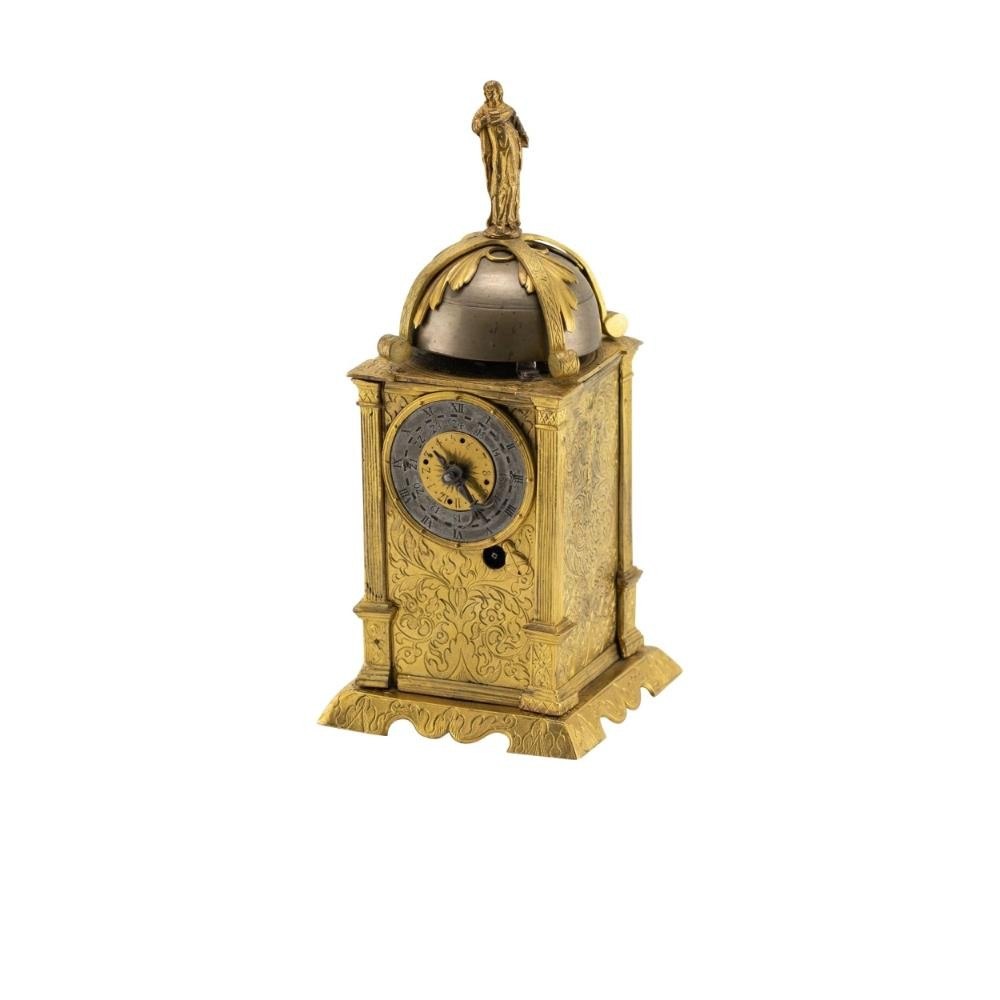
This small 205 mm tall tabernacle clock, dated circa 1585, is attributed to a South German origin. The case is constructed from square-sectioned, firegilt brass, which is decorated with extensive foliage engraving across all sides and supported by a base featuring curved cut-outs. Fluted pilasters are positioned at each of the four corners. The dial is equipped with an applied firegilt brass ring featuring 12 hour knobs intended for nighttime time reading. The silvered chapter ring displays Roman numerals for the hours and Arabic numerals for a 24-hour cycle. At the center lies an alarm disc featuring Arabic numerals and an engraved sunray motif, operated by a single blued iron hand. The movement is composed of an iron frame and iron wheels, powered by two chain and fusee systems. The clock retains its verge escapement, although it features a later short pendulum and the original alarm mechanism is absent.

A 205 mm tall tabernacle clock, circa 1585, featuring a firegilt brass case with ornate engraving and a silvered chapter ring.
A 205 mm tall tabernacle clock, circa 1585, featuring a firegilt brass case with ornate engraving and a silvered chapter ring. — Auktionen Dr. Crott / Invaluable. Rights pending — permission not yet requested. Original source

Catalogue identity

Source
orbiscollectibles.com
Category
Clock · Tabernacle clock
Maker / attribution
Not established
Reference
Not recorded
Catalogue / lot identifier
7d5017b323
Source-reported date
circa 1585
Source-reported place
South Germany

Source-reported attribution and specifications are not independent authentication. A listing does not establish present ownership, current display, availability or permission to reproduce.

Object description

Case and Dial Construction

The clock is housed in a square-sectioned firegilt brass case, which is profusely decorated with intricate foliage engravings covering all visible sides. The structure rests on a base with distinct curved cut-outs, and the four corners are punctuated by fluted pilasters.

The dial assembly includes an applied firegilt brass ring fitted with 12 knobs specifically intended for reading the time during low-light conditions at night. An inlaid silvered chapter ring serves as the primary time indicator, featuring Roman numerals ranging from I to XII alongside an Arabic 24-hour scale. The central portion of the dial is occupied by an alarm disc engraved with a sunray motif and Arabic numerals, manipulated via a single blued iron hand.

Evidence for this section
  • “Case: Brass, firegilt, square in cross-section, richly engraved with foliage on all sides, base with curved cut-outs.”
  • “The four corners have fluted pilasters.”
  • “applied firegilt brass ring with 12 hour knobs for time reading by night, inlaid silvered chapter ring with Roman numerals "I-XII" and Arabic 24 hours”

Movement and Mechanical Details

The movement is constructed using an iron frame containing iron wheels. It utilizes two separate chain and fusee systems to drive both the going and striking trains. The escapement is of the verge type, indicating an early mechanical arrangement.

The technical state of the movement is modified, as the original alarm mechanism has been removed and the clock now operates with a later, non-original short pendulum. The striking train is powered by a single hammer arrangement.

Evidence for this section
  • “Movm.: Iron frame, iron wheels, 2 x chain/fusee for going and striking train, 1 hammer, verge escapement, later short pendulum, alarm mechanism removed.”

Attribution and Status

The object is recorded as an anonymous work, with an attribution to South German origin based on the provided documentation. It is dated to approximately 1585.

The current record notes that the classification of the object remains in a status where credible evidence exists, but it has not been fully established, necessitating further specialist verification of the wider type and provenance.

Evidence for this section
  • “Anonymous - Am 5 Iuni Ano 1585”
  • “probably South German tabernacle clock”
  • “Credible evidence exists but classification is not fully established.”

Open research questions

  • Confirm the identity of the top-mounted figure finial, which is visible in the photograph but not described in the text.
  • Verify the chronological sequence of the documented movement modifications.

Source evidence

Recorded claims and source quotations for Tabernacle Clock
FieldSource-reported valueSource quotation
MakerAnonymous“Anonymous”
Datecirca 1585“circa 1585”
Dimensions205 mm“205 mm”
OriginSouth Germany“probably South German”
Case MaterialBrass, firegilt“Case: Brass, firegilt, square in cross-section”
Dial FeaturesSilvered chapter ring with Roman numerals I-XII and Arabic 24 hours“inlaid silvered chapter ring with Roman numerals "I-XII" and Arabic 24 hours”
Movement ComponentsIron frame, iron wheels, two chain/fusee systems“Iron frame, iron wheels, 2 x chain/fusee for going and striking train”
EscapementVerge escapement“verge escapement”

Visible details

  • Firegilt brass case with foliage engraving
  • Silvered chapter ring with 12 hour knobs
  • Top-mounted figure finial
  • Central engraved sunray motif on the alarm disc

Research qualifications

  • Alarm mechanism is reported as removed
  • Pendulum is described as a later addition

Photograph identity and source facts were screened before import; rights clearance remains pending.

Consulted source

Anonymous - Am 5 Iuni Ano 1585

Reviewed 2026-11-02 · Record 9c55cf4167

Terms in this record

Glossary explanations for terms named in this object’s record.