Construction and Design
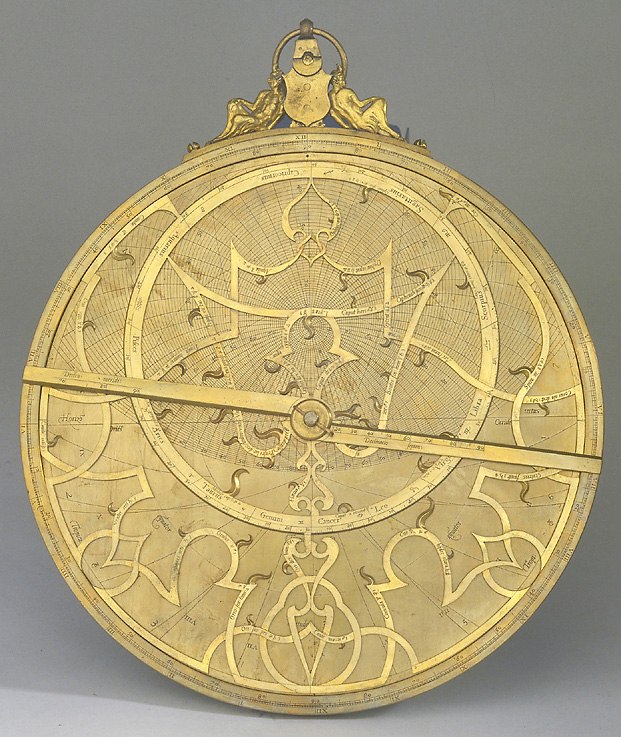
The astrolabe is constructed from brass and measures 297 mm in diameter. Its primary assembly consists of a central mater designed to accommodate a series of eight latitude plates. These plates provide coverage for a wide range of settings, calibrated for specific latitudes including 24, 27, 30, 33, 36, 38, 40, 42, 44, 46, 48, 51, 54, 57, and 60 degrees, with the final plate including a tablet of horizons. The instrument's mechanical features are completed by an alidade, which is graduated on both sides and equipped with pierced sighting holes at its extremities for astronomical observation.
The aesthetic and structural details, particularly the reclining satyrs on the throne, are key to its identification. The limb of the instrument is divided into four 90-degree quadrants, with further divisions from I to XII repeated twice to facilitate measurement. The rete, or star map, is engraved with 54 star positions, each indicated by a point accompanied by its star name.
Evidence for this section
- “The throne of the astrolabe displays two reclining counterpoised satyrs, who lean on the moulded block to which the suspension ring of the instrument is pivoted.”
- “The limb is divided into four 90? quadrants and in divisions from I to XII repeated twice.”
- “The rete bears 54 stars, represented by protruding points accompanied by their names.”
Astronomical and Calendar Scales
The back of the astrolabe functions as a complex calculator for time and celestial measurement. It includes an outer ring featuring the zodiac signs in Latin, accompanied by symbols and numbered I to XII starting from Aries. This is followed by calendar divisions for months, likewise labeled in Latin. The central portion of the back contains hour lines divided into two sections by the horizontal diameter. These are marked for 'Hore aequales', with specific notations for 'Hore ante meridiem' and 'Hore post meridiem' relative to the observer's position.
Below the central diameter, the instrument features a semi-shadow square labeled 'Scalae altimetrae'. The sides of this square are engraved with double divisions ranging from 0 to 60 and 1 to 12, with clear inscriptions for 'UMBRA RECTA' and 'VMBRA UERSA'.
Evidence for this section
- “The back of the astrolabe has its limb divided into four 90? quadrants.”
- “The upper part is traced with slightly curved lines, running towards the diameter from the top.”
- “The lower part of the back, under the diameter, bears the semi shadow square, in which one can read the inscription 'Scalae altimetrae'.”
Attribution and Provenance
The instrument is held in the collection of the Istituto e Museo di Storia della Scienza, Firenze, under inventory number 1094. Although the astrolabe is not explicitly signed, researchers attribute the piece to Gualterus Arsenius. This attribution rests on several qualitative markers including the style of the engraving, the specific construction techniques employed, and the inclusion of bas-relief figures on the suspension assembly.
The object has been documented in established academic catalogues, specifically referencing the museum's own inventories and research publications, providing a clear association with the technical traditions of Flemish astrolabe production during the mid-1500s.
Evidence for this section
- “The instrument is unsigned, but its decorative characteristics and the style in which it is made suggest its attribution to Gualterus Arsenius, nephew of Gemma Frisius.”
- “See M. Miniati, Museo di Storia della scienza: Catalago (Florence, 1991), p. 34.”