
Skip to content
The Encyclopedia of Horology

Tool · Flemish astrolabe

Astrolabe by Gillis Coignet

Partially verified

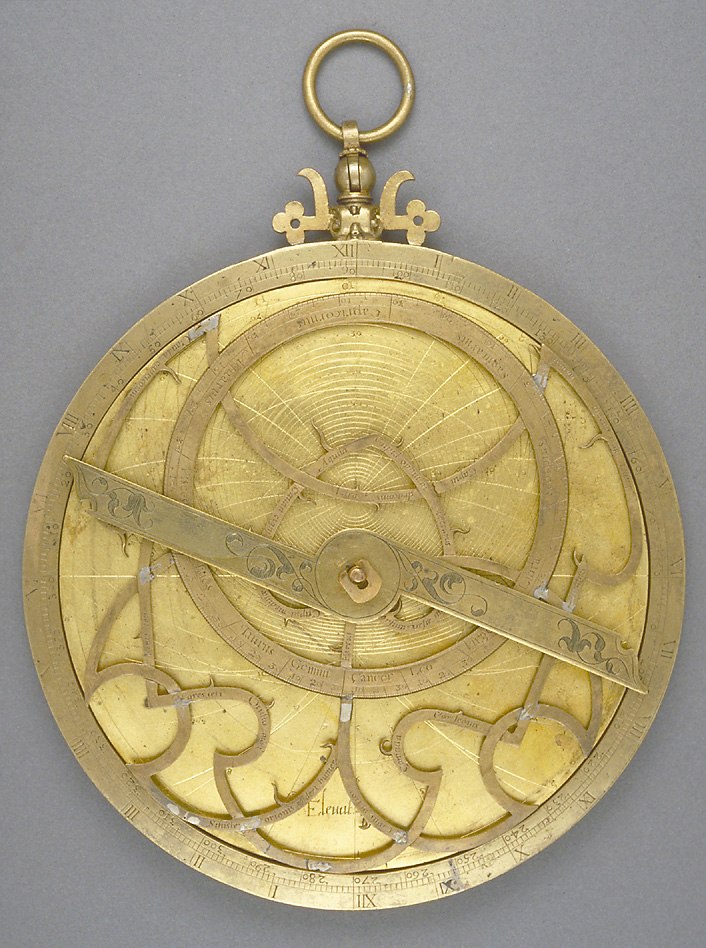
This gilt brass astrolabe, 182 mm in diameter, is attributed to the maker Gillis Coignet and dates to approximately 1575. The object comprises a mater with a riveted rim, an unusual throne featuring two trefoils and stylized leaves, a rete designed with a heart-shaped feature inside the ecliptic, four interchangeable plates, a rule, and an alidade. The mater features a 24-hour scale and a 360-degree altitude scale. The four plates provide varied latitude projections, including a 'HORIZONTALE CATHOLICUM' on plate 4b. The back of the instrument includes circular scales for altitude, zodiacal positions, and a Julian calendar, alongside a double shadow scale and a double horary quadrant. The instrument is signed 'AEgidius quiniet antverp faciebat' in a cartouche on the back. The assembly is held in the British Museum collection.

Front view of the Flemish gilt brass astrolabe, showing the rete, the rule, the mater, and the stylized throne, circa 1575.
Front view of the Flemish gilt brass astrolabe, showing the rete, the rule, the mater, and the stylized throne, circa 1575. — British Museum, London. Rights pending — permission not yet requested. Original source

Catalogue identity

Source
www.mhs.ox.ac.uk
Category
Tool · Flemish astrolabe
Maker / attribution
Gillis Coignet
Reference
Not recorded
Catalogue / lot identifier
MLA 1895,7-23.61
Source-reported date
circa 1575
Source-reported place
Antwerp

Source-reported attribution and specifications are not independent authentication. A listing does not establish present ownership, current display, availability or permission to reproduce.

Object description

Construction and Design

The astrolabe is constructed of gilt brass with a diameter of 182 mm. The mater features a riveted rim bearing a 24-hour scale and a 360-degree altitude scale, with a recess beneath the throne designed to accommodate the tongues of the internal plates. The throne exhibits an unconventional design characterized by two trefoils linked by a strap, supplemented by two stylized leaves pointing upwards.

The instrument includes a rete featuring a heart-shaped design within the ecliptic, calibrated with the Latin names of the zodiac. It is accompanied by four plates etched with projections for various latitudes, including specific markings for horizons, azimuths, almucantars, and twilight curves. The rule and alidade are both counterchanged, featuring foliate scroll decorations that match those found on the rear of the instrument.

Evidence for this section
  • “Gilt brass; 182 mm in diameter”
  • “The throne is of unusual shape, consisting of two trefoils connected by a strap and two stylized leaves pointing upwards.”
  • “The rete, with a heart shaped design inside the ecliptic, gives the names of 24 stars.”

Scales and Calibrations

The back of the astrolabe is populated with complex astronomical scales. These include a 360-degree altitude scale, a zodiacal scale with symbols and degree divisions, and a Julian calendar scale. The equinoxes are calibrated to March 11 and September 13.5.

The lower section of the back plate hosts a double shadow scale labeled 'Vmbra recta' and 'Vmbra versa', while the upper section contains a double horary quadrant. The signature of Gillis Coignet is prominently featured within a cartouche situated at the base of the shadow scale, enclosed by a foliate scroll design.

Evidence for this section
  • “A Julian calendar scale with the usual Latin names of the months”
  • “The bottom half of the empty space inside these circles is taken up by a double shadow scale ('SCALA ALTIMETRA')”
  • “'AEgidius quiniet antverp faciebat' in a cartouche at the bottom.”

Provenance and Condition

The instrument was acquired by the British Museum in 1895 and is formally catalogued as MLA 1895,7-23.61. The current state of the rete indicates that it has been subject to extensive repairs, which have caused the loss of certain engravings due to the soldering process.

References for the object include the 1981 publication by F. A. B. Ward, which details the instrument within the broader context of the British Museum's collection of scientific antiquities. The attribution to circa 1575 is supported by stylistic comparison to other instruments by the maker and the use of the Julian calendar.

Evidence for this section
  • “The instrument was purchased in 1895”
  • “It has been heavily repaired and some of the engravings are lost due to the soldering.”
  • “This Flemish astrolabe is not dated, but other instruments by the same maker and the Julian calendar used on the back suggest it was made in about 1575.”

Open research questions

  • What is the specific nature of the 'old markings' on the reverse of the rule?
  • To what extent did the reported repairs to the rete alter the original stellar positions or nomenclature?

Source evidence

Recorded claims and source quotations for Astrolabe by Gillis Coignet
FieldSource-reported valueSource quotation
MakerGillis Coignet“Signed by Gillis Coignet”
MaterialGilt brass“Gilt brass; 182 mm in diameter”
LocationAntwerp“Antwerp”
Diameter182 mm“182 mm in diameter”
Inventory numberMLA 1895,7-23.61“MLA 1895,7-23.61”
SignatureAEgidius quiniet antverp faciebat“'AEgidius quiniet antverp faciebat' in a cartouche at the bottom.”
EquinoxesMarch 11 and September 13 1/2“The equinoxes correspond with March 11 and September 13 1/2.”

Visible details

  • Throne features two trefoils and stylized leaves
  • Signature located in a cartouche at the bottom of the back plate
  • Rete contains names for 24 stars
  • Alidade and rule decorated with foliate scroll designs

Research qualifications

  • The rete has undergone heavy repairs resulting in some lost engravings
  • The exact date is not inscribed on the object and is based on comparative analysis

Photograph identity and source facts were screened before import; rights clearance remains pending.

Consulted source

Astrolabe

Reviewed 2026-10-26 · Record 7765552d2a

Terms in this record

Glossary explanations for terms named in this object’s record.

Other flemish astrolabe records