
Skip to content
The Encyclopedia of Horology

Tool · Flemish astrolabe

Gualterus Arsenius Astrolabe

Partially verified

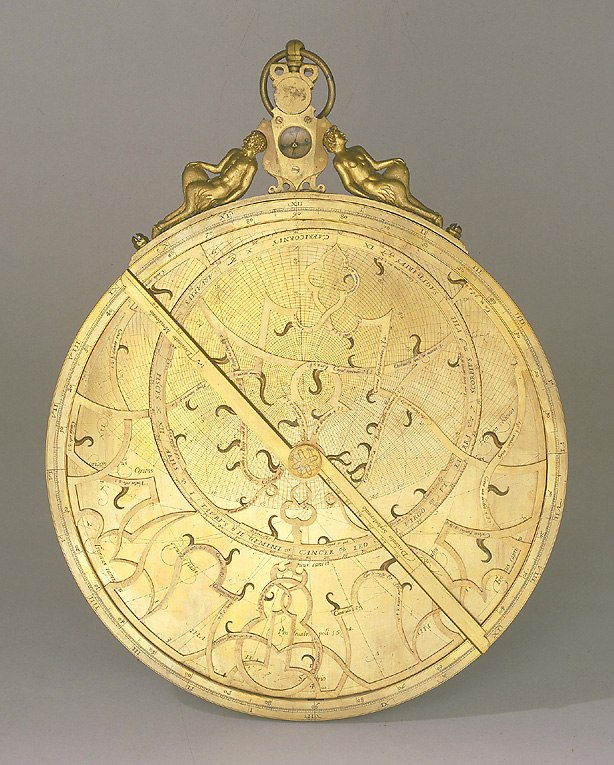
This brass astrolabe, measuring 341 mm in diameter, was created by Gualterus Arsenius in Louvain in 1572. The instrument consists of a mater housing ten plates calibrated for various latitudes, which are installed in an inverted orientation. The suspension mechanism features a compass equipped with a magnetic needle, flanked by two satyr figures—one feminine and one masculine. The rete displays 54 star positions identified by names, while the zodiacal circle includes Latin nomenclature and symbols. A central pointer, divided by a pivot, is graduated for declination measurements labeled as meridionalis and septentrionalis. The reverse side includes a limb graduated into 90-degree quadrants, a calendar with saint names, and a half shadow square for topographical calculations. The instrument is signed: 'Gualterus Arsenius nepos Gemmae Frisij Louuanij fecit anno 1572'. It is held within the collection of the Istituto e Museo di Storia della Scienza in Florence.

Front view of the Gualterus Arsenius astrolabe, dated 1572, showing the rete, the throne with satyr figures, and the central pointer.
Front view of the Gualterus Arsenius astrolabe, dated 1572, showing the rete, the throne with satyr figures, and the central pointer. — Istituto e Museo di Storia della Scienza, Firenze. Rights pending — permission not yet requested. Original source

Catalogue identity

Source
www.mhs.ox.ac.uk
Category
Tool · Flemish astrolabe
Maker / attribution
Gualterus Arsenius
Reference
Not recorded
Catalogue / lot identifier
1103
Source-reported date
1572
Source-reported place
Louvain

Source-reported attribution and specifications are not independent authentication. A listing does not establish present ownership, current display, availability or permission to reproduce.

Object description

Construction and Decoration

The astrolabe is constructed from brass and measures 341 mm in diameter. The throne is fashioned with two satyrs, one young and one old, reclining against a block that houses a compass complete with its magnetic needle and glass. The suspension ring is attached to this block via an elaborate mechanism.

The rete displays 54 stars, indicated by protruding points labeled with names. The zodiac circle is marked with Latin names, symbols, and numbers I to XII. The central pivot is flattened and decorated with a stylized engraving.

Evidence for this section
  • “The impressive throne bears two satyrs, one young, the other old, who recline against a block containing a compass complete with its glass and magnetic needle.”
  • “The rete displays 54 stars, by means of protruding points accompanied by their names.”

Back and Topographical Features

The reverse side of the instrument features a limb divided into four 90-degree quadrants. It lists the zodiac signs in Latin with their associated symbols and numbers. A calendar is also present, divided into twelve months, each consisting of thirty days, including the names of saints corresponding to specific dates.

The central area is split into upper and lower sections. The lower portion includes a half shadow square with double graduations from 0 to 60 and 1 to 12, along with the inscriptions 'UMBRA RECT' and 'UMBRA VERSA' for topographical operations.

Evidence for this section
  • “The back of the instrument has its limb divided into four 90? quadrants”
  • “The lower part bears the half shadow square with a double graduation from 0 to 60 and 1 to 12, and the inscriptions 'UMBRA RECT' and 'UMBRA VERSA'.”

Plates and Signature

The mater contains ten plates calibrated for various latitudes ranging from 23 to 60 degrees. The source indicates that these plates are placed in an upside-down orientation. A pointer crosses the face, divided into two graduated sections labeled 'Declinatio: Meridionalis' and 'Declinatio Septentrionalis'.

The instrument is signed by the maker with the inscription: 'Gualterus Arsenius nepos Gemmae Frisij Louuanij fecit anno 1572', confirming its production in 1572.

Evidence for this section
  • “The mater contains 10 plates for latitudes 23 and 26, 29 and 32, 35 and 38, 40 and 41, 42 and 43, 44 and 45, 46 and 47, 50 and 51, 53 and 56, and 58 and 60 degrees.”
  • “Underneath the half square the following signature can be read: 'Gualterus Arsenius nepos Gemmae Frisij Louuanij fecit anno 1572'.”

Open research questions

  • What is the historical reason for the unusual upside-down placement of the ten plates?
  • Does the inclusion of saint names on the calendar indicate a specific geographical region of intended use beyond Louvain?

Source evidence

Recorded claims and source quotations for Gualterus Arsenius Astrolabe
FieldSource-reported valueSource quotation
MakerGualterus Arsenius“Signed by Gualterus Arsenius”
Date1572“Dated 1572; Louvain”
Inventory Number1103“Inventory number: 1103”
Diameter341 mm“341 mm in diameter”
SignatureGualterus Arsenius nepos Gemmae Frisij Louuanij fecit anno 1572“Gualterus Arsenius nepos Gemmae Frisij Louuanij fecit anno 1572”
Plate Count10“The mater contains 10 plates”

Visible details

  • Suspension system includes a compass with a magnetic needle.
  • Two satyr figures flank the compass block on the throne.
  • Rete contains 54 star points.
  • Reverse side features a half shadow square with inscriptions UMBRA RECT and UMBRA VERSA.

Research qualifications

  • The plates are noted to be placed upside-down, which is described as unusual.
  • The specific function of the feminine and masculine satyr figures beyond being characteristic of the workshop is not detailed.

Photograph identity and source facts were screened before import; rights clearance remains pending.

Consulted source

Astrolabe

Reviewed 2026-10-26 · Record 65dc006aaa

Terms in this record

Glossary explanations for terms named in this object’s record.

Other flemish astrolabe records