
Skip to content
The Encyclopedia of Horology

Tool · Astrolabe

Astrolabe

Partially verified

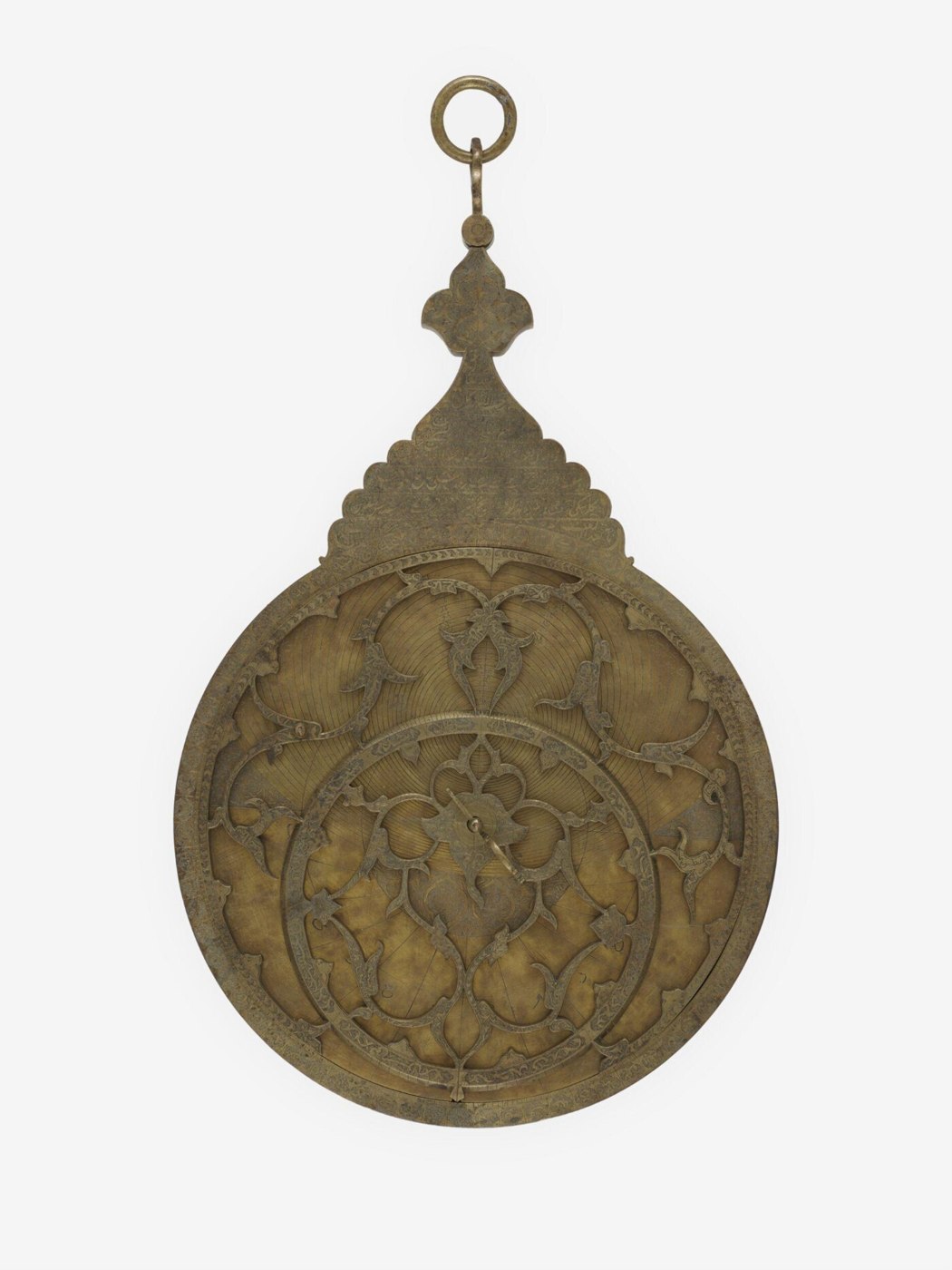
This astrolabe, dated to 1781, comprises a brass mater, a rete, seven engraved plates, an alidade, and a central pin with a horse. The complex structure includes a kursi, which is an extension at the top ending in a suspension loop. This variety suggests that the instrument is a composite piece. The total weight is 2.9 kg, and the instrument measures 35.5 cm in height with a diameter of 20.3 cm. The accuracy of the scientific data engraved on the plates remains unverified.

Front view of the astrolabe showing the rete and the decorative kursi.
Front view of the astrolabe showing the rete and the decorative kursi. — Victoria and Albert Museum, London. Rights pending — permission not yet requested. Original source

Catalogue identity

Source
collections.vam.ac.uk
Category
Tool · Astrolabe
Maker / attribution
'Abd al-Ghafur
Reference
Not recorded
Catalogue / lot identifier
M.826-1928
Source-reported date
1781
Source-reported place
Iran

Source-reported attribution and specifications are not independent authentication. A listing does not establish present ownership, current display, availability or permission to reproduce.

Object description

Construction and Components

The astrolabe is constructed from metal and follows a standard configuration including a mater, or casing, which holds the internal components. Attached to the top of the mater is the kursi, a structured extension that terminates in a loop designed to hold a suspension cord for practical use. The central assembly consists of a rete, which features an openwork design representing a star map, and a central pin secured by a horse.

The instrument includes seven distinct plates, all engraved on both sides to provide thirteen specific latitude settings. These plates, alongside the alidade, serve as the functional components for the astrolabe. The material construction is primarily brass, resulting in a weight of 2.9 kilograms and a diameter of 20.3 centimeters. The instrument was manufactured in Urmia, Iran, by the maker 'Abd al-Ghafur. The instrument was commissioned by a resident of Urmia, Iran, where it was also manufactured by the maker 'Abd al-Ghafur in 1781.

Evidence for this section
  • “The astrolabe consists of a mater (casing), with an extension at the top (called the kursi in Arabic) that is of complex shape and structure and ends in a loop for a suspension cord; a rete (openwork star map); seven plates for different latitudes; an alidade (viewing device); and the pin and "horse" that hold the instrument together.”

Engraving and Composite Nature

The inscriptions on the plates indicate a range of latitudes from 29° N to 46° N. Examination of the engraving styles reveals two distinct formats. In the first format, text is presented unframed over a background of plant-based ornamentation. In the second, the latitude information is contained within scalloped cartouches.

The coexistence of these disparate engraving styles on the set of seven plates suggests that the astrolabe is a composite object. This is further indicated by the inclusion of duplicate plates for 30° N and inconsistencies in the labeling of latitude values and the length of the longest day.

Evidence for this section
  • “There are two different formats, one with the text presented unframed, as though written over the plant-based ornament that forms the background (A), the other with the two texts in separate scalloped cartouches (B).”
  • “This suggests that the instrument is composite.”

Provenance and Commission

The engraving includes details regarding the latitude settings, which allow for the device to be used at various locations between 29° N and 40° N.

While the scientific data has been recorded on the device, its accuracy has not been formally assessed by the collection. The identification of Urmia as the site of manufacture is derived from the captions engraved on the plates themselves.

Evidence for this section
  • “Urmia, the residence of the man who commissioned the instrument and its place of manufacture by 'Abd al-Ghafur”
  • “The accuracy of the scientific data engraved on the astrolabe has not been assessed”

Open research questions

  • What is the origin of the plates that differ in style from the core components?
  • To what degree do the calculated coordinates for the various latitudes correspond to mid-18th century Iranian geographical data?

Source evidence

Recorded claims and source quotations for Astrolabe
FieldSource-reported valueSource quotation
Maker'Abd al-Ghafur“manufacture by 'Abd al-Ghafur”
Accession numberM.826-1928“Accession number: M.826-1928”
Date1781“Date: 1781”
Dimensions35.5 cm high x 20.3 cm diameter“Height: 35.5 cm; Diameter: 20.3 cm”
Place of manufactureUrmia, Iran“Urmia, the residence of the man who commissioned the instrument and its place of manufacture by 'Abd al-Ghafur”
Weight2.9 kg“Weight: 2.9 kg”

Visible details

  • Kursi features complex shape and structure with a suspension loop
  • Rete shows openwork star map configuration
  • Alidade is present on the reverse
  • Plates show two distinct engraving styles for latitude captions

Research qualifications

  • Scientific accuracy of the engraved data has not been assessed
  • Presence of varied plate formats suggests the instrument may be a composite object

Photograph identity and source facts were screened before import; rights clearance remains pending.

Consulted source

Astrolabe

Reviewed 2026-10-26 · Record e10ba2c0f1

Terms in this record

Glossary explanations for terms named in this object’s record.