
Skip to content
The Encyclopedia of Horology

Tool · Arabic-inscribed astrolabe, Indian subcontinent

Astrolabe by Muḥammad Muqīm

Partially verified

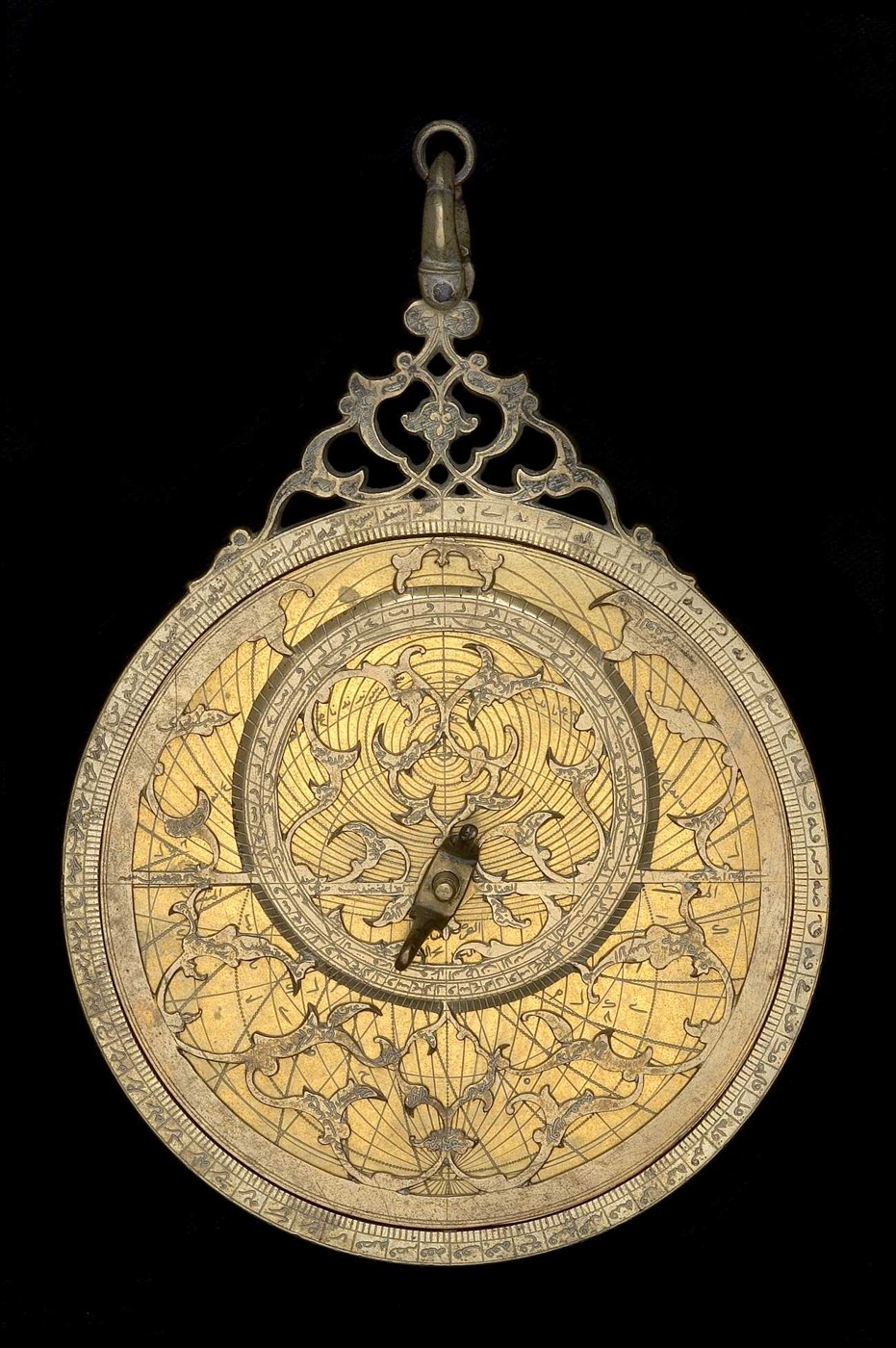
This brass astrolabe is attributed to the maker Muḥammad Muqīm and dated to approximately 1650. Constructed in Lahore, the instrument features an Indo-Persian, pierced-style throne, which culminates in a trefoil and is attached via an integrated base. The mater and limb are formed of one-piece construction. The back of the instrument is engraved with 14 distinct scales, including those for altitude, sine/cosine, declination, cotangent, and shadow squares, alongside astrological markers such as zodiacal signs, terms, faces, and triplicities. The womb contains a comprehensive gazetteer listing coordinates for 77 cities. The object was presented to the History of Science Museum by J. A. Billmeir in 1957, having previously been part of the Henri Michel collection.

The rete and throne of the brass astrolabe (inventory 37530) featuring foliate pointers.
The rete and throne of the brass astrolabe (inventory 37530) featuring foliate pointers. — History of Science Museum, University of Oxford. Rights pending — permission not yet requested. Original source

Catalogue identity

Source
www.mhs.ox.ac.uk
Category
Tool · Arabic-inscribed astrolabe, Indian subcontinent
Maker / attribution
Muḥammad Muqīm
Reference
Not recorded
Catalogue / lot identifier
1957-84/3
Source-reported date
ca. 1650
Source-reported place
Lahore
Source-reported serial
37530

Source-reported attribution and specifications are not independent authentication. A listing does not establish present ownership, current display, availability or permission to reproduce.

Object description

Construction and Design

The instrument is fabricated from brass and follows a traditional Indo-Persian layout. It features a pierced throne attached to an integrated base, terminating in a trefoil shape. The ring follows a simple round cross-section design, and the shackle is similarly of the trefoil type, open at the base.

The mater and limb are manufactured as a one-piece construction. A tab intended to hold the tympans in position is located at the bottom of the instrument, precisely 180 degrees from the throne. The circular degree scale on the limb is marked every five degrees, covering 0 to 360 degrees.

Evidence for this section
  • “The throne is of the indo-persian, pierced type made of brass attached with integrated base made of brass”
  • “The mater and limb are of one-piece construction.”

Rete and Astronomical Markings

The rete, which functions as a star map, is of the foliate type and includes 42 marked stars. Each star is designated with a specific foliate pointer. The zodiacal band on the rete is inscribed with names in Arabic.

The back of the astrolabe is densely inscribed with 14 distinct functional scales. These include quadrants for altitude and cotangents, as well as trigonometric and astrological scales such as sine/cosine, declination, zodiacal signs, faces, triplicities, and lunar mansions. The shadow square includes both finger and foot measurements.

Evidence for this section
  • “The rete is of the foliate (plain) type. One pointer within the ecliptic is pierced by a 3-mm hole.”
  • “The back contains 14 scales of the following types: Altitude; Sine/Cosine; Declination; Cotangent; Shadow square; Terms; Zodiacal signs; Faces; Triplicities; Lunar Mansions.”

Provenance and Documentation

The object is held under inventory number 37530. It was donated to the collection by J. A. Billmeir in 1957. The object's history is linked to the Belgian collector Henri Michel, from whom Billmeir purchased the collection circa 1950.

The womb of the instrument features a gazetteer containing coordinate data for 77 cities, ranging from regional centers like Lahore and Delhi to locations as far as Sarandib and Bulghar.

Evidence for this section
  • “Presented by J. A. Billmeir in 1957”
  • “Billmeir acquired it with the collection of Henri Michel, of Brussels, which he purchased about 1950.”
  • “The womb contains a gazetteer with coordinates for 77 cities”

Open research questions

  • Can the specific 3mm hole in one of the rete pointers be linked to a specific functional modification?
  • Do the discrepancies in the city gazetteer coordinates suggest a specific travel history for this instrument?

Source evidence

Recorded claims and source quotations for Astrolabe by Muḥammad Muqīm
FieldSource-reported valueSource quotation
MakerMuḥammad Muqīm“Maker Muḥammad Muqīm”
Dateca. 1650“Date ca. 1650”
Place of originLahore“Place Lahore”
MaterialBrass“Material Brass”
Inventory number37530“Inventory no. 37530”
Accession number1957-84/3“Accession 1957-84/3”
Star count42 stars“The rete contains 42 stars.”
ProvenanceAcquired via the collection of Henri Michel by J. A. Billmeir.“Billmeir acquired it with the collection of Henri Michel, of Brussels, which he purchased about 1950.”

Visible details

  • Throne features a pierced Indo-Persian design ending in a trefoil.
  • Rete includes 42 stars with foliate-style pointers.
  • Womb contains a gazetteer table with coordinates for 77 cities.
  • Back plate includes shadow squares for both fingers and feet.

Research qualifications

  • Specific identities for some star pointers remain unverified.
  • The precise origin of the metallurgical brass composition is not specified.

Photograph identity and source facts were screened before import; rights clearance remains pending.

Consulted source

Astrolabe, inventory 37530 (Lahore, ca. 1650)

Reviewed 2026-10-26 · Record bc5baab4ff

Terms in this record

Glossary explanations for terms named in this object’s record.