
Skip to content
The Encyclopedia of Horology

Tool · Arabic-inscribed astrolabe, Indian subcontinent

Astrolabe by Ḍiyā’ ad-Dīn Muḥammad

Partially verified

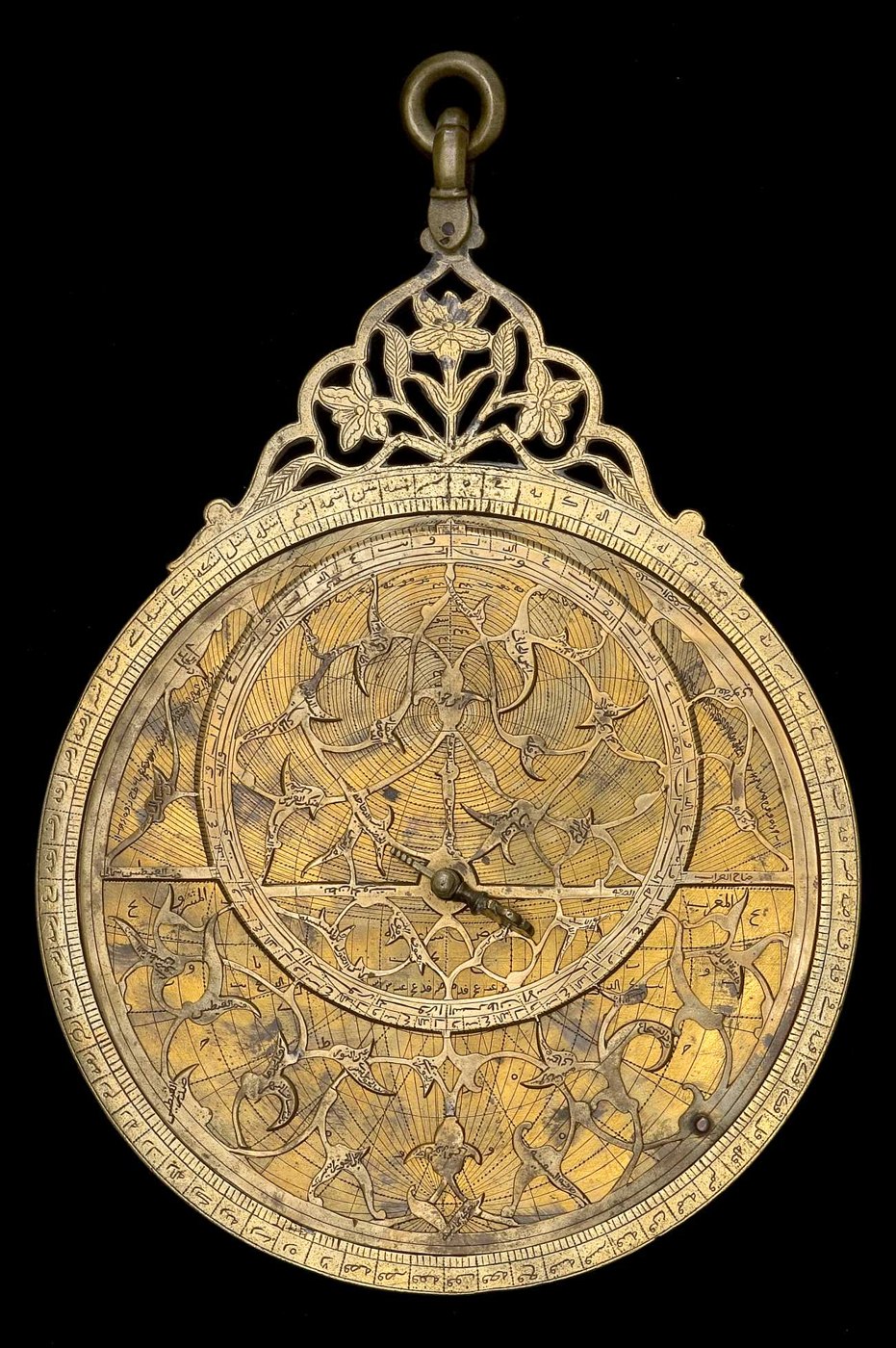
This brass astrolabe (inventory number 53637) dates to 1658/9 and was produced in Lahore by the maker Ḍiyā’ ad-Dīn Muḥammad. The object is of one-piece construction, comprising a mater and limb, and features an Indo-Persian, pierced-type throne with an integrated base, a squared-section ring, and a trefoil shackle. The instrument includes five latitude plates ranging from 18°0' to 66°0', and a foliate-type rete. The back of the instrument contains 15 distinct scales, including altitude, declination, prayer lines, and zodiacal signs. It is accompanied by a double-ended alidade which is identified as a replacement. The astrolabe was presented to the History of Science Museum by Lewis Evans in 1924, who had previously purchased the instrument from Vitali Francis Frères in Algeria in 1911. The object remains in the collection of the History of Science Museum, University of Oxford.

Front view of the brass astrolabe showing the rete, throne, and limb scales.
Front view of the brass astrolabe showing the rete, throne, and limb scales. — History of Science Museum, University of Oxford. Rights pending — permission not yet requested. Original source

Catalogue identity

Source
www.mhs.ox.ac.uk
Category
Tool · Arabic-inscribed astrolabe, Indian subcontinent
Maker / attribution
Ḍiyā’ ad-Dīn Muḥammad
Reference
Not recorded
Catalogue / lot identifier
53637
Source-reported date
1658/9
Source-reported place
Lahore
Source-reported serial
53637

Source-reported attribution and specifications are not independent authentication. A listing does not establish present ownership, current display, availability or permission to reproduce.

Object description

Construction and Design

The astrolabe is a brass instrument of one-piece construction for the mater and limb. It features an Indo-Persian style throne that is pierced and attached via an integrated base. The central section of this throne is decorated with three large flowers. The suspension system consists of a simple ring with a squared cross-section, attached to a trefoil-type shackle. The shackle connects to the throne via large, simple tabs.

The rete is designed in a foliate, single-knob style. The zodiacal labels on the rete represent the twelve signs from Aries to Pisces. The entire assembly is held together by a pin and wedge mechanism; the pin is undecorated, while the wedge features a shaped tab that is noted as being more decorative than the pin.

Evidence for this section
  • “The throne is of the indo-persian, pierced type made of brass”
  • “The rete is of the foliate (single knob) type”
  • “The rete is attached using a pin & wedge.”

Scales and Plates

The instrument includes five plates providing latitude coverage from 18°0' to 66°0'. The back of the astrolabe is highly complex, containing 15 scales of various types, including altitude, declination, prayer lines, sine/cosine, cotangent, zodiacal signs, lunar mansions, terms, faces, shadow squares, and triplicities. The limb features a degree scale ranging from 0 to 360 degrees, with markings every 5 degrees.

The womb of the astrolabe is engraved with a gazetteer containing lists of cities organized by their respective climates. The shadow square on the back is divided into four faces, with the left-hand vertical and bottom faces marked 1-7 in feet, and the right-hand bottom and vertical faces marked 1-12 in feet.

Evidence for this section
  • “There are 5 plates with latitudes ranging from 18°0' to 66°0'”
  • “The back contains 15 scales of the following types:”
  • “The womb is engraved with a gazeteer with the cities arranged by climate..”

Provenance and History

The object was added to the collection of the History of Science Museum at the University of Oxford following a presentation by Lewis Evans in 1924. Its documented provenance indicates that Evans had acquired the piece earlier, purchasing it from the firm Vitali Francis Frères located in Algeria during 1911.

The current configuration of the instrument includes a double-ended alidade, which is catalogued as a replacement rather than an original component. This alidade shows slight decorative elements surrounding its central hole, and its construction includes both sine/cosine and unequal hours scales on its right arm.

Evidence for this section
  • “Presented by Lewis Evans in 1924”
  • “Evans bought it from Vitali Francis Frères, Algeria, in 1911.”
  • “The rule is not original. Slight decoration around the central hole.”

Open research questions

  • What is the specific historical context of the replacement alidade?
  • Are there any identifiable, un-marked star positions on the rete that were meant to be added later?

Source evidence

Recorded claims and source quotations for Astrolabe by Ḍiyā’ ad-Dīn Muḥammad
FieldSource-reported valueSource quotation
MakerḌiyā’ ad-Dīn Muḥammad“Maker Ḍiyā’ ad-Dīn Muḥammad”
Date1658/9“Date 1658/9”
Place of manufactureLahore“Place Lahore”
MaterialBrass“Material Brass”
Inventory number53637“inventory number 53637”
ProvenancePresented by Lewis Evans in 1924“Presented by Lewis Evans in 1924”
Latitude plates5“There are 5 plates with latitudes ranging from 18°0' to 66°0'”
AlidadeReplacement“The rule is not original.”

Visible details

  • Throne features three large flowers in the center section
  • Rete is of the foliate single-knob type
  • Back features a shadow square with four faces

Research qualifications

  • The alidade is noted to be a replacement and not original to the instrument
  • The rete contains no star pointers

Photograph identity and source facts were screened before import; rights clearance remains pending.

Consulted source

Astrolabe, inventory 53637 (Lahore, 1658/9)

Reviewed 2026-10-26 · Record a34eb0488f

Terms in this record

Glossary explanations for terms named in this object’s record.