
Skip to content
The Encyclopedia of Horology

Tool · Arabic-inscribed astrolabe, Indian subcontinent

Astrolabe by Allāh-Dād

Partially verified

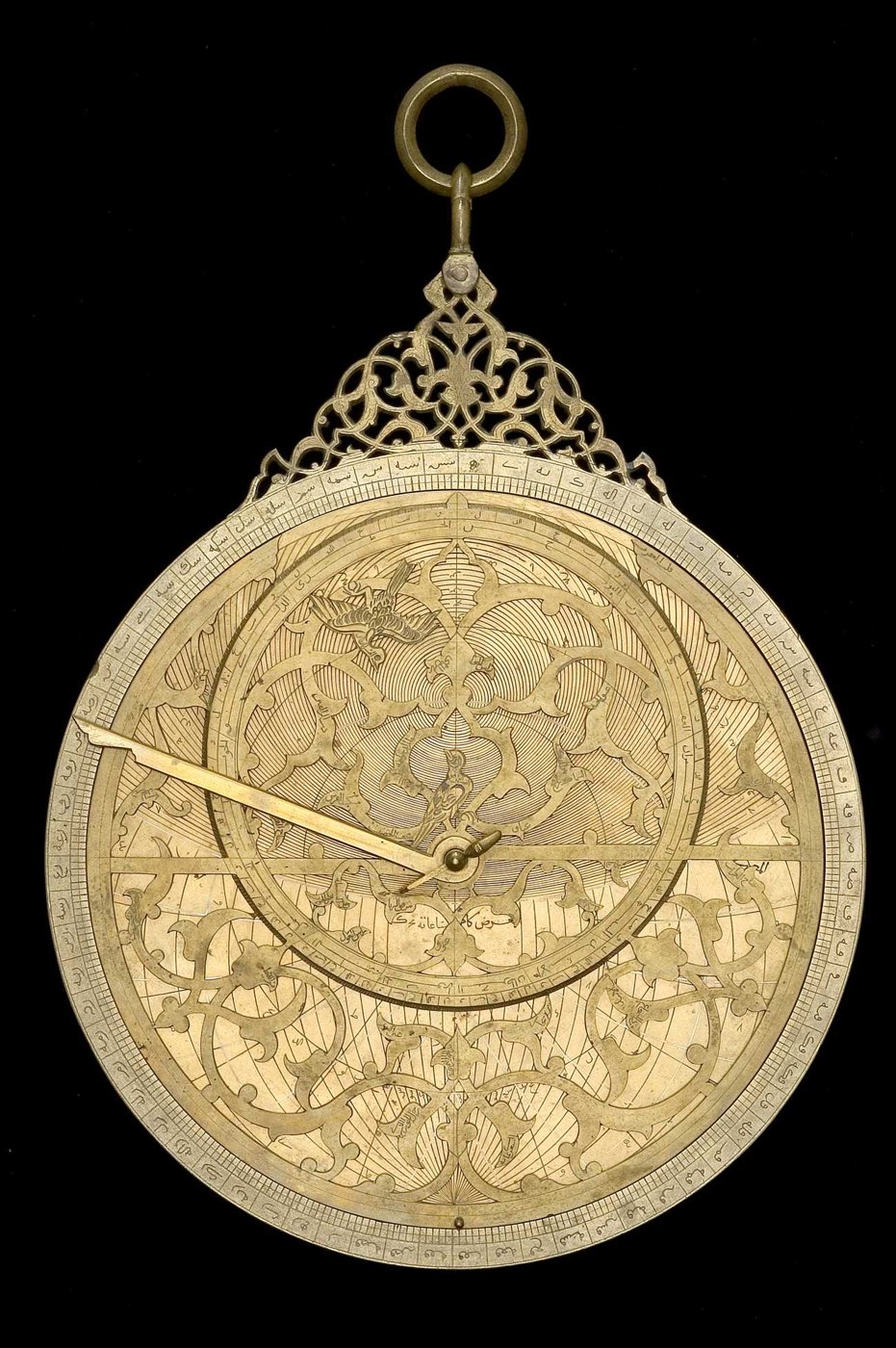
This brass astrolabe is attributed to the maker Allāh-Dād, produced in Lahore circa 1570. The instrument features an Indo-Persian pierced throne with an integrated base and a trefoil shackle. The rete, attached by a round-headed pin and an intricately engraved horse, is of the foliate type and incorporates bird-shaped star pointers. It includes six plates with latitude ranges from 21° to 66°. The mater and limb are constructed as a single piece. The back contains 11 distinct scales including altitude, sine/cosine, declination, cotangent, and shadow squares, alongside astrological markers for faces and triplicities. The object is completed by an original double-ended alidade and a single-ended replacement pointer. Acquired by the History of Science Museum in 1957, the piece was previously held in the Charles Chadenat collection and auctioned in Paris in 1956.

Front view of the astrolabe showing the pierced throne, the rete with zoomorphic pointers, and the rule.
Front view of the astrolabe showing the pierced throne, the rete with zoomorphic pointers, and the rule. — History of Science Museum, University of Oxford. Rights pending — permission not yet requested. Original source

Catalogue identity

Source
www.mhs.ox.ac.uk
Category
Tool · Arabic-inscribed astrolabe, Indian subcontinent
Maker / attribution
Allāh-Dād
Reference
Not recorded
Catalogue / lot identifier
47376
Source-reported date
ca. 1570
Source-reported place
Lahore

Source-reported attribution and specifications are not independent authentication. A listing does not establish present ownership, current display, availability or permission to reproduce.

Object description

Structural Design and Components

The astrolabe is constructed primarily of brass, featuring a mater and limb formed as a single-piece component. The throne is of an Indo-Persian, pierced design, mounted on an integrated base, and supports a heavy trefoil-shaped shackle and a ring with a squared cross-section. The rete follows a foliate style, lacking designated stars but containing zoomorphic engravings of birds that function as pointers.

The assembly is secured by a round-headed pin and a life-like, engraved horse. There are six plates present with latitude coverage spanning 21° to 66°. The alidade is an original, double-ended instrument with a right-hand sight angled toward the center and a scale marked along the upper edge of the right arm. A single-ended replacement pointer is also present.

Evidence for this section
  • “The throne is of the indo-persian, pierced type made of brass attached with integrated base made of brass and has a simple, squared cross-section ring made of brass”
  • “The mater and limb are of one-piece construction.”
  • “The rete contains zoomorphs: two star pointers (النسر الواقع and النسر الطاير) are indicated by the figures of birds.”
  • “Double-ended. The right-hand sight is bent toward the center.”

Scales and Instrumentation

The instrument’s functionality is defined by a comprehensive series of scales located on the limb and the back. The limb features a circular, concentric degree scale marked at five-degree intervals. The back contains eleven scales, including circular altitude scales, sine and cosine measurements, declination arcs, and cotangent scales marked in fingers and feet.

The shadow square is positioned in the lower quadrants and is divided into segments measuring fingers and feet. Additionally, the instrument contains interior boxes designated for astrological data, specifically faces and triplicities, and a gazetteer within the womb of the instrument.

Evidence for this section
  • “The back contains 11 scales of the following types: Altitude; Sine/Cosine; Declination; Cotangent; Shadow square; Faces; Triplicities.”
  • “Scales on the limb: degree scale.”
  • “e Womb Contains a gazeteer.”

Provenance and Documentation

The astrolabe is identified by inventory number 47376 and was acquired by the History of Science Museum in 1957. The object was donated by J. A. Billmeir. The documented provenance traces the instrument to the Charles Chadenat collection, a Parisian dealer and collector.

It was purchased by Billmeir at an auction sale held at the Hôtel Drouot in Paris on May 24, 1956. No further ownership history is recorded in the provided museum catalogue entries for this specific item.

Evidence for this section
  • “Presented by J. A. Billmeir in 1957”
  • “Billmeir bought it at the auction sale of the Chadenat collection at the Hotel Drouot, Paris, on 24 May 1956.”

Open research questions

  • What is the historical significance of the specific bird species depicted on the rete pointers?
  • Does the replacement pointer utilize the same metal alloy as the original components?

Source evidence

Recorded claims and source quotations for Astrolabe by Allāh-Dād
FieldSource-reported valueSource quotation
MakerAllāh-Dād“Maker Allāh-Dād”
PlaceLahore“Place Lahore”
Dateca. 1570“Date ca. 1570”
MaterialBrass“Material Brass”
Inventory number47376“Inventory no. 47376”
AcquisitionPresented by J. A. Billmeir in 1957“Presented by J. A. Billmeir in 1957”
ProvenanceCharles Chadenat collection, Hotel Drouot, Paris, 1956“Billmeir bought it at the auction sale of the Chadenat collection at the Hotel Drouot, Paris, on 24 May 1956.”
Rete styleFoliate“The rete is of the foliate (single knob) type.”

Visible details

  • Foliate rete with zoomorphic bird-shaped star pointers
  • Pierced Indo-Persian throne with integrated base
  • Double-ended original alidade with bent right-hand sight
  • Replacement single-ended pointer

Research qualifications

  • The rule is a replacement part
  • Exact astrological scale readings and specific star identities require further verification

Photograph identity and source facts were screened before import; rights clearance remains pending.

Consulted source

Astrolabe, inventory 47376 (Lahore, ca. 1570)

Reviewed 2026-10-26 · Record 415c11eba4

Terms in this record

Glossary explanations for terms named in this object’s record.