
Skip to content
The Encyclopedia of Horology

Tool · Arabic-inscribed astrolabe, Indian subcontinent

Astrolabe by Muḥammad Ṣāliḥ Tatawī

Partially verified

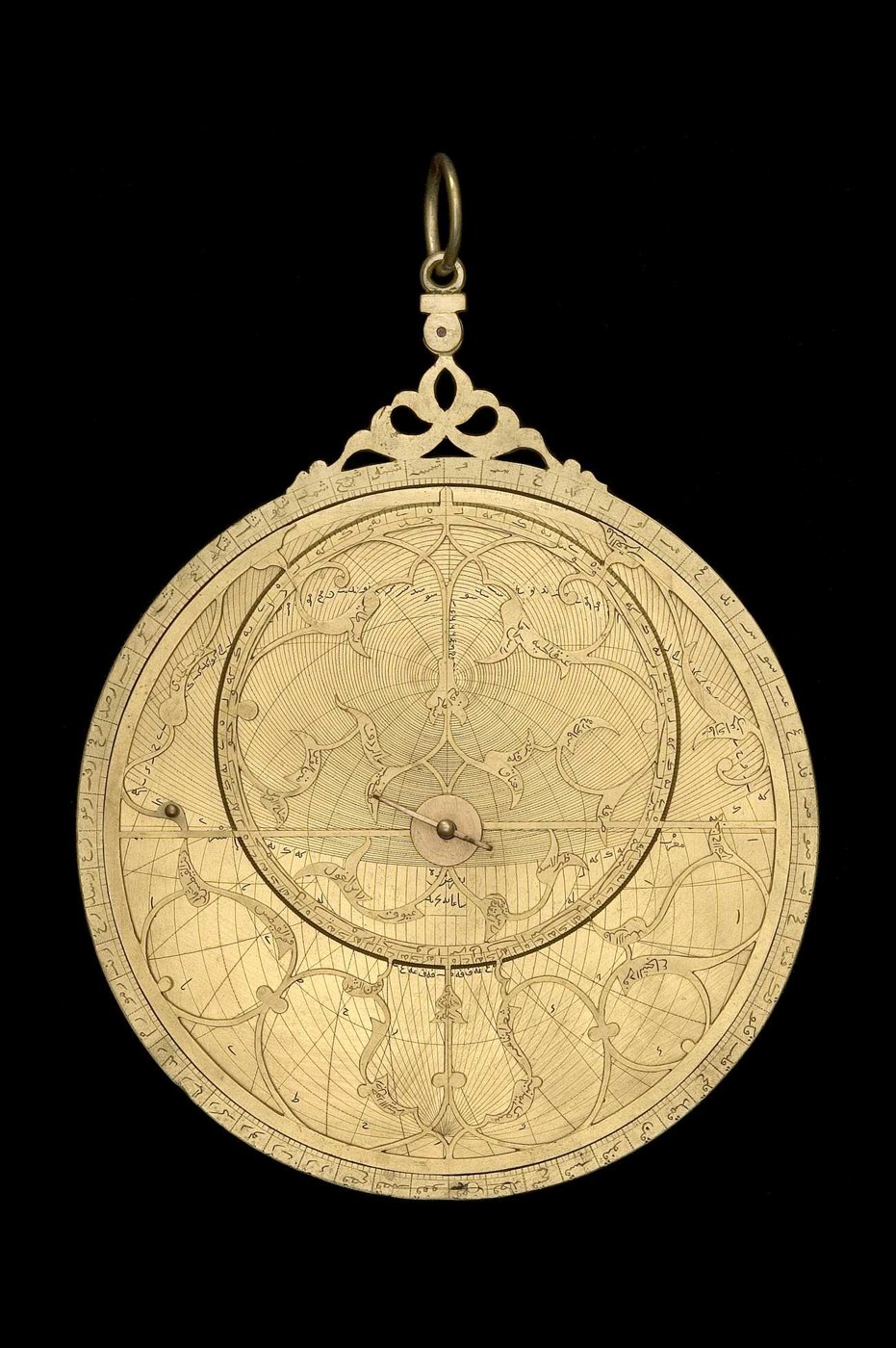
This brass astrolabe, designated inventory number 33474, was crafted by Muḥammad Ṣāliḥ Tatawī in the year 1077 AH (1666/7 AD). The instrument features a pierced, Indo-Persian style throne with an integrated base and a round-section ring. Its construction includes a one-piece mater and limb, with the latter inscribed with the maker’s signature and date. The womb of the mater contains a gazetteer with coordinates for 133 cities. The device is equipped with six plates covering latitudes from 18° to 66°, and a foliate-type rete. The back of the instrument hosts 12 distinct scales, including altitude, declination, unequal hours, and a shadow square. The alidade is double-ended and rigid. The object was presented to the museum by J. A. Billmeir in 1957, following its acquisition at the 1956 Chadenat collection sale in Paris.

Full view of the astrolabe including the rete, limb, and throne assembly.
Full view of the astrolabe including the rete, limb, and throne assembly. — History of Science Museum, University of Oxford. Rights pending — permission not yet requested. Original source

Catalogue identity

Source
www.mhs.ox.ac.uk
Category
Tool · Arabic-inscribed astrolabe, Indian subcontinent
Maker / attribution
Muḥammad Ṣāliḥ Tatawī
Reference
Not recorded
Catalogue / lot identifier
1957-84/164
Source-reported date
1666/7
Source-reported place
Tatta
Source-reported serial
33474

Source-reported attribution and specifications are not independent authentication. A listing does not establish present ownership, current display, availability or permission to reproduce.

Object description

Construction and Design

The astrolabe is fabricated from brass and utilizes a one-piece construction for the mater and limb. It features a pierced throne of the Indo-Persian type, which is attached to an integrated base. A plain, round-section ring is connected to the throne via an eye-bolt shackle that pivots on a pin. The tab designed to secure the tympans is positioned at the base of the instrument, exactly 180 degrees from the throne.

The front of the instrument displays a foliate, single-knob rete, which is attached using a pin and wedge mechanism with a thick washer between the horse and the rete. Six interchangeable plates are included, facilitating measurements across a latitude range of 18 degrees to 66 degrees. A double-ended alidade serves as the primary sighting tool on the back, featuring a rigid construction without pinholes or notches.

Evidence for this section
  • “The throne is of the indo-persian, pierced type made of brass”
  • “The mater and limb are of one-piece construction”
  • “The rete is of the foliate (single knob) type”

Inscriptions and Gazetteer

A significant component of this instrument is the gazetteer engraved within the womb of the mater. This feature consists of three concentric circular tables detailing the coordinates for 133 cities throughout the Muslim world, providing both longitude and latitude for each location.

The maker's signature is located on the limb and reads "The work of Muḥammad Ṣāliḥ Tatawi, year 777." The authenticity of this date is considered questionable by researchers, who interpret the characters as an intended reading of 1077 AH (1666/7 AD). This revised dating has become the accepted chronological marker for the object.

Evidence for this section
  • “One remarkable feature of this astrolabe in the extensive gazeteer engraved in the womb of the mater.”
  • “The limb is inscribed: with a maker's signature marked as عمل محمد صالح تتوى سنه ٧٧٧ (The work of Muḥammad Ṣāliḥ Tatawi, year 777).”
  • “The date on this inscription is almost certainly a mistake. One suggestion is that it should read ١٠٧٧ (1077), which has been accepted as the correct year.”

Provenance and History

The object was acquired by the History of Science Museum in Oxford following a donation from J. A. Billmeir in 1957. Official records assign the accession number 1957-84/164 to the item.

Prior to its arrival in the museum, the astrolabe was part of the Chadenat collection in Paris. It was sold at the Hôtel Drouot in Paris on 24 May 1956, where it was purchased by Charles Chadenat, a known collector and dealer who had previously held the object in his collection.

Evidence for this section
  • “Presented by J. A. Billmeir in 1957”
  • “Billmeir bought it at the auction sale of the Chadenat collection at the Hotel Drouot, Paris, on 24 May 1956.”

Open research questions

  • What is the specific historical relationship between the maker Muḥammad Ṣāliḥ Tatawī and the city of Tatta in the 17th century?
  • Could the gazetteer data be correlated with specific contemporary travel logs to determine the instrument's intended geographic use?

Source evidence

Recorded claims and source quotations for Astrolabe by Muḥammad Ṣāliḥ Tatawī
FieldSource-reported valueSource quotation
MakerMuḥammad Ṣāliḥ Tatawī“عمل محمد صالح تتوى سنه ٧٧٧”
Date1666/7“1666/7”
Inventory Number33474“Inventory number: 33474”
MaterialBrass“Material Brass”
ProvenancePresented by J. A. Billmeir in 1957“Presented by J. A. Billmeir in 1957”
Gazetteer Size133 towns“longitudes and latitudes of no less than 133 towns”
Limb Scales0 - 360 Degrees“0 - 360 Degrees”

Visible details

  • Pierced Indo-Persian throne design
  • Engraved gazetteer in the womb containing 133 cities
  • Double-ended alidade with linear scales
  • Rete features foliate-style pointers

Research qualifications

  • The year 777 inscribed on the instrument is widely considered an error for 1077
  • The precise identification of all city gazetteer entries remains subject to historical analysis

Photograph identity and source facts were screened before import; rights clearance remains pending.

Consulted source

Astrolabe, inventory 33474 (Tatta, 1666/7)

Reviewed 2026-10-26 · Record 704bd79fdf

Terms in this record

Glossary explanations for terms named in this object’s record.