
Skip to content
The Encyclopedia of Horology

Tool · Arabic-inscribed astrolabe, Indian subcontinent

Astrolabe by Muḥammad Muqīm

Partially verified

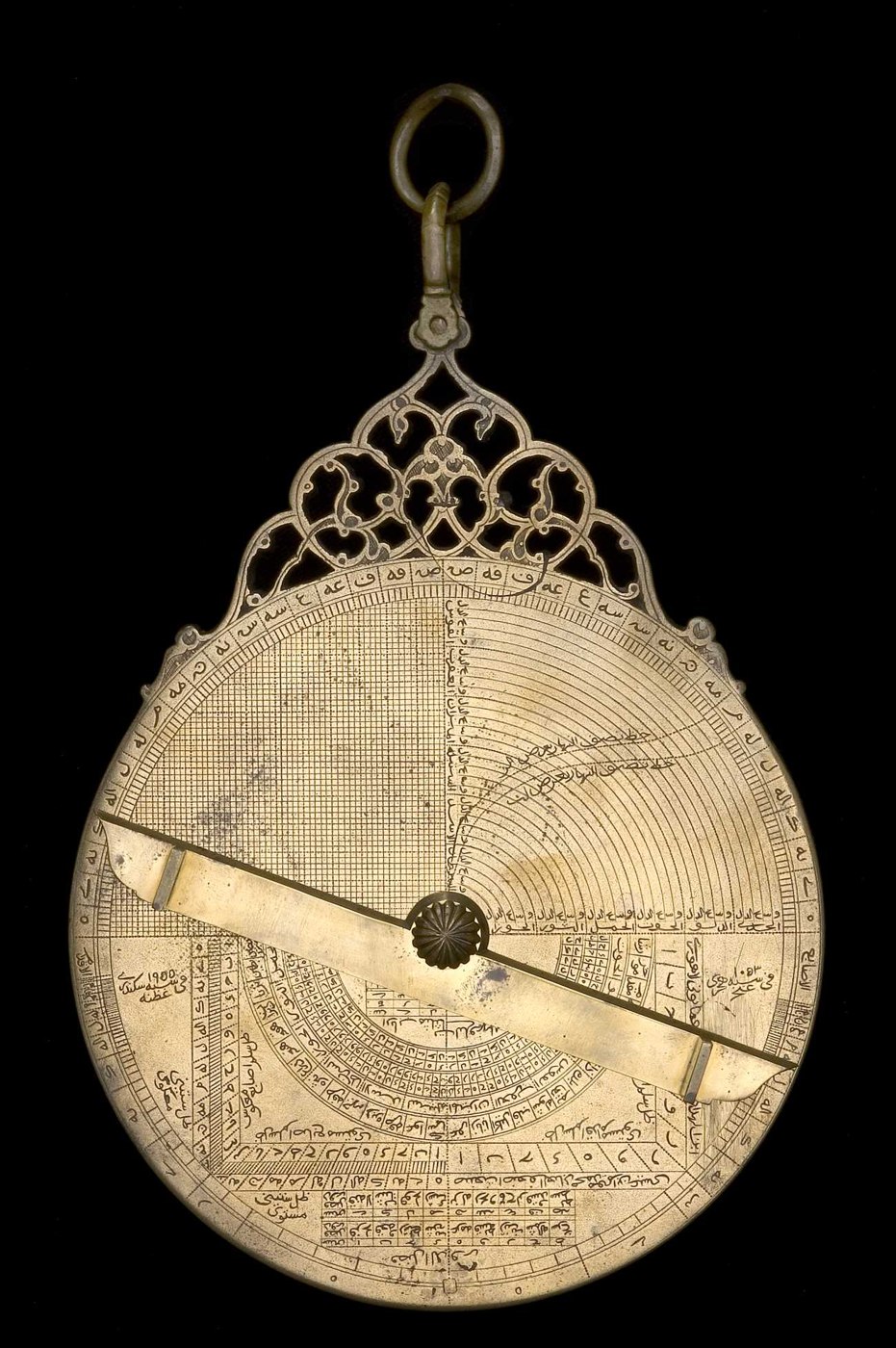
This brass astrolabe is signed by the maker Muḥammad Muqīm of Lahore and dated to 1643/4 (A.H. 1053). The mater and limb are constructed in one piece, with the limb featuring a degree scale graduated every 5 degrees. The back displays 15 different scales, including altitude, declination, prayer lines, sine/cosine, cotangents, a shadow square, lunar mansions, zodiacal signs, terms, faces, and triplicities. The instrument includes 5 plates for latitudes ranging from 22°0' to 66°0'. The current double-ended alidade is a replacement. Additional inscriptions on the back reflect later dates of 1806/7 and a year of Alexander.

Back view of the astrolabe showing the alidade, shadow square, and various inscribed scales.
Back view of the astrolabe showing the alidade, shadow square, and various inscribed scales. — History of Science Museum, University of Oxford. Rights pending — permission not yet requested. Original source

Catalogue identity

Source
www.mhs.ox.ac.uk
Category
Tool · Arabic-inscribed astrolabe, Indian subcontinent
Maker / attribution
Muḥammad Muqīm
Reference
43704
Catalogue / lot identifier
1924-0/2009
Source-reported date
1643/4
Source-reported place
Lahore

Source-reported attribution and specifications are not independent authentication. A listing does not establish present ownership, current display, availability or permission to reproduce.

Object description

Construction and Mater

The astrolabe is constructed primarily of brass and follows a traditional Indo-Persian form. The mater and the limb are made of one-piece construction, providing a robust base for the remaining components. A positioning tab is located at the base of the instrument, 180 degrees from the throne, to hold the tympans in place. The limb features a circular, concentric degree scale ranging from 0 to 360, with markings provided at 5-degree intervals.

It features a trefoil design that serves as the mounting point for the omega-shaped shackle. This shackle is embellished with engraved bands and connects to the throne using decorative tabs, while the suspension ring is a simple round rod.

Evidence for this section
  • “The mater and limb are of one-piece construction.”
  • “The throne is of the indo-persian, pierced type made of brass attached with integrated base”
  • “Shackle of the omega type (i.e. Ω-shaped shackle).”

The Back and Inscriptions

The reverse side of the instrument acts as a complex calculation tool containing 15 distinct scales. These include standardized sets for altitude (marked in the upper quadrants), sine/cosine, cotangents, and a central shadow square. Additional astronomical and astrological data are represented through scales for lunar mansions, zodiacal signs, planetary terms, faces, and triplicities arranged in concentric circular patterns.

The back is also the site of the maker’s signature, which identifies the creator as the 'weakest of servants' Qāʾim Muḥammad ibn ʿĪsā ibn Allāhdād of Lahore. Beside the maker's mark are several dated inscriptions added in different hands. These include the original date of 1053 Hijri, a later notation for the year 1221, and a reference to the year of Alexander (1955), which are provided in both modern Arabic numerals and abdjad numerical notation.

Evidence for this section
  • “The back contains 15 scales of the following types”
  • “The back is inscribed: with a maker's signature marked as صنعت أضعف العباد محمد مقيم ابن عيسى ابن الهداد اسطرلابي همايوني لاهوري”
  • “The year is written twice, once in modern Arabic numerals and once in abdjad numbers.”

Rete and Accessories

The rete is designed in the foliate style, consisting of a network of foliage-patterned metalwork that rotates within the mater. It is noteworthy for currently lacking star pointers. The zodiac is marked on the rete using standard Arabic script labels. The central assembly includes a pin with a radially-engraved head and a horse, the latter of which is considered a replacement component rather than part of the original instrument.

The set includes five interchangeable plates covering latitudes from 22 to 66 degrees. A double-ended alidade is provided to span the back of the astrolabe for observation, although this piece is a replacement for the original. The provenance record indicates that the instrument was acquired in 1909 at a sale in Carpenden Park before being presented to the museum by Lewis Evans in 1924.

Evidence for this section
  • “The rete is of the foliate (single knob) type.”
  • “The horse is rather simple in design and probably not original.”
  • “The rule is not original.”
  • “Evans bought it at a sale at Carpenden Park, Bushey, Hertfordshire, in July 1909.”

Open research questions

  • What is the significance of the 1806/7 inscription regarding the change of ownership?
  • Could the absence of star pointers on the rete be a deliberate omission or a later modification?

Source evidence

Recorded claims and source quotations for Astrolabe by Muḥammad Muqīm
FieldSource-reported valueSource quotation
MakerMuḥammad Muqīm“Maker Muḥammad Muqīm”
Date1643/4“Date 1643/4 (A.H. 1053)”
Place of manufactureLahore“Place Lahore”
MaterialBrass“Material Brass”
Inventory Number43704“Inventory no. 43704”
Accession Number1924-0/2009“Accession 1924-0/2009”
Throne typeIndo-Persian, pierced“The throne is of the indo-persian, pierced type”
Plates5 plates“There are 5 plates”

Visible details

  • The back bears multiple inscriptions added in different hands, including dates in Arabic numerals and abdjad numbers.
  • The alidade is a straight, double-ended replacement.
  • The shadow square is divided for fingers and feet.

Research qualifications

  • The horse attaching the rete is noted as likely not being original.
  • The alidade is explicitly identified as a replacement.
  • The precise authorship of the later date inscriptions is unknown.

Photograph identity and source facts were screened before import; rights clearance remains pending.

Consulted source

Astrolabe, inventory 43704 (Lahore, 1643/4 (A.H. 1053))

Reviewed 2026-10-26 · Record cd27b63570

Terms in this record

Glossary explanations for terms named in this object’s record.