
Skip to content
The Encyclopedia of Horology

Tool · English astrolabe

Astrolabe by Blakene

Partially verified

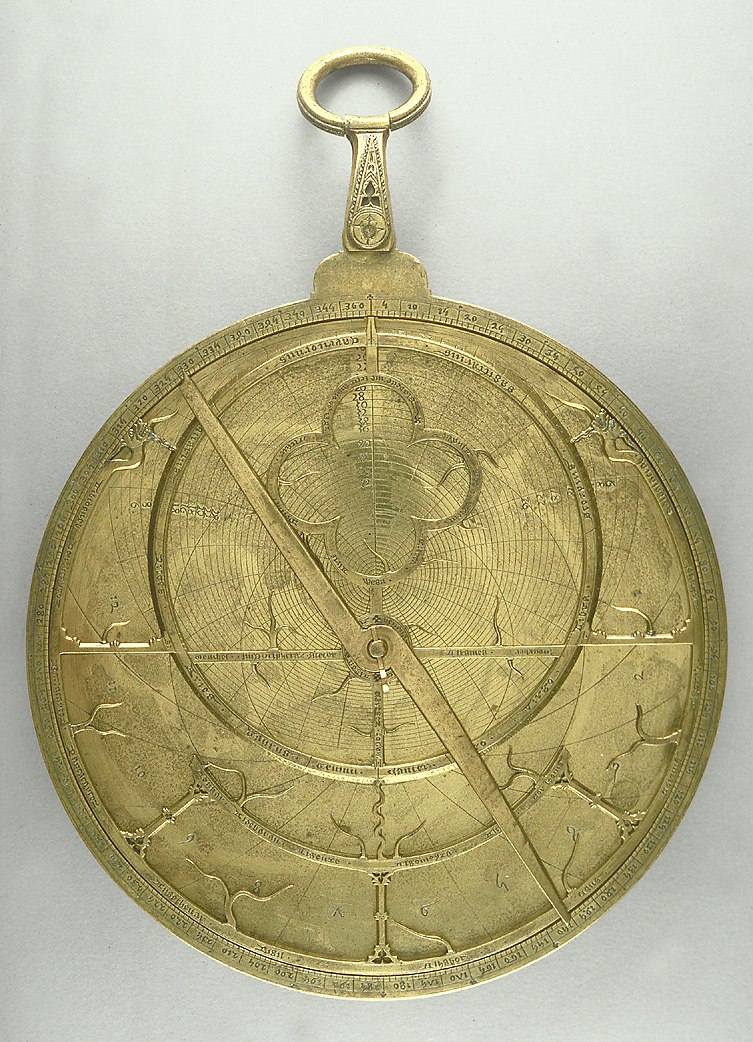
This planispheric astrolabe, crafted from brass and measuring 218 mm in diameter, is signed by its maker, Blakene, and dated 1342. Recognized as the earliest signed and dated European instrument of its type, it features a tri-lobed throne, a long shackle, and a decorated ring. The rete includes a quatrefoil base for star pointers, which is inscribed with the maker's name and date. The central disc is hollowed out into four quadrants with cross-shaped supports. The instrument includes two plates marked for latitude 52 degrees north and other astronomical functions, alongside an alidade with sighting vanes and a ruler. The reverse side features altitude scales, a solar scale, and complex concentric calendrical scales. The instrument was donated to the British Museum in 1853 by Joseph Mayer and is documented in scholarly catalogs regarding historical scientific instruments.

Front view of the 1342 astrolabe by Blakene showing the rete, throne, and graduation.
Front view of the 1342 astrolabe by Blakene showing the rete, throne, and graduation. — © British Museum, London. Rights pending — permission not yet requested. Original source

Catalogue identity

Source
www.mhs.ox.ac.uk
Category
Tool · English astrolabe
Maker / attribution
Blakene
Reference
MLA 1853,11-4.1
Catalogue / lot identifier
MLA 1853,11-4.1
Source-reported date
1342
Source-reported place
England

Source-reported attribution and specifications are not independent authentication. A listing does not establish present ownership, current display, availability or permission to reproduce.

Object description

Construction and Design

The astrolabe is a brass circular instrument measuring 218 mm in diameter. It possesses a tri-lobed throne integrated with a decorated long shackle and a suspension ring. The mater, the main body of the instrument, features a double-line decoration around its perimeter and is graduated in degrees clockwise. The internal central disc structure is hollowed into four quadrants, supported by a cross-shaped element connecting the inner and outer rings.

The rete is characterized by a central quatrefoil that supports various star pointers and bears the maker's signature and the year of manufacture. The equatorial bar is connected to the tropic of Capricorn via three stylized columns, and each end of the tropic of Capricorn is shaped to resemble a dragon's head. The ecliptic is marked with zodiac signs and graduated for astronomical calculation.

Evidence for this section
  • “The mater with a double-line decoration on the edge is graduated clockwise 0? to 360?”
  • “The throne is tri-lobed, the long shackle and the ring are decorated.”
  • “The equatorial bar, which is counter-changed on each side of the ecliptic, is connected with the tropic of Capricorn by three stylized columns and to the ecliptic by a wavy bar.”
  • “Each end of the tropic of Capricorn is of dragon head shape.”

Plates and Astronomical Functions

The instrument includes two plates providing specific astronomical data. The first plate is configured for a latitude of approximately 52 degrees North, featuring circles for the tropics, the equator, azimuths, and lines representing unequal hours. The second plate provides circles for the tropics and the equator but is otherwise blank on one side, with lines for the houses in the manner of Regiomontanus on the other.

The reverse side of the instrument provides a comprehensive set of scales for solar and calendrical tracking. It incorporates four altitude scales, a solar scale inscribed with zodiac names, and multiple concentric bands for tracking solar cycles, day letters, and dominical letters. A pair of shadow scales is located in the lower half of the reverse.

Evidence for this section
  • “The two plates are marked as follows: 1a) laid out and marked for latitude 52? N”
  • “is engraved with four altitude scales starting at the top clockwise 90? to 0?”
  • “In the middle is a concentric calendrical scale consisting of four bands”
  • “In the lower half is a pair of shadow scales, each divided to 12 digits, numbered by 2.”

Signature and Documentation

The instrument is significant for being the earliest known signed and dated European scientific instrument. The maker is identified only by the name Blakene, as no further biographical information is available. The signature and date are clearly inscribed on the top lobe of the quatrefoil located on the rete.

The item's provenance is tied to its 1853 donation by Joseph Mayer. It has been examined in multiple historical studies of scientific instruments, including works by R. T. Gunther and F. A. B. Ward, which detail its technical specifications and physical composition as held in the British Museum collection.

Evidence for this section
  • “This is the earliest signed and dated European instrument, though its maker Blakene is otherwise unknown.”
  • “The quatrefoil is inscribed the name of the maker and the date in the top lobe: 'Blakene me fecit anno do{mini} 1342'.”
  • “The instrument was donated in 1853 by Joseph Mayer and is described in W. H. Morley”
  • “F. A. B. Ward, A Catalogue of European Scientific Instruments in the Department of Medieval and Later Antiquities of the British Museum (London, 1981), p. 113, no. 326 (with plate LII).”

Open research questions

  • What is the specific astronomical function of the small numeric sequence '3, 6, 8, 9, 8' found on the edge of the mater?
  • Are there contemporary European astrolabes with similar design motifs that might provide context for the 'Blakene' workshop identity?

Source evidence

Recorded claims and source quotations for Astrolabe by Blakene
FieldSource-reported valueSource quotation
MakerBlakene“Signed by Blakene”
Date1342“Dated 1342”
Diameter218 mm“218 mm in diameter”
Accession numberMLA 1853,11-4.1“Registration no. MLA 1853,11-4.1”
Star count38“indicate the following 38 stars”
Maker inscriptionBlakene me fecit anno domini 1342“'Blakene me fecit anno do{mini} 1342'”

Visible details

  • Tri-lobed throne construction with decorated shackle
  • Dragon head-shaped terminations on the tropic of Capricorn
  • Engraved inscriptions for thirty-eight individual stars
  • Concentric calendrical scales on the instrument reverse

Research qualifications

  • Purpose of the small numerals '3, 6, 8, 9, 8' on the edge remains uncertain
  • Originality of the wedge, which is noted as a replacement

Photograph identity and source facts were screened before import; rights clearance remains pending.

Consulted source

Astrolabe

Reviewed 2026-10-26 · Record ffae083b99

Terms in this record

Glossary explanations for terms named in this object’s record.