
Skip to content
The Encyclopedia of Horology

Tool · English astrolabe

Mathematical Jewel Astrolabe by Charles Whitwell

Partially verified

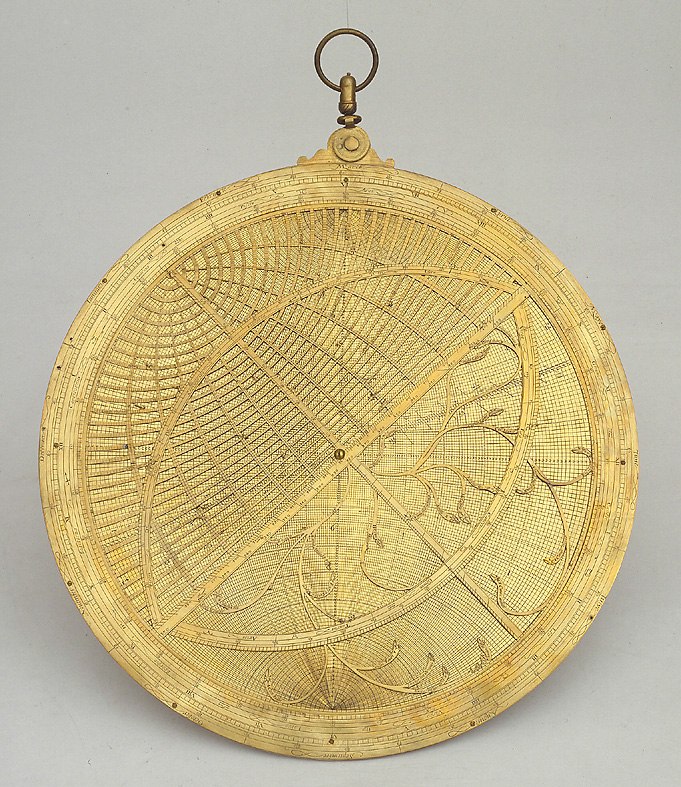
This 388 mm diameter brass astrolabe is a construction based on the 'Mathematical Jewel' design published by John Blagrave in 1585. Signed by Charles Whitwell and dated 1595, the instrument utilizes a universal projection of the saphea type. The mater contains lines for right ascension and declination, an ecliptic line, and hour lines numbered 1 to 12. Its rete design is divided into two distinct halves: one side features a skeletal grid of meridians and parallels combined with a southern ecliptic arc, while the other side displays star pointers and the northern ecliptic. The limb includes a zodiacal calendar with English month names and degree scales. The instrument was formerly in the collection of Sir Robert Dudley, who bequeathed it to the Grand Duke of Tuscany. It is currently held by the Istituto e Museo di Storia della Scienza in Florence.

Front view of the Mathematical Jewel astrolabe showing the rete grid and zodiacal scale.
Front view of the Mathematical Jewel astrolabe showing the rete grid and zodiacal scale. — Istituto e Museo di Storia della Scienza, Firenze. Rights pending — permission not yet requested. Original source

Catalogue identity

Source
www.mhs.ox.ac.uk
Category
Tool · English astrolabe
Maker / attribution
Charles Whitwell
Reference
Not recorded
Catalogue / lot identifier
1095
Source-reported date
1595
Source-reported place
England

Source-reported attribution and specifications are not independent authentication. A listing does not establish present ownership, current display, availability or permission to reproduce.

Object description

Construction and Design

The astrolabe is constructed from brass and measures 388 mm in diameter. It is designed according to the 'Mathematical Jewel' principles described by John Blagrave in 1585, utilizing a universal projection of the saphea type within the mater. The limb is secured by a series of screws and features a suspension system consisting of a throne, shackle, and ring.

The limb incorporates a zodiacal calendar with an outer scale of dates, with months named in English. The degree scales on the limb are divided to 10, 5, and 1 units, allowing for precise measurement. Inside the mater are lines for every degree of right ascension and declination, with hour lines numbered 1 to 12 and 12 to 1.

Evidence for this section
  • “This astrolabe is of the type describes by John Blagrave as his 'Mathematical Jewel'.”
  • “The limb is secured to the plate by a series of screws, the plate has a simple throne, a shackle and suspension ring.”
  • “Inside the mater is a universal projection of the saphea type, with lines for every degree of right ascension and declination”

Rete Configuration

The rete is characterized by a distinctive split design. One half contains a skeletal grid of meridians and parallels based on the universal projection, accompanied by an arc representing the southern half of the ecliptic. This section includes a zodiacal scale and a meridian bar marked with degrees.

The opposing half of the rete contains pointers for named stars and the corresponding northern half of the ecliptic. A diametric bar connects the two halves, featuring a degree scale radiating from the center. The edge of the rete also includes a degree scale, which is numbered specifically on the side containing the grid.

Evidence for this section
  • “it combines this with a distinctive rete divided into two halves: a stereographic grid and the more familiar rete form with star pointers and an ecliptic semicircle.”
  • “A meridian bar has a scale of degrees, divided to 5, subdivided to 1, numbered only on the half containing the grid, 0 to 90 by 10.”
  • “The other half of the rete has pointers for named stars and the corresponding northern half of the ecliptic.”

Signature and Provenance

The instrument is signed 'Charolus Whitwell fecit 1595' on the verso, which remains incomplete. The verso also contains an altitude scale along the edge. The engraving style is associated with the navigation function of the device, intended for locating stars and reference points when specific latitude coordinates are not known.

The provenance of the astrolabe is linked to Sir Robert Dudley, who transported a group of objects from England. These items were subsequently bequeathed to the Grand Duke of Tuscany. The instrument is now housed in the collection of the Istituto e Museo di Storia della Scienza in Florence.

Evidence for this section
  • “The verso is incomplete, includes an altitude scale on the edge, and is signed: '[star] Charolus Whitwell fecit 1595 [star]'.”
  • “The type of engraving allows the use of the instrument in navigation, for finding stars and reference points when latitude co-ordinates are unknown.”
  • “The astrolabe belonged to the group of objects brought by Sir Robert Dudley from England, which he later bequeathed to the Grand Duke of Tuscany.”

Open research questions

  • What is the nature of the missing components that render the verso incomplete?
  • How does the actual usage of this specific universal projection compare to standard astrolabe projections in 16th-century English navigation?

Source evidence

Recorded claims and source quotations for Mathematical Jewel Astrolabe by Charles Whitwell
FieldSource-reported valueSource quotation
MakerCharles Whitwell“Signed by Charles Whitwell”
Date1595“Dated 1595”
MaterialBrass“Brass; 388 mm in diameter”
OriginEnglish“English”
Inventory Number1095“Inventory number: 1095”
Design sourceJohn Blagrave“This astrolabe is of the type describes by John Blagrave as his 'Mathematical Jewel'.”
ProvenanceSir Robert Dudley“The astrolabe belonged to the group of objects brought by Sir Robert Dudley from England, which he later bequeathed to the Grand Duke of Tuscany.”

Visible details

  • The limb features a zodiacal calendar with English month names
  • The rete is split between a stereographic grid and traditional star pointers
  • The suspension assembly includes a throne, shackle, and ring
  • The instrument is signed on the verso as 'Charolus Whitwell fecit 1595'

Research qualifications

  • The verso of the instrument is described as incomplete
  • The intended primary function for navigation is inferred from the type of engraving

Photograph identity and source facts were screened before import; rights clearance remains pending.

Consulted source

Astrolabe

Reviewed 2026-10-26 · Record 439fcdec17

Terms in this record

Glossary explanations for terms named in this object’s record.