
Skip to content
The Encyclopedia of Horology

Tool · English astrolabe

Humfrey Cole Astrolabe

Partially verified

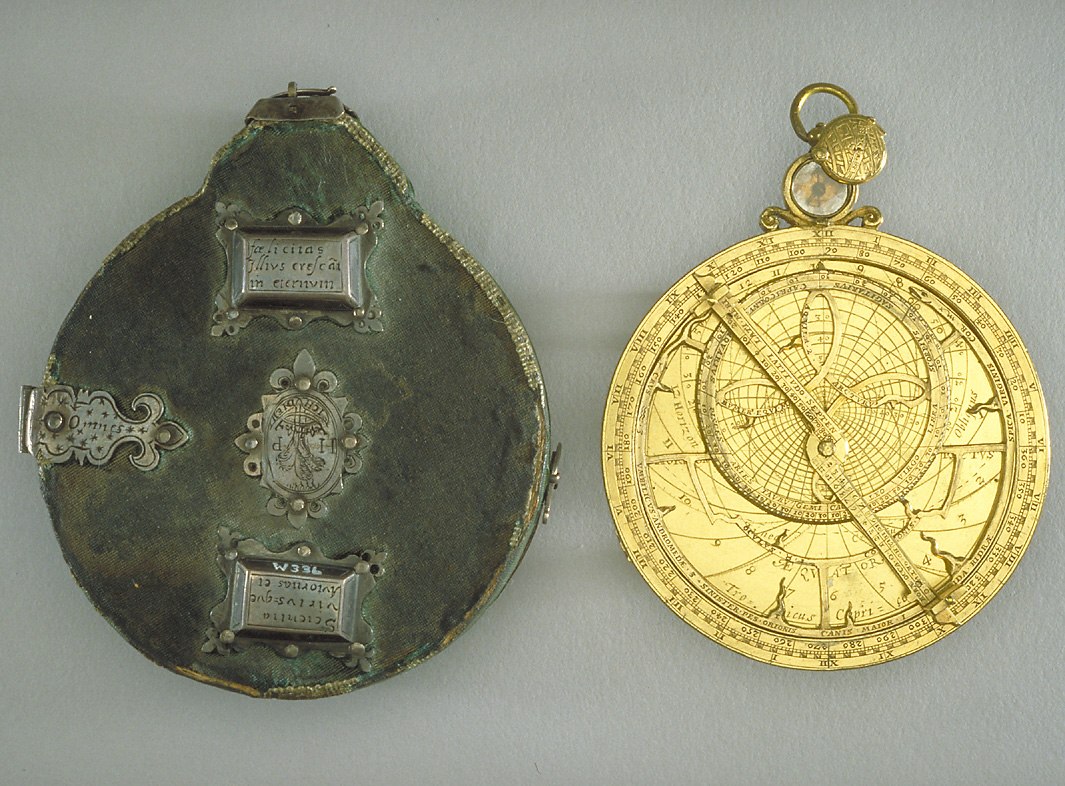
This gilt brass astrolabe, measuring 88 mm in diameter, is signed by the maker Humfrey Cole and dated 1574. Constructed in London, the instrument features a rete with flame-shaped star pointers and a circle for the tropic of Capricorn terminating in the head and tail of a dragon. The mater is engraved with a Quadratum Nauticum and a compass diagram, while the back displays Gemma Frisius' universal projection. It includes four plates, one of which is blank, alongside a unique pincer-like alidade mechanism. The astrolabe incorporates various scales for astronomical calculations, including equal and unequal hour conversion and star positions identified by magnitude.

Gilt brass astrolabe signed by Humfrey Cole (1574) alongside its 19th-century green velvet carrying case.
Gilt brass astrolabe signed by Humfrey Cole (1574) alongside its 19th-century green velvet carrying case. — British Museum, London. Rights pending — permission not yet requested. Original source

Catalogue identity

Source
www.mhs.ox.ac.uk
Category
Tool · English astrolabe
Maker / attribution
Humfrey Cole
Reference
MLA 1855,12-1.223
Catalogue / lot identifier
MLA 1855,12-1.223
Source-reported date
1574
Source-reported place
England

Source-reported attribution and specifications are not independent authentication. A listing does not establish present ownership, current display, availability or permission to reproduce.

Object description

Construction and Design

The astrolabe is crafted from gilt brass with a diameter of 88 mm. The rim of the mater features an equal 24-hour scale on the exterior, while the interior is graduated 0 to 360 degrees anticlockwise. The instrument’s throne is formed by two foliate scrolls and contains an inset compass protected by a movable lid, which is engraved with an armillary sphere.

The rete includes flame-shaped star pointers, with the circle for the tropic of Capricorn terminating in the head and tail of a dragon. The instrument includes four plates, one of which is blank, with the others engraved for various latitudes and the Horizontale Catholicum. The back of the instrument contains calendrical scales and a universal projection as described by Gemma Frisius.

Evidence for this section
  • “Gilt brass; 88 mm in diameter”
  • “The throne consists of two foliate scrolls and an inset compass under a movable lid”
  • “The rete has flame-shaped star pointers. The circle for the tropic of Capricorn ends in the head and tail of a dragon.”

Signatures and Mechanisms

Humfrey Cole signed the instrument as 'Made by Humfrey Cole' on the right-hand side of the square within the mater. The instrument also bears the date 1574. A secondary inscription referring to Henry, Prince of Wales appears at the bottom in a different hand.

The alidade features a unique mechanism designed for removal. It consists of two layers: a solid bar holding the sighting vanes and two pincer-like arms pivoted to the bar. These arms are secured with small studs; raising and turning them allows the alidade to be lifted from the central pin.

Evidence for this section
  • “The instrument is signed 'Made by Humfrey Cole' and dated '1574'”
  • “The alidade itself consits of two layers: a solid bar to which the sighting vanes are fixed and two pincer-like arms which are pivoted to the solid bar in the centre.”

Case and Provenance

The astrolabe is housed in a green velvet-covered case featuring silver hinges and fastenings. The lid is decorated with three silver mounts engraved with Latin phrases and initials.

The item was acquired by the British Museum in 1855 from the Bernal Collection. It has been documented in various horological and scientific literature, including the works of R. T. Gunther and F. A. B. Ward.

Evidence for this section
  • “The fitted case - probably a 19th century addition - is covered with green velvet”
  • “The instrument was acquired in 1855 from the Bernal Collection”

Open research questions

  • Does metallurgical analysis confirm the 16th-century origin of the brass compared to the 19th-century silver mounts?
  • What specific technical purpose did the unique pincer-like alidade mechanism serve for the user?
  • Can the specific hand that added the inscription 'AD Henr{ici} Princ{ipi} Magni Brittan{iae}' be identified or dated more precisely?

Source evidence

Recorded claims and source quotations for Humfrey Cole Astrolabe
FieldSource-reported valueSource quotation
MakerHumfrey Cole“Signed by Humfrey Cole”
Date1574“Dated 1574; London”
MaterialGilt brass“Gilt brass; 88 mm in diameter”
Inventory NumberMLA 1855,12-1.223“Registration no. MLA 1855,12-1.223”
Dimensions88 mm diameter“88 mm in diameter”
Case materialGreen velvet with silver mounts“fitted case - probably a 19th century addition - is covered with green velvet”

Visible details

  • Throne features two foliate scrolls with an inset compass under a movable lid
  • Rete circle for the tropic of Capricorn terminates in a dragon's head and tail
  • Alidade utilizes a pincer-like mechanism pivoted on the central pin
  • Fitted carrying case is covered in green velvet with silver metalwork

Research qualifications

  • Inscriptions on the case relating to Henry, Prince of Wales are considered likely 19th-century additions
  • The fixing screw on the central pin is identified as a replacement
  • The case itself is considered a likely 19th-century addition

Photograph identity and source facts were screened before import; rights clearance remains pending.

Consulted source

Astrolabe

Reviewed 2026-10-26 · Record 2a2c922f18

Terms in this record

Glossary explanations for terms named in this object’s record.