
Skip to content
The Encyclopedia of Horology

Tool · English astrolabe

Thomas Gemini Astrolabe

Partially verified

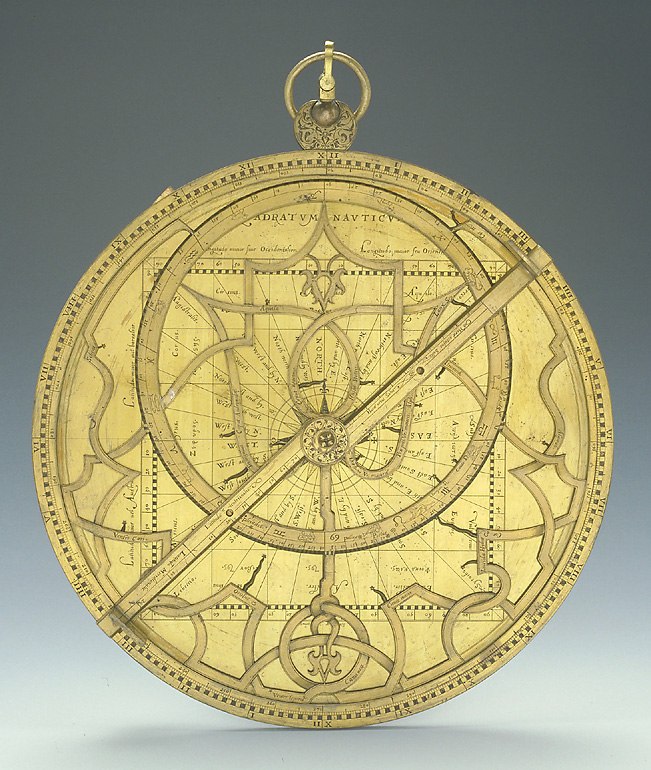
This mid-16th-century brass astrolabe, measuring 355 mm in diameter, is the work of maker Thomas Gemini. It features a mater constructed of three soldered and riveted brass layers, with a central wind rose for 32 directions labeled in English. The interior includes a 'QVADRATVM NAVTICVM' with coordinates marked in Latin. The rete is characterized by 'wavy flame' star pointers and lacks an east-west line. Gemini signed the instrument on the bottom of the shadow square with the inscription 'Thomas II Anno 155', indicating an incomplete date. Historically, the instrument formed part of a bequest from Robert Dudley to Ferdinand II de' Medici, Grand Duke of Tuscany, in 1649. The suspension system utilizes a sphere within a grooved throne, fixed by a pin and nut mechanism rather than a wedge. It serves as a navigational aid, containing markings for astronomical and stellar observation and various mathematical scales.

Front view of the Thomas Gemini astrolabe showing the rete, mater, and navigational markings.
Front view of the Thomas Gemini astrolabe showing the rete, mater, and navigational markings. — Istituto e Museo di Storia della Scienza, Firenze. Rights pending — permission not yet requested. Original source

Catalogue identity

Source
www.mhs.ox.ac.uk
Category
Tool · English astrolabe
Maker / attribution
Thomas Gemini
Reference
Not recorded
Catalogue / lot identifier
1093
Source-reported date
Mid 16th century
Source-reported place
England

Source-reported attribution and specifications are not independent authentication. A listing does not establish present ownership, current display, availability or permission to reproduce.

Object description

Construction and Mater

The astrolabe's mater is composed of three distinct brass layers, which have been soldered and riveted together to form the body of the instrument. The rim features two primary scales: an outer scale of hours, divided into intervals of 1/15 and numbered I to XII twice, and an inner scale of degrees numbered 10 to 360 in increments of 10.

The interior space is dominated by a 'QVADRATVM NAVTICVM' (nautical square). This square is subdivided, with coordinates labeled 'Latitudo maior aut borealior', 'Latitudo minor uel Australior', 'Longitudo minor siue Occidentalior', and 'Longitudo maior seu Orientalior'. A 32-direction wind rose sits at the center, employing English nomenclature for the winds alongside Latin and Greek designations.

Evidence for this section
  • “The mater consists of three layers of brass soldered and riveted together.”
  • “The inside of the mater is engraved with a 'QVADRATVM NAVTICVM'.”
  • “In the centre of the mater is a wind rose for 32 directions, all named in English.”

Rete and Ecliptic

It includes 23 stellar pointers executed in a 'wavy flame' style, each terminating in a small star and labeled in Latin. A tulip-shaped design is positioned within the ecliptic circle, which is engraved with a scale of degrees and the symbols and pictorial representations of the zodiac signs.

A meridian line is present exclusively on the lower portion of the rete, described as being elaborately detailed. Additional star positions are plotted directly onto the ecliptic ring, which features degrees numbered from 5 to 30 in increments of 5.

Evidence for this section
  • “The rete has star pointers of the 'wavy flame' type, with a small star at the end of the pointer, for 23 stars all named in Latin.”
  • “It does not have an east-west line and it is made with the typical overlapping straps, and with a tulip form inside the ecliptic circle.”
  • “The meridian line is only on the lower part of the rete and is richly elaborated.”

Signature and Suspension

The instrument is signed 'Thomas II Anno 155' on the base of the shadow square, signifying the maker, Thomas Gemini. This inscription provides an incomplete date. The throne is circular and adorned with foliate engraving, providing a base for the suspension assembly.

The suspension mechanism is composed of a sphere that fits into a groove located on the throne, connected to a ring via a second ring. Unlike some contemporaneous instruments, this example does not utilize a wedge for securement, opting instead for a pin and nut system.

Evidence for this section
  • “On the bottom of the shadow square is the signature 'Thomas II Anno 155'.”
  • “The throne is circular and engraved with a foliate decoration and the suspension system consists of a sphere fitting in a groove on the throne.”
  • “There is no wedge but a pin and nut system.”

Open research questions

  • What specific historical context led to the use of an incomplete date '155' on this instrument?
  • What is the technical purpose of the two symmetrical screw holes found on the alidade?

Source evidence

Recorded claims and source quotations for Thomas Gemini Astrolabe
FieldSource-reported valueSource quotation
MakerThomas Gemini“Signed by Thomas Gemini”
DateMid 16th century“Mid 16th century”
Inventory Number1093“Inventory number: 1093”
MaterialBrass“Brass; 355 mm in diameter”
SignatureThomas II Anno 155“On the bottom of the shadow square is the signature 'Thomas II Anno 155'.”
ProvenanceRobert Dudley to Ferdinand II de' Medici“The instrument belonged to the bequest left by Robert Dudley to the Grand Duke of Tuscany Ferdinand II de' Medici on his death (1649).”

Visible details

  • Wavy flame style star pointers on the rete
  • Central wind rose with 32 directions
  • Circular throne decorated with foliate engraving
  • Signature 'Thomas II Anno 155' visible on the shadow square

Research qualifications

  • The date inscribed is incomplete, marked only as '155'
  • The function of two symmetrical screw holes on the alidade is not identified

Photograph identity and source facts were screened before import; rights clearance remains pending.

Consulted source

Astrolabe

Reviewed 2026-10-26 · Record 2565901729

Terms in this record

Glossary explanations for terms named in this object’s record.