
Skip to content
The Encyclopedia of Horology

Tool · English astrolabe

Astrolabe

Partially verified

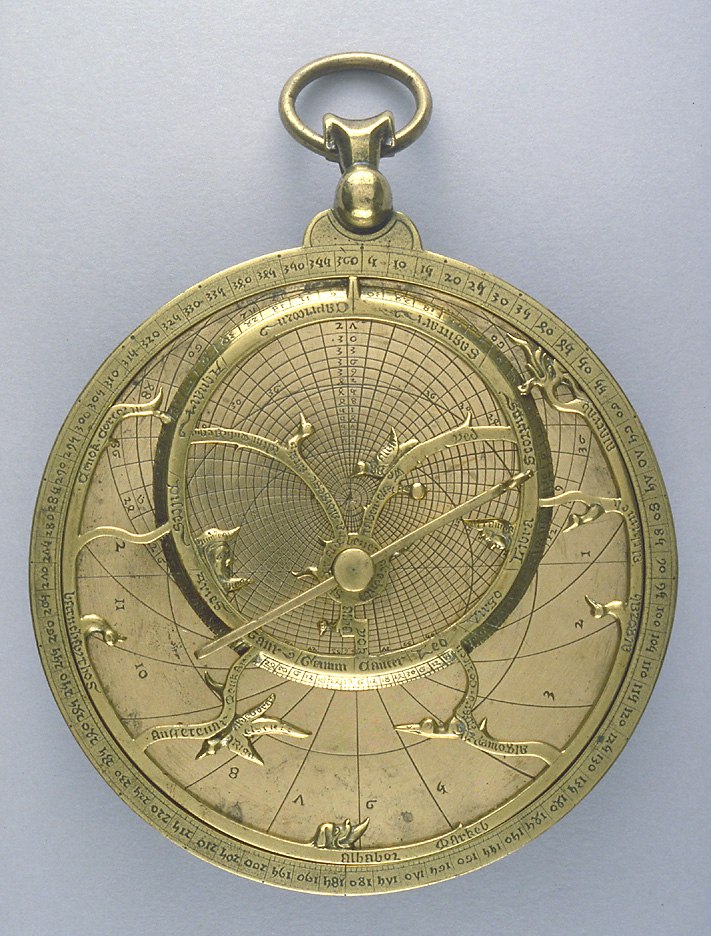
This brass astrolabe, measuring 132 mm in diameter, is dated 1326 and is widely associated with English origins. The mater is cut from a solid block with a crescent-shaped throne and a saddle-shaped shackle. The rete features a Y-shape inside the ecliptic and incorporates 33 star pointers, ten of which are zoomorphic in the form of birds or a dog's head, with two depicted as human heads. The ecliptic displays the Latin names of the zodiacal signs. The reverse includes altitude scales, a circular solar scale, an eccentric calendrical scale, and a list of 46 saints and feasts. The plates are inscribed for various latitudes, including Oxford and Paris. The alidade is counter-changed with two sighting vanes, accompanied by a long wedge featuring a horse head.

Front view of the 1326 brass astrolabe showing the rete, star pointers, and the mater graduation.
Front view of the 1326 brass astrolabe showing the rete, star pointers, and the mater graduation. — British Museum, London. Rights pending — permission not yet requested. Original source

Catalogue identity

Source
www.mhs.ox.ac.uk
Category
Tool · English astrolabe
Maker / attribution
Not established
Reference
Not recorded
Catalogue / lot identifier
MLA 1909,6-17.1
Source-reported date
1326
Source-reported place
England

Source-reported attribution and specifications are not independent authentication. A listing does not establish present ownership, current display, availability or permission to reproduce.

Object description

Construction and Mater

The astrolabe is constructed with a mater cut from a solid brass block. The frame is graduated clockwise from 0 to 360 degrees, with numbering by 5-degree increments and divisions to a single degree. The throne exhibits a crescent shape, complemented by a saddle-shaped shackle.

The circumferential frame of the instrument is decorated with a dragon's head and tail at the respective ends. The interior of the mater is hollowed out, providing the base for the plates and the rete.

Evidence for this section
  • “The mater which is cut from a solid block is graduated clockwise 0? to 360?, numbered by 5? and divided to 1?.”
  • “The throne is crescent shaped and the shackle saddle shaped.”
  • “The circumferential frame has a dragon's head and tail respectively at the ends.”

Rete and Star Pointers

The rete is characterized by a distinctive Y-shape situated within the ecliptic. It contains 33 identified stars, represented by pointers of varying designs. Ten of these star-pointers are zoomorphic, representing birds and a dog's head, while two are rendered as human heads.

The ecliptic circle is marked with Latin names of the zodiacal signs. Each sign is divided into 30 degrees, with numbering occurring every 6 degrees and further subdivisions of 2 degrees.

Evidence for this section
  • “On the rete, with a distinctive Y inside the ecliptic, 33 stars are indicated”
  • “Ten of the star-pointers are zoomorphic (birds and the head of a dog), two are heads of human beings.”
  • “The ecliptic bears the usual Latin names of the zodiacal signs, each sign is divided to 30?, numbered by 6? and divided to 2?.”

Plates and Reverse Markings

The reverse of the instrument features four altitude scales and a circular solar scale marked with Latin names for zodiacal signs. An eccentric calendrical scale is positioned further inside, identifying months and specific feast days or saints. A pair of shadow scales is located in the lower half.

The plates contain markings for almucantars, unequal hours, and the tropics. They are labeled for latitudes corresponding to locations including Jerusalem, Rome, Paris, and Oxford, providing geographical context for the instrument's use.

Evidence for this section
  • “The back bears four altitude scales starting at the top clockwise 90? to 0?”
  • “Inside this scale is a band with the names of 46 saints”
  • “one of the plates is marked for Oxford.”
  • “They are laid out and labelled for the following latitudes ('Latitudo'): 1a) 32? 0' 'Jerlm' (Jerusalem); 1b) 35? 30', 'Babilonie'; 2a) 41? 50', 'Rome'; 2b) 44? 40', 'Motis pessulani' [Montpellier]; 3a) 48? 32', 'parisius'; 3b) 51? 50', 'Oxonie' [Oxford]”

Open research questions

  • What is the specific purpose of the unusual 'prime vertical' markings on the plates?
  • How does the inclusion of the 1326 date and the specific saint list confirm the English provenance beyond the current attribution?

Source evidence

Recorded claims and source quotations for Astrolabe
FieldSource-reported valueSource quotation
Date1326“Dated 1326”
Diameter132 mm“132 mm in diameter”
Inventory NumberMLA 1909,6-17.1“Registration no. MLA 1909,6-17.1”
MakerUnsigned“Unsigned”
Star Pointers33“33 stars are indicated”
Calendrical ScaleEccentric“eccentric calendrical scale”

Visible details

  • The rete includes zoomorphic star pointers featuring birds and a dog's head.
  • The circumferential frame displays a dragon's head and tail at the ends.
  • The wedge is designed with a small horse head at one end.
  • The mater is graduated in a clockwise direction from 0 to 360 degrees.

Research qualifications

  • The English origin is suggested by specific saint names and plate markers but remains an attribution.
  • The specific function or meaning of the unusual prime vertical marking on the plates is not fully defined in the source.

Photograph identity and source facts were screened before import; rights clearance remains pending.

Consulted source

Astrolabe

Reviewed 2026-10-26 · Record a28c0a2381

Terms in this record

Glossary explanations for terms named in this object’s record.