
Skip to content
The Encyclopedia of Horology

Tool · Astrolabe

Astrolabe

Partially verified

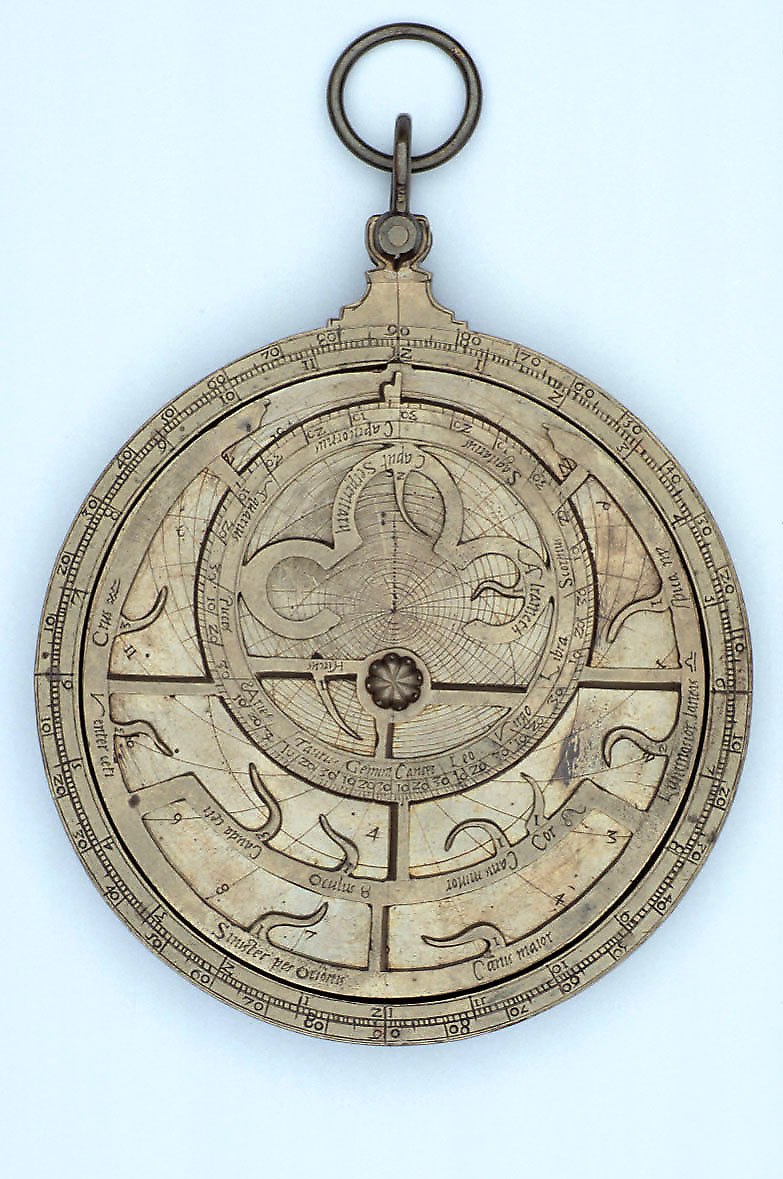
This unsigned astrolabe is constructed of brass and measures 115 mm in diameter. It is held by the Museum of the History of Science, Oxford. The instrument features a limb soldered to the back plate of the mater, with a throne, shackle, and suspension ring. It includes a rete for 13 stars and three plates for various latitudes (37/40°, 43/46°, and 49/52°). The back features a degree scale, a zodiacal scale with symbols, and a calendar scale. The central area includes a double shadow square and a diagram of unequal hours, alongside a linear scale for sine calculation. The alidade is straight and fitted with double pinhole sights. The authenticity of the instrument remains uncertain, with reports noting stylistic inconsistencies in the engravings and non-standard features of the rete, though it is not definitively classified as a counterfeit.

Front view of the unsigned brass astrolabe (Inv. 52528) showing the rete, limb scales, and throne.
Front view of the unsigned brass astrolabe (Inv. 52528) showing the rete, limb scales, and throne. — Museum of the History of Science, Oxford. Rights pending — permission not yet requested. Original source

Catalogue identity

Source
www.mhs.ox.ac.uk
Category
Tool · Astrolabe
Maker / attribution
Not established
Reference
Not recorded
Catalogue / lot identifier
52528
Source-reported date
Early 16th century
Source-reported place
Not established

Source-reported attribution and specifications are not independent authentication. A listing does not establish present ownership, current display, availability or permission to reproduce.

Object description

Construction and Layout

The astrolabe is composed of a brass mater with a soldered limb and a central throne, shackle, and suspension ring. The limb contains a degree scale marked 90 to 0 in quadrants, divided to 1-degree intervals, alongside a 1 to 12 hour scale repeated twice.

The central rete is designed for 13 stars and incorporates an ecliptic circle marked with signs. The back of the instrument hosts a similar limb scale, a zodiacal scale, and a calendar scale where the first point of Aries is marked at 10 1/2 March. A double shadow square occupies the lower central space, while the upper left contains a linear scale for calculating the sines of angles.

Evidence for this section
  • “The limb is soldered to the back plate of the mater”
  • “The limb has a degree scale 90 to 0 to 90 to 0 to 90”
  • “The lower half of the central space has a double shadow square”
  • “The first point of Aries is at 101/2 March.”

Plates and Sighting

The instrument includes three interchangeable plates covering six different latitudes. These are engraved with azimuths every 10 degrees and almucantars at 3-degree intervals. The layout includes meridian and east-west lines, as well as indications for tropics and the equator.

The alidade is a straight design equipped with double pinhole sights. It is secured to the instrument via a threaded bolt and nut assembly.

Evidence for this section
  • “There are three plates, for latitudes 37 and 40?; 43 and 46?; 49 and 52?.”
  • “Each side is engraved with azimuths for every 10 degrees, and almucantars for every 3 degrees”
  • “Straight alidade with double pinhole sights”

Condition and Authenticity

The provenance and physical condition of the astrolabe are subject to academic debate. Reports indicate that while some aspects appear medieval, the engraved letters reflect a later and non-standard style. The rete is noted for having a thick plate and incorrect divisions.

The status of the instrument is not fully resolved; it may represent an eccentric, non-commercial production or an authentic piece with later modifications. Current findings suggest it is not necessarily a simple counterfeit.

Evidence for this section
  • “Some of its features seem medieval, but the engraved letters are in a later style”
  • “The rete is made from a rather thick brass plate and has been incorrectly divided.”
  • “Although puzzles remain with this instrument, it is probably not straightforwardly a counterfeit.”

Open research questions

  • Could the engraving inconsistencies be attributed to a specific restoration effort?
  • Does metallurgical analysis of the brass plate align with an early 16th-century origin?

Source evidence

Recorded claims and source quotations for Astrolabe
FieldSource-reported valueSource quotation
Diameter115 mm“115 mm in diameter”
Inventory number52528“Inventory number 52528”
MakerUnsigned“Unsigned”
DateEarly 16th century“Early 16th century”
AlidadeStraight with pinholes“Straight alidade with double pinhole sights; threaded bolt and nut.”
Latitude platesThree plates for various latitudes“There are three plates, for latitudes 37 and 40?; 43 and 46?; 49 and 52?.”

Visible details

  • The rete is engraved for 13 named stars.
  • The instrument features a throne, shackle, and suspension ring.
  • The alidade is a straight bar with double pinhole sights.
  • A double shadow square is present on the lower half of the back.

Research qualifications

  • The auction description notes doubts regarding its authenticity.
  • The engravings are reported to be in a later style inconsistent with other features.
  • The rete is described as having an incorrect division.

Photograph identity and source facts were screened before import; rights clearance remains pending.

Consulted source

Astrolabe

Reviewed 2026-10-26 · Record 17d604866f

Terms in this record

Glossary explanations for terms named in this object’s record.