
Skip to content
The Encyclopedia of Horology

Pocket watch · Painted enamel pocket watch

Arthur à Paris 20K gold and painted enamel pocket watch

Partially verified

This 20K gold pocket watch is signed 'Arthur à Paris' and numbered 497. The piece dates to approximately 1760, supported by the Paris hallmarks present on the case. The watch features a white enamel dial with Roman numerals for the hours and Arabic numerals for the minute track, paired with gold Louis XV style hands. The two-body gold case is decorated with chased geometrical patterns and champlevé enameled flowers on the bezel. The gilt brass, full-plate movement is powered by a fusee with chain and features a verge escapement with a micrometric potence adjustment. The movement is signed and includes a silver regulation dial. Jean Arthur was active in Paris from approximately 1755 to 1810.

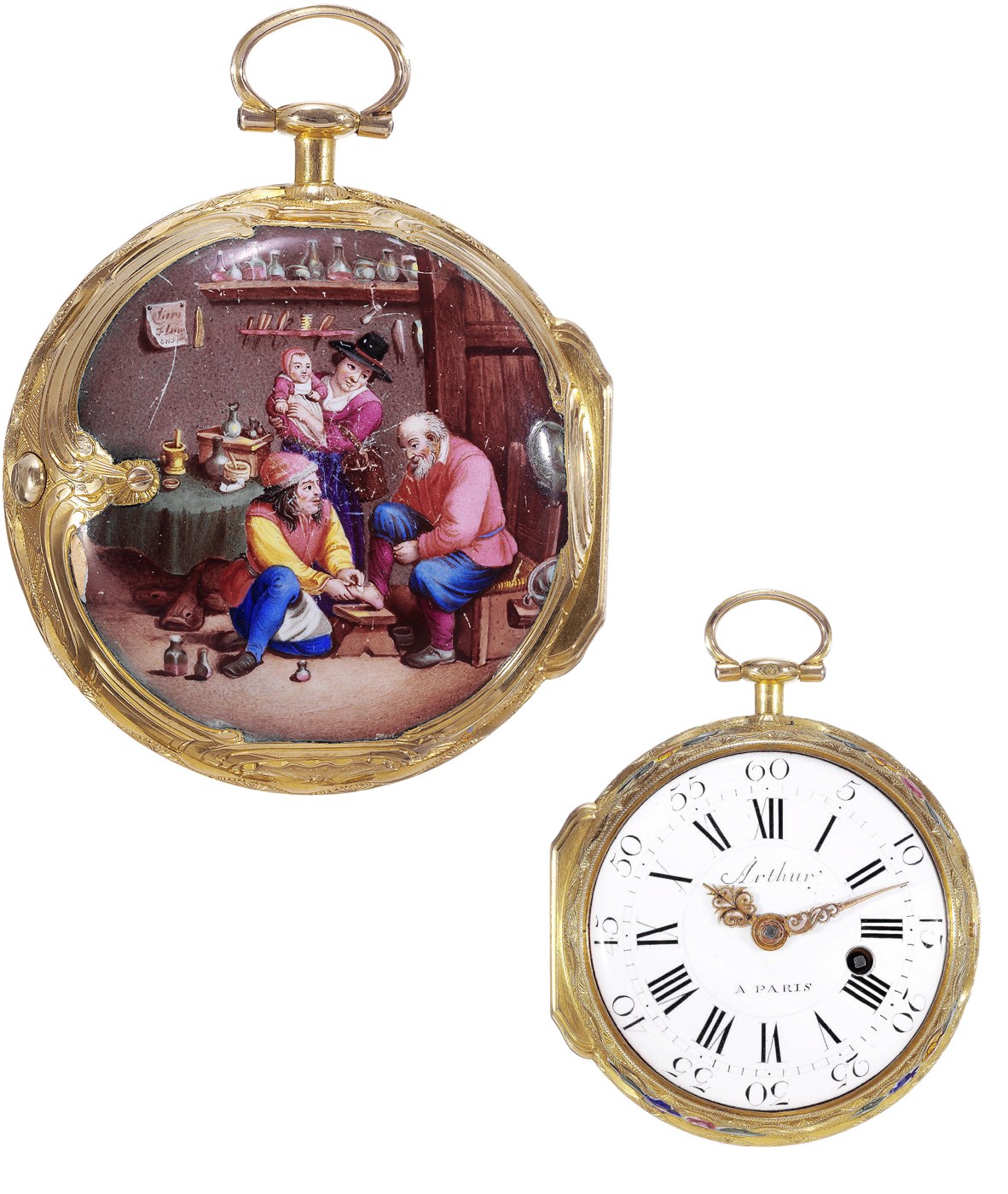
Front view showing the enamel dial and the painted enamel case back scene.
Front view showing the enamel dial and the painted enamel case back scene. — Antiquorum. Rights pending — permission not yet requested. Original source

Catalogue identity

Source
catalog.antiquorum.swiss
Category
Pocket watch · Painted enamel pocket watch
Maker / attribution
Jean Arthur
Reference
Not recorded
Catalogue / lot identifier
22
Source-reported date
circa 1760
Source-reported place
France
Source-reported serial
497

Source-reported attribution and specifications are not independent authentication. A listing does not establish present ownership, current display, availability or permission to reproduce.

Object description

Case and Dial Design

The bezel is embellished with a chased geometrical pattern interspersed with painted champlevé enameled flowers. The case back serves as a canvas for a detailed painted enamel scene, which depicts an elderly gentleman undergoing treatment for a bunion. This scene is surrounded by an outer border featuring chased rocaille and geometric motifs. The enamel scene on the case back has been associated with the work of David II Teniers the Younger, an Antwerp-born painter known for his genre scenes.

The watch retains its original white enamel dial, which displays radial Roman numerals for the hours. An outer minute track utilizes Arabic numerals at five-minute intervals, facilitating precise time reading. The dial is completed with gold Louis XV hands and bears the signature 'Arthur' as well as the location 'A PARIS'. A winding aperture is positioned on the dial.

Evidence for this section
  • “the bezel chased in a geometrical pattern and with painted champleve enameled flowers”
  • “the back with a fine and amusing painted on enamel scene”
  • “White enamel with radial Roman numerals, outer minute track and Arabic minute numerals. Gold Louis XV hands.”

Movement and Mechanism

The timepiece is powered by a 37 mm gilt brass, full-plate movement. The construction incorporates pentagonal baluster pillars and a traditional fusee with chain mechanism. For the escapement, the watch employs a verge system, enhanced with a micrometric potence adjustment to allow for fine regulation.

The balance wheel is a plain steel three-armed type, complemented by a gilt brass continental cock. The cock is finished with a polished steel endpiece, adding to the decorative quality of the movement. A silver regulation dial is included to assist in timekeeping adjustments, and both the dial and the movement are signed by the maker.

Evidence for this section
  • “37 mm., giIt brass, full plate with pentagonal baluster pillars, fusee with chain, verge escapement with micrometric potence adjustment”
  • “plain steel three armed balance, gilt brass continental cock with polished steel endpiece, silver regulation dial.”

Provenance and Attribution

The watch is attributed to Jean Arthur, a Parisian horologist who received his master title in 1757. Records suggest his active period in Paris spanned from approximately 1755 to 1810. The production of the case is anchored by Paris hallmarks dating to 1760, providing a reliable timeframe for the watch's assembly.

However, this attribution remains a hypothesis, with the auction description noting it is 'probably' derived from his work.

Evidence for this section
  • “The case with Paris hallmarks for 1760.”
  • “the back with a fine and amusing painted on enamel scene probably after David II Teniers, The Younger”
  • “There are 11 known watches by Jean Arthur and one clock”

Open research questions

  • Is there physical evidence within the movement to confirm the watch was originally a cylinder escapement piece as the maker's reputation suggests?
  • Can the provenance be traced to specific collections before its entry into the auction record?

Source evidence

Recorded claims and source quotations for Arthur à Paris 20K gold and painted enamel pocket watch
FieldSource-reported valueSource quotation
MakerJean Arthur“Jean Arthur Received master in 1757, he is recorded as working in Paris c. 1755-1810.”
Movement typeGilt brass, full plate, verge escapement“t brass, full plate with pentagonal baluster pillars, fusee with chain, verge escapement with micrometric potence adjustment”
DateCirca 1760“The case with Paris hallmarks for 1760.”
Dial detailsWhite enamel with Roman and Arabic numerals“White enamel with radial Roman numerals, outer minute track and Arabic minute numerals.”
Case material20K gold“Very fine, 20K gold and painted on enamel pocket watch.”
DecorationChamplevé enamel flowers and painted scene“the bezel chased in a geometrical pattern and with painted champleve enameled flowers, the back with a fine and amusing painted on enamel scene”
SignedDial and movement“Dial and movement signed.”

Visible details

  • Painted enamel scene on the case back showing a figure receiving a bunion treatment
  • Chased rocaille and geometrical decorations on the case border
  • Presence of an enamel dial with radial Roman numerals
  • Visible winding hole on the white enamel dial

Research qualifications

  • The painted enamel scene on the case back is only 'probably' after David II Teniers the Younger
  • Condition reports indicate minor chips and 'lacking elements' in the case

Photograph identity and source facts were screened before import; rights clearance remains pending.

Terms in this record

Glossary explanations for terms named in this object’s record.