
Skip to content
The Encyclopedia of Horology

Clock · Architectural table clock

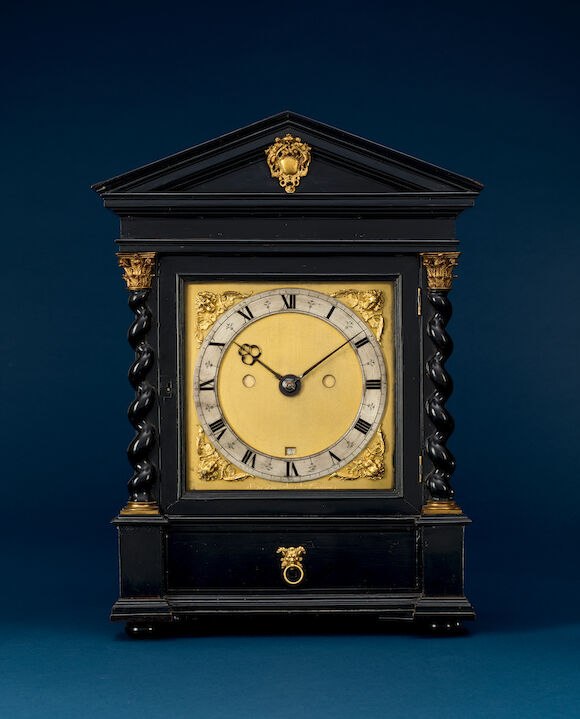
Architectural ebony table clock, Edward East, attributed to Samuel Knibb

Partially verified

This architectural ebony table clock dates from the third quarter of the 17th century and features a dial signed 'Eduardus East Londini', with the movement attributed by the source to Samuel Knibb. The case is surmounted by a triangular pediment with a cast gilt mount in the tympanum, supported by spirally twisted Corinthian columns above an inverted breakfront base containing a lower drawer with a Pan mask ring pull. The 8-inch gilt-brass dial features cast cherub-head spandrels, a silvered chapter ring with Roman hours and Arabic minutes, a date aperture above six o'clock, and maintaining power shutters. The twin-fusee movement is reported to have nine latched pillars, a verge escapement, and an engraved floral backplate.

Front view of the architectural ebony table clock showing the pediment, twisted columns, and dial
Front view of the architectural ebony table clock showing the pediment, twisted columns, and dial — Bonhams. Rights pending — permission not yet requested. Original source

Catalogue identity

Source
www.bonhams.com
Category
Clock · Architectural table clock
Maker / attribution
Edward East (movement attributed to Samuel Knibb)
Reference
Not recorded
Catalogue / lot identifier
75
Source-reported date
third quarter of the 17th century
Country
England

Source-reported attribution and specifications are not independent authentication. A listing does not establish present ownership, current display, availability or permission to reproduce.

Object description

Case Architecture

The clock is housed in an architectural ebony-veneered case with a moulded cornice. The tympanum contains an oval gilded mount depicting a pair of standing figures framing a vacant cartouche. The structure features spirally twisted Corinthian columns with original bases and capitals, arranged in three-quarter form at the front and quarter-form at the rear.

The case features an inverted breakfront base containing a drawer with a Pan mask ring handle. It is elevated on squat bun feet. The solid rear door bears two internal labels referencing a 1955 Sotheby's auction and a 1964 Science Museum exhibition in London.

Evidence for this section
  • “The case surmounted by an architectural pediment with finely moulded cornice, the recessed tympanum centred by a single oval gilt mount cast with a pair of standing figures framing a vacant cartouche”
  • “raised on an inverted breakfront base centred by a deep drawer with ring handle in the form of a Pan mask”
  • “the solid rear door with (broken) lock and applied to the inside with two labels relating to the 1955 auction at Sotheby's and subsequent Exhibition in The Science Museum, London, 1964”

Dial and Calendar

The 8-inch gilt-brass dial is adorned with four cherub-head spandrels at the corners. The signature 'Eduardus East Londini' is inscribed in copperplate script at the lower edge. The narrow silvered chapter ring contains Roman hour numerals, fleur-de-lys half-hour markers, and an Arabic minute track.

The matted dial center features a chamfered calendar aperture positioned above the VI o'clock mark. Maintaining power is provided by a bolt-and-shutter mechanism operated via a side-mounted pull cord.

Evidence for this section
  • “The 8-inch gilt-brass dial framed by four exceptionally cast and finished cherub-head spandrels, signed in flowing copperplate script to the lower edge Eduardus East Londini”
  • “The finely matted centre with chamfered calendar aperture above the VI o'clock position”
  • “the matted bolt-and-shutter maintaining power shutters operated via a pull cord”

Movement and Attribution

The twin-fusee movement comprises split front plates, nine latched and pinned pillars, and an engraved floral backplate signed 'Eduardus East Londini'. The train includes a knife-edge verge escapement and a countwheel engraved with a Tudor rose.

The movement is attributed to Samuel Knibb by the source, citing stylistic comparisons of the potence, hammer spring, and plate construction to other works identified as Knibb's. It is noted that the movement bears these hallmarks despite the dial signature of Edward East.

Evidence for this section
  • “The substantial movement with split front plates, united by nine latched and pinned pillars”
  • “the going train with bolt-and-shutter maintaining power and knife-edge verge escapement with bud-form apron and engraved detail”
  • “the movement bears multiple hallmarks associated with Samuel Knibb, as supported by close comparisons with three other clocks signed by Samuel Knibb”

Open research questions

  • What criteria specifically link the potence and hammer spring design to the workshop of Samuel Knibb?
  • Does the presence of wire lines instead of gut indicate a specific period of alteration?

Source evidence

Recorded claims and source quotations for Architectural ebony table clock, Edward East, attributed to Samuel Knibb
FieldSource-reported valueSource quotation
Dial SignatureEduardus East Londini“signed in flowing copperplate script to the lower edge Eduardus East Londini”
Height50.5 cm (20 in)“50.5cms (20ins) high.”
EscapementKnife-edge verge escapement“knife-edge verge escapement with bud-form apron and engraved detail”
Base Drawer MountRing handle in the form of a Pan mask“deep drawer with ring handle in the form of a Pan mask”
Movement AttributionAttributable to Samuel Knibb“The movement attributable to Samuel Knibb.”
Height50.5 cm“50.5cms (20ins) high.”
DateThird quarter of the 17th century“third quarter of the 17th century”

Visible details

  • Architectural pedimented ebony case flanked by spirally twisted columns with gilt Corinthian capitals and bases.
  • Tympanum centered by an oval gilded figural mount.
  • Square brass dial with winged cherub-head spandrels, silvered chapter ring, blued steel hands, twin winding holes, and a square calendar aperture above VI.
  • Inverted breakfront lower drawer fitted with a central gilded Pan mask ring handle, resting on squat bun feet.

Research qualifications

  • The internal twin-fusee movement, latched pillars, maintaining power mechanism, and engraved backplate are not visible in this frontal image.
  • The movement attribution to Samuel Knibb is source-reported based on constructional characteristics rather than a signature.

Photograph identity and source facts were screened before import; rights clearance remains pending.

Terms in this record

Glossary explanations for terms named in this object’s record.