
Skip to content
The Encyclopedia of Horology

Movement · Pocket watch movement

Adams & Perry Lancaster Watch Movement #1369

Partially verified

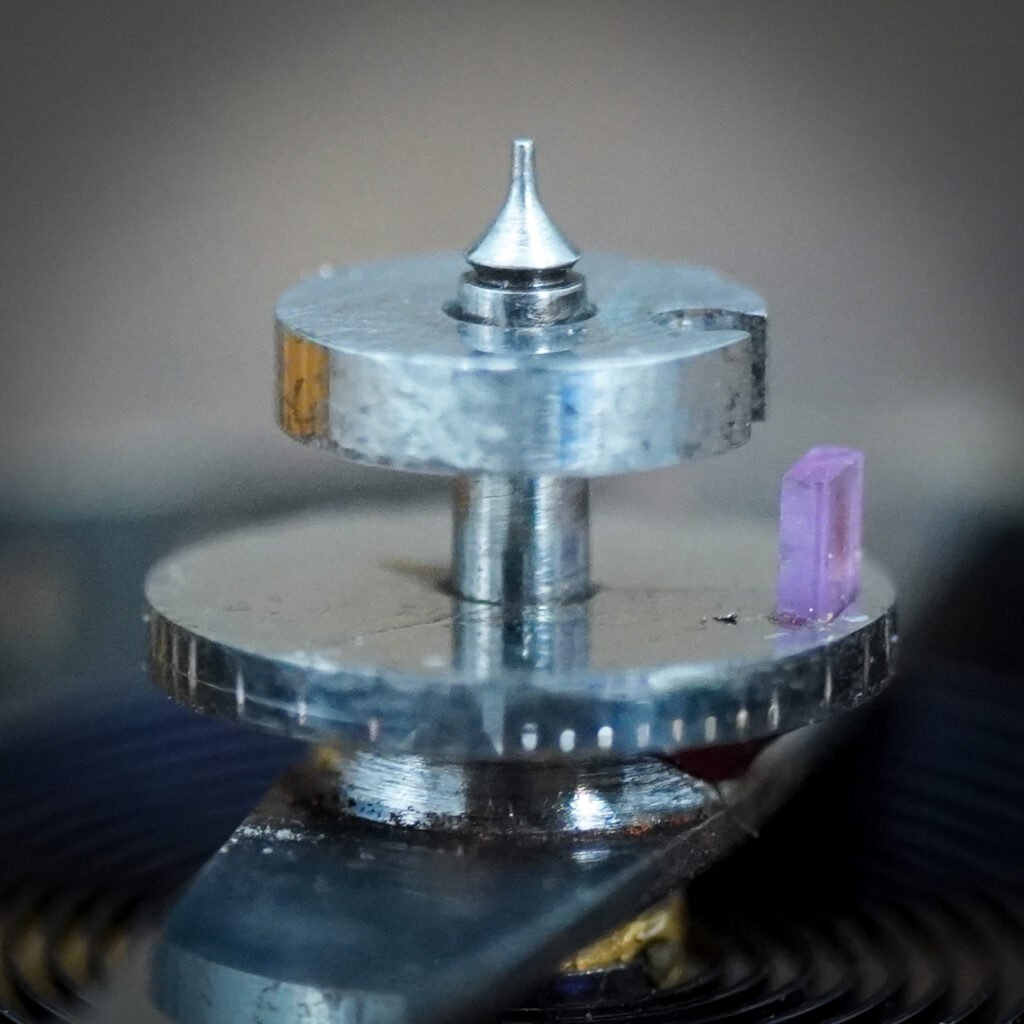
This movement represents an early American pocket watch design by Adams & Perry, introduced to the market in 1876. The source reports that the movement features a double roller escapement separating an impulse roller table from a smaller notched safety roller table. The impulse roller is fitted with an unusually wide, flattened pink roller jewel shaped like a tooth, reflecting a design inspired by George Savage's two-pin double roller escapement. The author notes this escapement configuration delegates the impulse action to the safety roller, employing the roller jewel solely for unlocking.

Macro view of the balance staff showing the notched safety roller and the wide roller jewel on the impulse roller table
Macro view of the balance staff showing the notched safety roller and the wide roller jewel on the impulse roller table — Nathan Moore / Pocket Watch Database. Rights pending — permission not yet requested. Original source

Catalogue identity

Source
blog.pocketwatchdatabase.com
Category
Movement · Pocket watch movement
Maker / attribution
Adams & Perry Watch Co.
Reference
Not recorded
Catalogue / lot identifier
Source URL identifies the listing
Source-reported date
1876
Country
United States
Source-reported serial
1369

Source-reported attribution and specifications are not independent authentication. A listing does not establish present ownership, current display, availability or permission to reproduce.

Object description

Identity and Historical Context

This object entry documents a movement component attributed by the source to an Adams & Perry Lancaster watch movement, recorded under movement number 1369. The source highlights the model as representing the first American-made watch to feature a double roller, noting its market introduction in 1876 when American factories otherwise produced movements exclusively with single rollers.

While double roller escapements were already found in certain high-end foreign watches at the time, standard American production did not widely adopt the feature until the 1880s and 1890s, making this early Lancaster production an unusual departure in domestic manufacturing.

Evidence for this section
  • “The Adams & Perry movement represents the first American-made watch featuring a double roller.”
  • “When the movement was introduced to the market in 1876, the double roller escapement was already utilized in some high-end watches manufactured by foreign makers, but American factories exclusively produced movements with single rollers.”
  • “Adams & Perry Lancaster Watch, Showing Movement #1369”

Visual Observations of Balance Staff Assembly

The provided macro image focuses tightly on the balance staff and roller tables. At the upper termination of the balance staff, a conical balance pivot tapers to a fine point. Below this pivot, the upper disc is visible with a distinct lateral perimeter notch cut into its rim.

Mounted underneath is a wider lower disc bearing a broad, upright, translucent pink rectangular roller jewel pin. Beneath this double roller assembly, portions of the balance wheel arm and a coiled blued hairspring are visible.

Evidence for this section
  • “Conical balance pivot tapering to a fine point terminates the upper end of the balance staff.”
  • “Upper disc features a distinct lateral perimeter notch on its rim.”
  • “Lower, wider disc carries a broad, upright, translucent pink rectangular roller jewel pin.”
  • “Portions of the underlying balance wheel arm and coiled blued hairspring are visible beneath the roller assembly.”

Escapement Mechanics and Source Limitations

According to the source documentation, the escapement geometry was directly influenced by George Savage's two-pin double roller design. Rather than functioning as a standard impulse pin, the unusually wide, tooth-like roller jewel serves solely to unlock the escapement, with impulse action delegated entirely to the safety roller.

Visual confirmation remains restricted to the macro perspective of the balance staff and rollers. The movement plates, escapement wheel, pallet fork, cap jewels, and serial number stamping 1369 are not visible in this image, leaving movement-level identification dependent on the external source article.

Evidence for this section
  • “The roller jewel used by Adams & Perry was unusually wide, with a flattened appearance more like a tooth than the standard pin – a design inspired by George Savage’s two-pin double roller escapement.”
  • “Interestingly, this escapement design delegates the impulse action to the safety roller rather than using the roller jewel, which only serves to unlock the escapement.”
  • “A close inspection of the escapement of the Adams & Perry movement reveals a unique notch shape in the safety roller to receive the guard pin and a pallet fork designed to receive the wide roller jewel.”

Open research questions

  • Does movement #1369 retain its original matching dial, pillar plate, and bridge serial stampings to confirm association with this specific balance staff assembly?
  • What specific alloy was utilized for the balance wheel rim and arm visible beneath the roller assembly on movement #1369?

Source evidence

Recorded claims and source quotations for Adams & Perry Lancaster Watch Movement #1369
FieldSource-reported valueSource quotation
Movement Number1369“Adams & Perry Lancaster Watch, Showing Movement #1369”
Market Introduction1876“When the movement was introduced to the market in 1876, the double roller escapement was already utilized in some high-end watches manufactured by foreign makers”
Design InspirationGeorge Savage's two-pin double roller escapement“a design inspired by George Savage’s two-pin double roller escapement.”
Escapement ConstructionDouble roller escapement“Adams & Perry Lancaster Watch, Showing Wide Roller Jewel and Notched Safety Roller of the Double Roller Escapement”
Pallet Fork and Escape Wheel JewelingConical pivots and cap jewels“The pallet fork and the escape wheel also feature conical pivots and cap jewels to improve reliability.”
Functional Role of Roller JewelUnlocking only (impulse delegated to safety roller)“delegates the impulse action to the safety roller rather than using the roller jewel, which only serves to unlock the escapement.”

Visible details

  • Conical balance pivot tapering to a fine point terminates the upper end of the balance staff.
  • Upper disc features a distinct lateral perimeter notch on its rim.
  • Lower, wider disc carries a broad, upright, translucent pink rectangular roller jewel pin.
  • Portions of the underlying balance wheel arm and coiled blued hairspring are visible beneath the roller assembly.

Research qualifications

  • Only a macro detail of the balance staff and roller tables is depicted; the wider movement plates and serial number are not visible in this image.
  • The source article discusses the escapement generally across images of movement #1369, but serial number 1369 is not directly stamped on this component.

Photograph identity and source facts were screened before import; rights clearance remains pending.

Terms in this record

Glossary explanations for terms named in this object’s record.