
Skip to content
The Encyclopedia of Horology

Clock · Vienna regulator wall clock

A Small 8-Day Vienna Regulator Timepiece Wall Clock

Partially verified

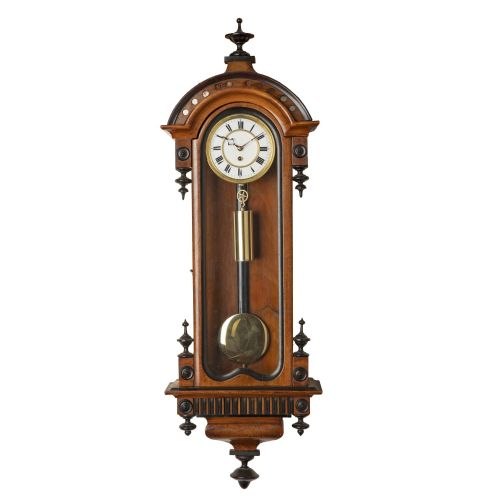
This antique wall clock is a small Vienna regulator timepiece dated by the dealer to circa 1895. The clock is reported to house an 8-day weight-driven movement equipped with a dead-beat escapement and a wood rod pendulum fitted with a large brass bob. Its dial measures 5 inches across and features a two-piece white enamel surface with black Roman numerals and blued steel hands. The slim case is constructed from walnut with ebonised trim, highlighted by architectural mouldings and turned ebonised finials flanking the upper arched pediment and lower fluted base.

Frontal view of the Vienna regulator wall clock in walnut and ebonised case
Frontal view of the Vienna regulator wall clock in walnut and ebonised case — The Antique Clock Co.. Rights pending — permission not yet requested. Original source

Catalogue identity

Source
www.sellingantiques.co.uk
Category
Clock · Vienna regulator wall clock
Maker / attribution
Not established
Reference
SA1037892
Catalogue / lot identifier
Source URL identifies the listing
Source-reported date
circa 1895
Country
Not established

Source-reported attribution and specifications are not independent authentication. A listing does not establish present ownership, current display, availability or permission to reproduce.

Object description

Case Architecture and Construction

The clock is housed in an upright rectangular walnut and ebonised wall case, measuring 91 cm high including finials, 29 cm wide, and 12 cm deep. The case architecture features turned ebonised finials flanking an arched upper pediment, which is surmounted by a central turned finial.

The lower section terminates in a fluted apron base with a turned bottom finial drop. A glazed front door encloses the chamber, displaying the suspended cylindrical weight and pendulum assembly within.

Evidence for this section
  • “Slim walnut and ebonised case with well-turned, ebonised finials.”
  • “Height: 36" or 91 cm (Including finials) Width: 11 ½" or 29 cm Depth: 4 ¾" or 12 cm”
  • “Arched upper pediment surmounted by a turned central finial.”
  • “Fluted apron base terminating in a turned bottom finial drop.”

Dial and Indication

The dial is a 5-inch, two-piece white enamel configuration. It features black Roman numeral hour markers and is paired with blued steel hands.

The dial assembly sits directly above the pendulum drop, visible through the glazed door panel.

Evidence for this section
  • “Two-piece 5" enamel dial with Roman numerals and fine quality blued steel hands.”
  • “Glazed front door displaying a cylindrical brass weight and circular brass pendulum bob.”

Movement and Pendulum Specification

According to the seller's documentation, the timepiece is driven by an 8-day weight-driven movement fitted with a dead-beat escapement. It regulates time via a wood rod pendulum equipped with a large brass bob.

A cylindrical brass weight and circular brass pendulum bob are visible through the glazed door. However, an internal movement view is not provided, and specific movement maker's marks or serial numbers are not recorded in the source.

Evidence for this section
  • “The beautiful 8-day weight-driven movement with ‘dead-beat’ escapement and wood rod pendulum with the large brass bob.”
  • “Glazed front door displaying a cylindrical brass weight and circular brass pendulum bob.”

Dating and Provenance Limits

The clock is dated by the dealer to circa 1895 and listed as 19th-century. Provenance is reported only as 'Private collection - U.K.', with no specific manufacturer recorded in the listing.

Because internal movement photographs are not provided, maker marks or specific regional origin cannot be independently verified from the source documentation.

Evidence for this section
  • “CIRCA. 1895”
  • “The Antique Clock Co. has dated this Vienna Regulator Wall Clock to the 19th Century.”
  • “Provenance: Private collection - U.K.”

Open research questions

  • Does the movement backplate bear factory stamps, serial numbers, or maker marks (such as German or Austrian manufacturers)?
  • Are the turned ebonised finials and pediment original or later additions to the walnut case?
  • What specific mounting bracket or movement mounting configuration is used inside the case?

Source evidence

Recorded claims and source quotations for A Small 8-Day Vienna Regulator Timepiece Wall Clock
FieldSource-reported valueSource quotation
Movement Duration8-day“8-day weight-driven movement”
EscapementDead-beat escapement“‘dead-beat’ escapement”
DialTwo-piece 5" enamel dial with Roman numerals“Two-piece 5" enamel dial with Roman numerals”
Case MaterialsSlim walnut and ebonised case“Slim walnut and ebonised case with well-turned, ebonised finials.”
DateCirca 1895“CIRCA. 1895”
Dimensions91 cm x 29 cm x 12 cm“Height: 36" or 91 cm (Including finials) Width: 11 ½" or 29 cm Depth: 4 ¾" or 12 cm”
Pendulum TypeWood rod with large brass bob“wood rod pendulum with the large brass bob”
Reported ProvenancePrivate collection, United Kingdom“Provenance: Private collection - U.K.”

Visible details

  • Glazed front door displaying a cylindrical brass weight and circular brass pendulum bob.
  • Arched upper pediment surmounted by a turned central finial.
  • Fluted apron base terminating in a turned bottom finial drop.

Research qualifications

  • Maker is unspecified in the listing.
  • Internal movement view is not provided.

Photograph identity and source facts were screened before import; rights clearance remains pending.

Consulted source

Vienna Regulator Wall Clock 19th Century | Sellingantiques.co.uk

Reviewed 2026-10-21 · Record 1c788e5f68

Terms in this record

Glossary explanations for terms named in this object’s record.