
Skip to content
The Encyclopedia of Horology

Tool · French astrolabe

13th Century Gilt Copper Astrolabe

Partially verified

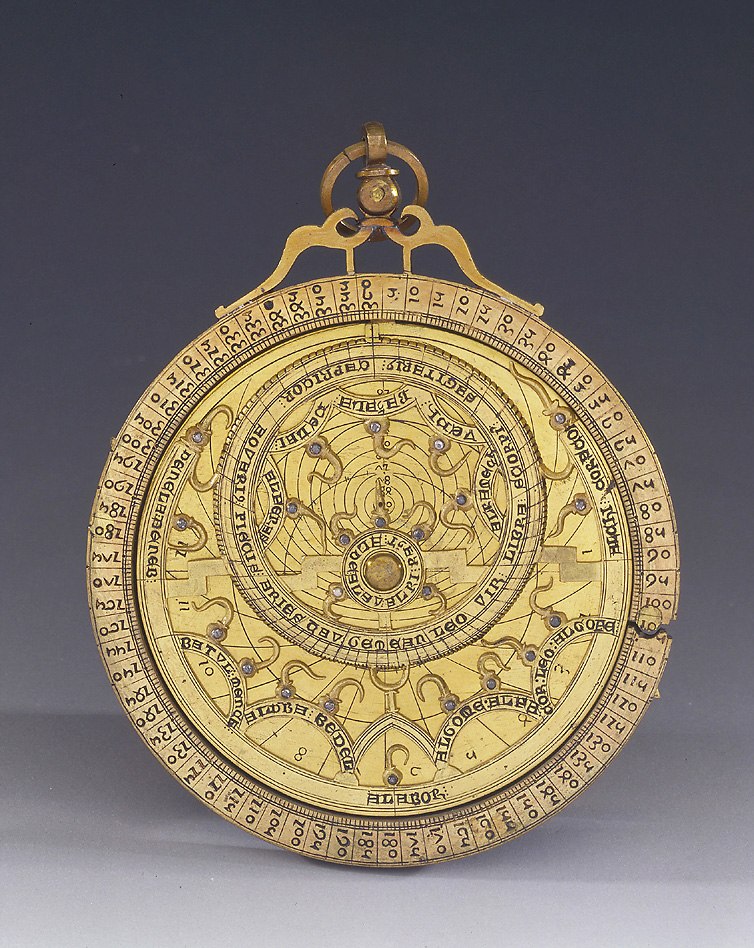
This 13th-century astrolabe is a small instrument measuring 98 mm in diameter, constructed from gilt copper. It is unsigned and features a rete adorned with 23 star indicators formed by silver studs. The instrument includes a mater housing three latitude plates, two of which are calibrated for latitudes covering 41 to 44 degrees. The third plate contains an incomplete projection of the heavens on one side and a series of traced lines on the reverse. The limb is graduated in 5-degree increments up to 360 degrees. The back displays zodiacal signs, months, and a shadow square labeled 'VMBRA VERSA' and 'VMBRA DIRECTA'. The alidade features sighting vanes and engraved leaf motifs. The piece originates from the historical scientific collection of the Medici family in Florence and is currently held by the Istituto e Museo di Storia della Scienza.

The obverse of the 13th-century gilt copper astrolabe showing the rete, 22 star studs, and limb graduations.
The obverse of the 13th-century gilt copper astrolabe showing the rete, 22 star studs, and limb graduations. — Istituto e Museo di Storia della Scienza, Firenze. Rights pending — permission not yet requested. Original source

Catalogue identity

Source
www.mhs.ox.ac.uk
Category
Tool · French astrolabe
Maker / attribution
Not established
Reference
Not recorded
Catalogue / lot identifier
1107
Source-reported date
13th century
Source-reported place
France

Source-reported attribution and specifications are not independent authentication. A listing does not establish present ownership, current display, availability or permission to reproduce.

Object description

Construction and Rete Design

The astrolabe is manufactured from gilt copper, measuring 98 mm in diameter. The central component is the rete, which acts as a star chart and ecliptic ring. It is embellished with 23 silver studs which function as star pointers. The zodiacal signs are identified in Latin using gothic lettering, consistent with the numbering style found on the instrument's limb.

The limb itself is systematically divided into 360 degrees, with groupings marked every 5 degrees. The throne at the top of the astrolabe is attached to a rotating pivot, allowing the ring to swivel. The alidade or pointer is equipped with sights at its extremities, with decorative leaf motifs engraved near the central pivot, demonstrating specific attention to detail in its assembly.

Evidence for this section
  • “The rete bears 23 stars indicated by silver studs.”
  • “The signs of the zodiac are named in Latin on the zodiac circle.”
  • “Numbers and words are in gothic characters.”

Latitude Plates and Mater

The mater contains three plates that fit within the instrument's frame. Two of these plates are calibrated for specific latitudes, covering 41-42 degrees and 43-44 degrees. These are associated with the regions of Castille and Provence. The third plate is distinct in that one face features an incomplete projection of the heavens without any latitude marking, while the reverse side contains several traced lines.

Interestingly, the inscriptions for the 43 and 44-degree plates are noted to be in non-gothic characters, differing from the primary engravings on the rest of the instrument.

Evidence for this section
  • “One face of the third plate is marked with the projection of the heavens, incomplete and without a latitude.”

Back Plate and Condition

The reverse of the astrolabe is densely engraved with astronomical and calculation scales. This includes a division from 90 to 0 and 0 to 90 degrees, repeated twice, alongside zodiacal signs and month names. A circumferential scale is divided from 1 to 28, beginning from the diameter. Below this, a shadow square is present, featuring the dual inscriptions 'VMBRA VERSA' and 'VMBRA DIRECTA', both repeated twice.

Regarding its physical state, a prominent crack is present. It traverses the instrument, originating from the exterior circumference and extending into the limb. The object is currently held in the collection of the Istituto e Museo di Storia della Scienza in Florence, having been part of the Medici family's historical collection of scientific instruments.

Evidence for this section
  • “A crack runs across the instrument, reaching as far as the limb.”
  • “Under the diameter, the half shadow square is engraved, accompanied by the inscriptions 'VMBRA VERSA', 'VMBRA DIRECTA', repeated twice.”

Open research questions

  • What is the origin of the non-gothic characters on the third latitude plate?
  • Did the crack in the limb occur during the instrument's period of use or during its time in the Medici collection?

Source evidence

Recorded claims and source quotations for 13th Century Gilt Copper Astrolabe
FieldSource-reported valueSource quotation
MaterialGilt copper“Gilt copper”
Diameter98 mm“98 mm in diameter”
Inventory Number1107“Inventory number: 1107”
Star indicators23 silver studs“The rete bears 23 stars indicated by silver studs.”
Shadow square inscriptionsVMBRA VERSA, VMBRA DIRECTA“accompanied by the inscriptions 'VMBRA VERSA', 'VMBRA DIRECTA', repeated twice.”
ProvenanceMedici collection“originates from the legacy of scientific instruments collected in Florence by the Medici family.”
ConditionStructural crack“A crack runs across the instrument, reaching as far as the limb.”

Visible details

  • The rete is decorated with 23 small silver studs representing stars.
  • A significant structural crack extends from the edge of the limb towards the center.
  • Gothic script is used for numbering and naming of zodiacal signs.
  • The throne incorporates a ring attached to a rotating pivot.

Research qualifications

  • The provenance attributing the piece to 13th-century France is based on museum categorization rather than a maker's mark or date inscription.
  • The third latitude plate contains non-gothic characters, suggesting potential later modifications or additions to the set.

Photograph identity and source facts were screened before import; rights clearance remains pending.

Consulted source

Astrolabe

Reviewed 2026-10-26 · Record 9f910fb15a

Terms in this record

Glossary explanations for terms named in this object’s record.