Construction and Design
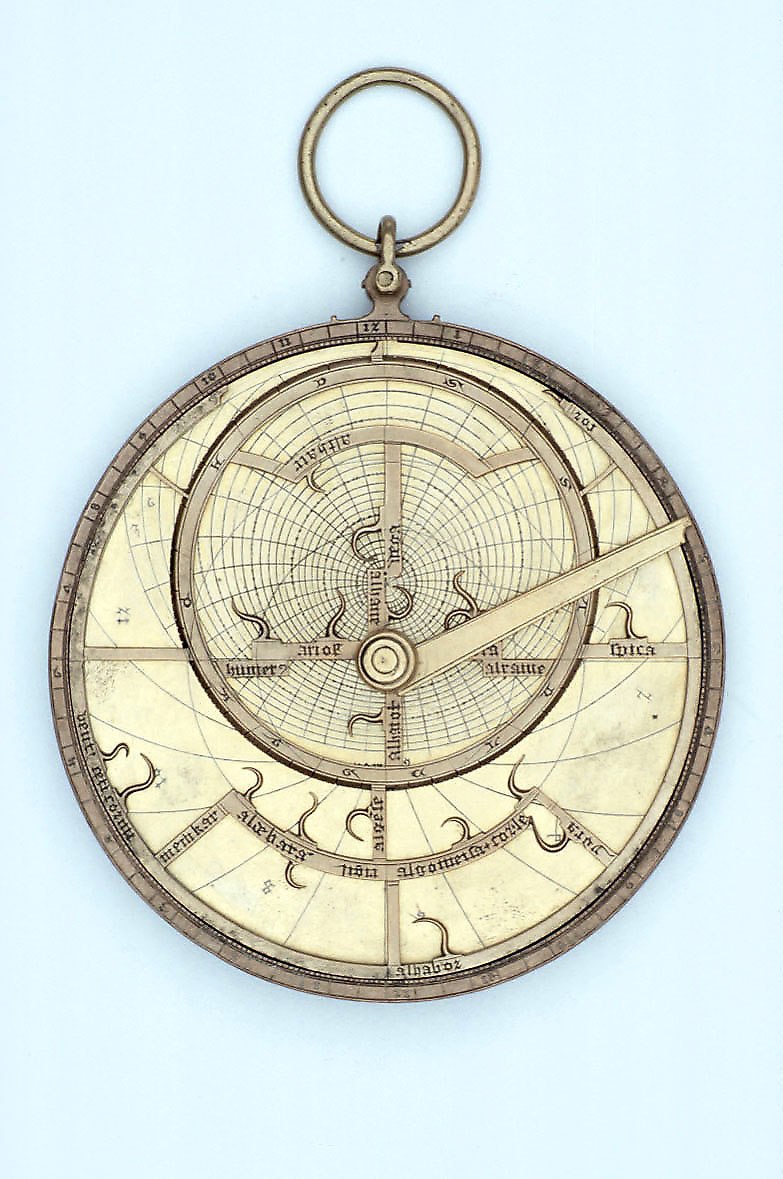
The astrolabe measures 100 mm in diameter and is manufactured from brass. The mater consists of two soldered brass plates, with one plate forming the limb and shackle, and the other serving as the plate. The suspension system comprises a throne, shackle, and ring, where the throne is lined on both sides. The limb is divided into 360 degrees, with intervals of 5 degrees and further subdivisions of 1 degree, and is numbered 1 to 12 twice every hour or 15 degrees.
The rete is characterized by a late Gothic design and possesses 21 star pointers of the wavy flame type, all bearing names in Gothic script. The ecliptic is divided along its edge into 360 degrees by 30-degree increments, with additional divisions of 5 and 2 degrees. The ecliptic is secured to the Capricorn band by two ties, and the east-west and meridian lines are counterchanged.
Evidence for this section
- “The mater is made of two soldered brass plates, one constituting the limb and shackle, the other the plate.”
- “The face of the limb is divided into 360? by 5? with further divisions to 1?, numbered 1 to 12 twice every hour or 15?.”
- “The rete is of late Gothic type, and bears 21 star pointers of the flambent type.”
Plates and Back of Mater
The instrument includes five plates, each engraved with east-west and meridian lines, as well as tropic and equator lines. Four of these plates feature almucantars every 3 degrees, azimuth lines, and unequal hour lines marked at even numbers. The specific latitude engravings vary across the plates, including settings for 40, 43, 45, 47, 51, 53, and 56 degrees, and one plate engraved for 'Parisi'. The fifth plate includes a tablet of horizons and a latitude scale.
The back of the mater features four quadrants of 90 degrees, divided into 5-degree and 1-degree increments. A corresponding zodiac scale includes the initials of the signs, and a calendar scale is divided into 365 days, further subdivided into 30, 5, and 1-day intervals. A double shadow square and unequal hour lines are also present, and the pin is secured by a square screw-nut.
Evidence for this section
- “The fifth plate is engraved in the same way for 'Parisi' and on the back has a tablet of horizons and a latitude scale, marked '15' and '90'.”
- “The back of the mater is engraved with four quadrants of 90? with 90? at the zenith, divided to 5? and to 1?, numbered from 10? to 90? by 30?.”
Components and Attribution
The rule of the astrolabe is simple and lined on the border of the single arm. The alidade is counterchanged and decorated with a simple line, featuring cusped ends in the Gothic style and one sighting hole at each vane. The instrument's construction and design details lead to an attribution to the workshop of Jean Fusoris, noting its stylistic similarities to other known instruments from this period.
The current holding is the Museum of the History of Science in Oxford. Documentation for the instrument includes references to R. T. Gunther's 'The Astrolabes of the World' and internal museum inventory tracking under number 39540.
Evidence for this section
- “This instrument, very similar to Epact 86424, can also be attributed to the Jean Fusoris workshop.”
- “The rule is simple and lined on the border of the single arm.”
- “Its ends are cusped in Gothic style. There is one sighting hole each vane.”