
Skip to content
The Encyclopedia of Horology

Tool · French astrolabe

Astrolabe by Philippe Danfrie

Partially verified

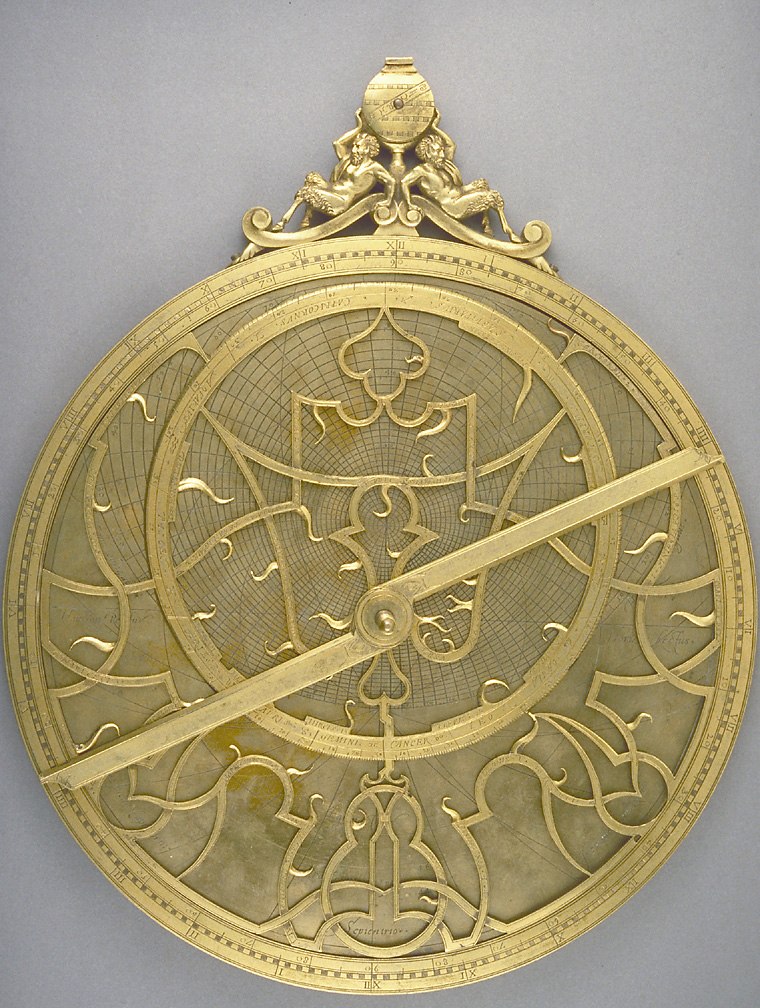
This astrolabe, crafted from gilt brass with a diameter of 270 mm, is signed by Philippe Danfrie. The instrument includes a rete featuring a tulip-shaped design and a throne composed of two satyrs supporting a swiveling suspension element in the shape of an armillary sphere. The back of the instrument contains an eccentric Gregorian calendar, zodiacal scales, and a solar cycle scale marked 'CYCLUS SOLARIS' with corresponding Dominical Letters, centered on the year 1600. The inside of the mater is engraved with a Quadratum Nauticum. The plates are marked for various latitudes, including specific settings for 42 to 52 degrees. The rule and alidade feature foliate engraving. The instrument is held by the British Museum and was donated by Ferdinand de Rothschild in 1897. Construction details include a riveted rim and a pin consisting of a long bolt with a ridged circular nut.

Front view of the brass astrolabe by Philippe Danfrie, showing the rete, throne, and mater scales.
Front view of the brass astrolabe by Philippe Danfrie, showing the rete, throne, and mater scales. — British Museum, London. Rights pending — permission not yet requested. Original source

Catalogue identity

Source
www.mhs.ox.ac.uk
Category
Tool · French astrolabe
Maker / attribution
Philippe Danfrie
Reference
Not recorded
Catalogue / lot identifier
MLA 1897,11-18.1
Source-reported date
circa 1600
Source-reported place
France

Source-reported attribution and specifications are not independent authentication. A listing does not establish present ownership, current display, availability or permission to reproduce.

Object description

Construction and Rete

The astrolabe is constructed from gilt brass and measures 270 mm in diameter. The rim of the mater is riveted to the backplate and features an equal 24-hour scale, divided into five-minute increments, alongside a 360-degree altitude scale. The throne is fixed to the rim with screws and is formed by two foliate scrolls that carry two reclining male satyrs; these figures support a swiveling suspension mechanism modeled as an armillary sphere.

The rete follows the pattern associated with Arsenius-type astrolabes and contains construction marks on the reverse. It displays the names of 42 stars with their respective magnitudes. The ecliptic is marked with Latin names of the zodiacal signs, each divided into 30-degree sections and further subdivided into single degrees.

Evidence for this section
  • “Gilt brass; 270 mm in diameter”
  • “The throne, fixed to the rim by screws, consists of two foliate scrolls carrying two reclining male satyrs supporting a swiveling suspension in the shape of an armillary sphere.”
  • “The rete, with construction marks on the reverse, follows the typical pattern of Arsenius type astrolabes.”

Backplate and Solar Cycle

The back of the instrument contains several circular scales, including a 360-degree altitude scale and a zodiacal scale with Latin names and figural representations. An eccentric Gregorian calendar scale is present, showing the months and days. Positioned at the bottom is a double shadow scale labeled 'VMBRA RECTA' and 'VMBRA VERSA' with bases of 12 and 60 respectively.

The center of the backplate houses a solar cycle scale, comprising four concentric circles. This area displays the years 1600, 1601, and 1602, alongside the 28-year solar cycle and corresponding Dominical Letters for ordinary and leap years. The center includes a blank escutcheon flanked by stylized eagles and a winged cherub head with strapwork.

Evidence for this section
  • “The back bears several circular scales”
  • “An eccentric Gregorian calendar scale marked with the usual Latin names of the months and figural representations”
  • “In the centre is a solar cycle scale consisting of four concentric circles”

Mater and Provenance

The inside of the mater is engraved with a Quadratum Nauticum, identifying compass points through the names of winds arranged in three bands with cardinal directions. The plates are marked for latitudes ranging from 42 to 52 degrees and contain circles for the equator and tropics, as well as markings for azimuths, almucantars, and astrological houses in the manner of Regiomontanus.

The instrument was donated to the British Museum by Ferdinand de Rothschild in 1897. It is catalogued under the registration number MLA 1897,11-18.1 and is further documented in F. A. B. Ward's 1981 publication regarding European scientific instruments in the museum's collection.

Evidence for this section
  • “The inside of the mater is engraved with a Quadratum Nauticum”
  • “The plates are laid out and marked for the following latitudes”
  • “The instrument was donated by Ferdinand de Rothschild in 1897”

Open research questions

  • What purpose was intended for the currently blank escutcheon on the back of the instrument?
  • Could the missing swivel pin and alidade vanes be reconstructed based on similar Danfrie instruments?

Source evidence

Recorded claims and source quotations for Astrolabe by Philippe Danfrie
FieldSource-reported valueSource quotation
MakerPhilippe Danfrie“Signed by Philippe Danfrie”
Datecirca 1600“circa 1600”
MaterialGilt brass“Gilt brass”
Diameter270 mm“270 mm in diameter”
Inventory NumberMLA 1897,11-18.1“Registration no. MLA 1897,11-18.1”
Signature locationBetween calendar and zodiacal scale“Between the calendar scale and the zodiacal scale at the bottom is the signature 'P[star]Danfrie F.[star]'”

Visible details

  • The throne features two male satyrs supporting an armillary sphere.
  • The rete displays construction marks on its reverse side.
  • The mater contains a central Quadratum Nauticum engraved with wind names.
  • The alidade and rule are counterchanged and decorated with foliate engraving.

Research qualifications

  • The swivel pin and suspension ring are missing.
  • The alidade sighting vanes are missing.
  • The specific year of manufacture remains inferred from internal solar cycle data.

Photograph identity and source facts were screened before import; rights clearance remains pending.

Consulted source

Astrolabe

Reviewed 2026-10-26 · Record e71559a31c

Terms in this record

Glossary explanations for terms named in this object’s record.