
Skip to content
The Encyclopedia of Horology

Tool · French astrolabe

Astrolabe by Adrianus Descrolieres

Partially verified

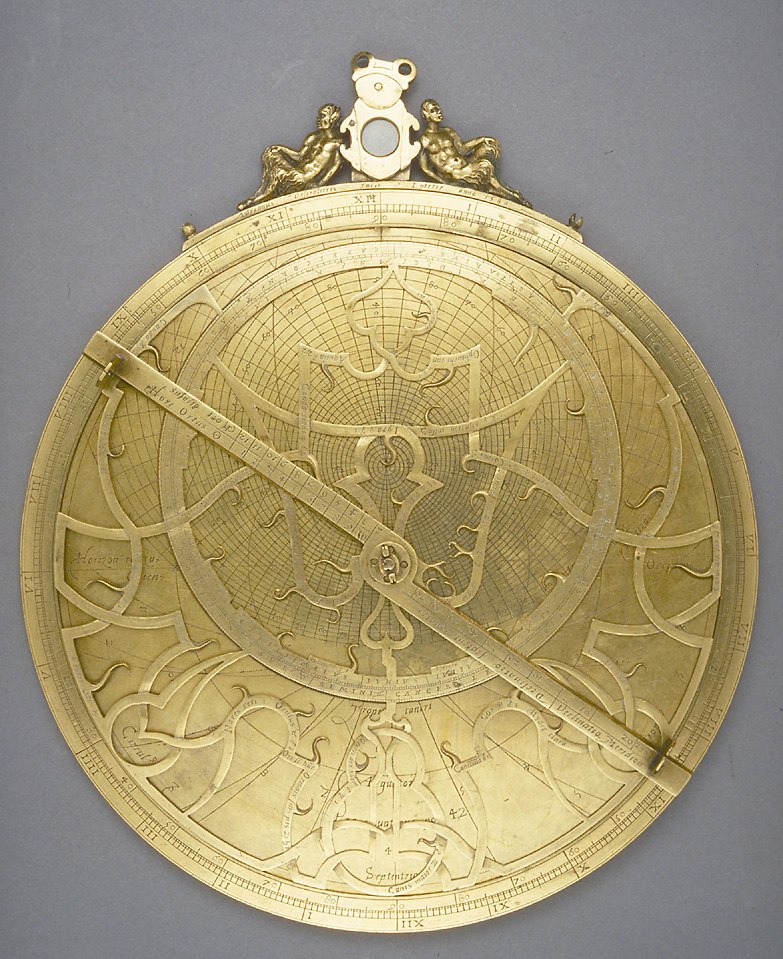
This gilt brass astrolabe, measuring 271 mm in diameter, was made in Paris by Adrianus Descrolieres and dated 1580. The instrument features a rete with tulip-shaped elements, and a throne designed as two reclining satyrs flanking a central shield. The mater rim is marked with an equal 24-hour scale and an altitude scale, with the interior containing a quadratum nauticum. The device includes three plates engraved with coordinates for varying latitudes, the Horizon rectus, and the Horizon obliquus. The back of the astrolabe displays a universal projection attributed to Gemma Frisius. Star names, planetary temperaments, and magnitudes are engraved throughout the instrument. The front is fitted with an alidade marked with sun rise and set times, alongside solar declination scales. The object was formerly part of the Spitzer collection and is held by the British Museum, registered as MLA 1893,6-16.1.

Front view of the 1580 astrolabe by Adrianus Descrolieres, showing the rete, throne with satyrs, and alidade.
Front view of the 1580 astrolabe by Adrianus Descrolieres, showing the rete, throne with satyrs, and alidade. — British Museum, London. Rights pending — permission not yet requested. Original source

Catalogue identity

Source
www.mhs.ox.ac.uk
Category
Tool · French astrolabe
Maker / attribution
Adrianus Descrolieres
Reference
Not recorded
Catalogue / lot identifier
MLA 1893,6-16.1
Source-reported date
1580
Source-reported place
France

Source-reported attribution and specifications are not independent authentication. A listing does not establish present ownership, current display, availability or permission to reproduce.

Object description

Construction and Layout

The astrolabe is constructed of gilt brass and measures 271 mm in diameter. The rim of the mater is riveted to the backplate and features an external 24-hour scale, with an internal 360-degree altitude scale graduated for observation. The interior of the mater is engraved with a quadratum nauticum, detailing wind names in three distinct bands covering cardinal and intermediate directions.

The throne is fixed to the rim with two screws and consists of a base ring featuring two reclining satyrs. This supports a central shield-shaped suspension piece originally intended to house a compass, though the needle is now absent. Additional components include a rule and an alidade fitted to the front, which bears specific markings for solar declination and sunrise and sunset hours.

Evidence for this section
  • “The rim is rivetted to the backplate.”
  • “The throne is fixed to the rim by two screws.”
  • “It consists of a base in the shape of the section of a ring carrying two reclining sartyrs”

Rete and Plates

The rete follows the Arsenius pattern, incorporating 43 identified stars. Each star is annotated with its magnitude and corresponding planetary temperament, often utilizing symbols in place of zodiacal names. The ecliptic is marked with zodiacal signs, months, and single-degree graduations.

Three plates provide coverage for various latitudes, marked for elevations ranging from 39 to 51 degrees. These plates feature circles for the equator and tropics, azimuths, and almucantars. Plate 3b contains a Horizontale catholicum, providing a shadow scale and an hour diagram for converting equal to unequal hours, represented by segments of vertical hyperbolic spirals.

Evidence for this section
  • “The rete follows the typical pattern of Arsenius type astrolabes.”
  • “There are three plates which are each marked on both sides (except 3b) with the circles for the equator”
  • “Plate 3b) bears markings for the Horizontale catholicum”

Provenance and Literature

The instrument was acquired by the British Museum in 1893, having previously been part of the Spitzer collection. It is catalogued as MLA 1893,6-16.1 in the Department of Medieval and Later Antiquities.

Detailed documentation of this specific astrolabe appears in F. A. B. Ward's 1981 publication regarding the British Museum's collection of European scientific instruments, where it is listed as item number 337.

Evidence for this section
  • “The instrument came from the Spitzer collection and was purchased in 1893.”
  • “It is described in F. A. B. Ward, A catalogue of European Scientific Instruments in the Department of Medieval and Later Antiquities of the British Museum (London, 1981), p. 117, no. 337.”

Open research questions

  • What is the specific composition of the gilding on the brass surface?
  • Are there known examples of the missing compass component that indicate the original needle configuration?

Source evidence

Recorded claims and source quotations for Astrolabe by Adrianus Descrolieres
FieldSource-reported valueSource quotation
MakerAdrianus Descrolieres“Signed by Adrianus Descrolieres”
Date1580“Dated 1580; Paris”
MaterialGilt brass“Gilt brass; 271 mm in diameter”
Inventory NumberMLA 1893,6-16.1“Registration no. MLA 1893,6-16.1”
ProvenanceSpitzer collection“The instrument came from the Spitzer collection”
Diameter271 mm“271 mm in diameter”

Visible details

  • The compass needle is missing from the inset shield.
  • The instrument is engraved with the signature and date on the base ring.
  • The rete includes star names and symbols for planetary temperaments.

Research qualifications

  • The magnetic deviation of the missing compass is listed as approximately 12 degrees east.
  • The source notes a reengraving on the Corona Septentrionalis.

Photograph identity and source facts were screened before import; rights clearance remains pending.

Consulted source

Astrolabe

Reviewed 2026-10-26 · Record edd5a0e1f5

Terms in this record

Glossary explanations for terms named in this object’s record.