
Skip to content
The Encyclopedia of Horology

Tool · French astrolabe

Astrolabe

Partially verified

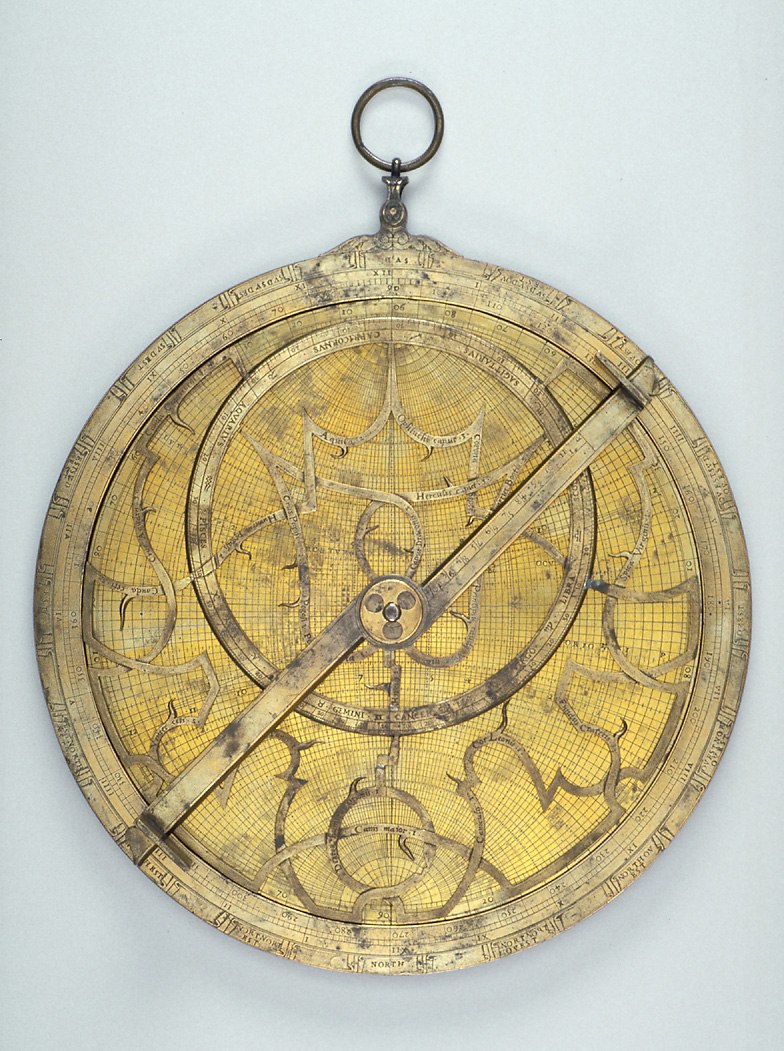
This unsigned brass astrolabe has a diameter of 232 mm and comprises a mater, rete, latitude plates, rule, and alidade. The mater features a squat throne with a shackle and suspension ring. Its limb contains hour divisions and a degree scale alongside French names for sixteen compass points. The rete follows the Arsenius type in tracery, featuring a tulip motif and 25 named stars, with an ecliptic circle marked by zodiacal signs. Two latitude plates provide projections for 45, 47, and 48 degrees, with one side displaying a universal projection of the Gemma Frisius type. The back includes a calendar scale, a double shadow square, and a conversion diagram for equal and unequal hours. The assembly includes a pin that engages with a sliding washer. The instrument is held at the Museum of the History of Science, Oxford.

Front view of the unsigned brass astrolabe, showing the rete and alidade
Front view of the unsigned brass astrolabe, showing the rete and alidade — Museum of the History of Science, Oxford. Rights pending — permission not yet requested. Original source

Catalogue identity

Source
www.mhs.ox.ac.uk
Category
Tool · French astrolabe
Maker / attribution
Not established
Reference
Not recorded
Catalogue / lot identifier
49726
Source-reported date
circa 1570
Source-reported place
France

Source-reported attribution and specifications are not independent authentication. A listing does not establish present ownership, current display, availability or permission to reproduce.

Object description

Construction and Mater

The astrolabe is constructed of brass and measures 232 mm in diameter. The mater is fitted with a squat throne, which supports the shackle and suspension ring. The back plate is secured to the main body by rivets. The limb features a complex series of markings, including hour divisions from 0 to 12 twice, indicated by Roman numerals, and a degree scale running from 0 to 360, divided into single-degree units.

A notable feature is the interior of the mater, which contains a latitude projection for 43 degrees. This includes azimuths and almucantars, as well as markings for the 12 houses labeled 'I DOMVS' through 'XII DOMVS', beginning from the eastern horizon.

Evidence for this section
  • “The mater has a squat throne, shackle and suspension ring, and the back plate secured by rivets.”
  • “Inside the mater is a latitude projection for 43 degrees”

Rete and Latitude Plates

The rete is designed in the Arsenius style, featuring intricate tracery with a tulip motif and displaying 25 named stars. The ecliptic circle is marked with names and symbols of the zodiacal signs, each provided with a 30-degree scale. The instrument is equipped with two latitude plates providing projections for 45, 47, and 48 degrees. These plates feature azimuths and almucantars numbered by 10.

A significant variation in the design is the inclusion of a universal projection of the Gemma Frisius type on the back of one of the latitude plates for 48 degrees. This plate displays lines of right ascension and declination, as well as additional star and ecliptic markings. The configuration represents a blend of familiar elements in an unconventional arrangement, drawing on both Flemish influences and French characteristics.

Evidence for this section
  • “Rete of the Arsenius type in tracery with a tulip motif”
  • “On the other side of the projection for 48 degrees is a universal projection of the Gemma Frisius type”

Back Plate and Accessories

The back of the instrument carries an outer degree scale that serves both for angular measurements and as a base for a zodiacal scale. Accompanying this is a calendar scale with Latin month names, divided into days. The central area contains a double shadow square and a conversion diagram used for equal and unequal hours.

The rule has shaped ends and is fixed with an attached pin, featuring a linear scale divided into 10-degree increments and marked with zodiacal signs. The counterchanged alidade is marked with a scale of hours on one arm. The central assembly is secured by a pin that engages with a sliding washer, completing the functional requirements for the astrolabe's operation.

Evidence for this section
  • “The back has an outer degree scale, whose divisions are also used for a zodiacal scale”
  • “The central area has a double shadow square and a conversion diagram between equal and unequal hours.”

Open research questions

  • What is the definitive significance of the French compass point names?
  • Are there similar extant instruments that combine Flemish rete design with this specific internal latitude projection configuration?

Source evidence

Recorded claims and source quotations for Astrolabe
FieldSource-reported valueSource quotation
Inventory number49726“Inventory number 49726”
Diameter232 mm“232 mm in diameter”
MaterialBrass“Brass; 232 mm in diameter”
Datecirca 1570“circa 1570; French”
Attributed countryFrench“French”
Compass points16“The limb has the French names of 16 compass points”
Rete typeArsenius“Rete of the Arsenius type in tracery with a tulip motif”

Visible details

  • Squat throne with shackle and suspension ring
  • Arsenius-type rete with tulip-motif tracery
  • Degree scale on limb numbered by 10
  • Double shadow square on the instrument's back

Research qualifications

  • The French origin is based on the uncertain significance of the compass point names
  • The universal projection's placement on a latitude plate is an unusual configuration

Photograph identity and source facts were screened before import; rights clearance remains pending.

Consulted source

Astrolabe

Reviewed 2026-10-26 · Record 74453be92b

Terms in this record

Glossary explanations for terms named in this object’s record.