
Skip to content
The Encyclopedia of Horology

Clock · Bracket clock

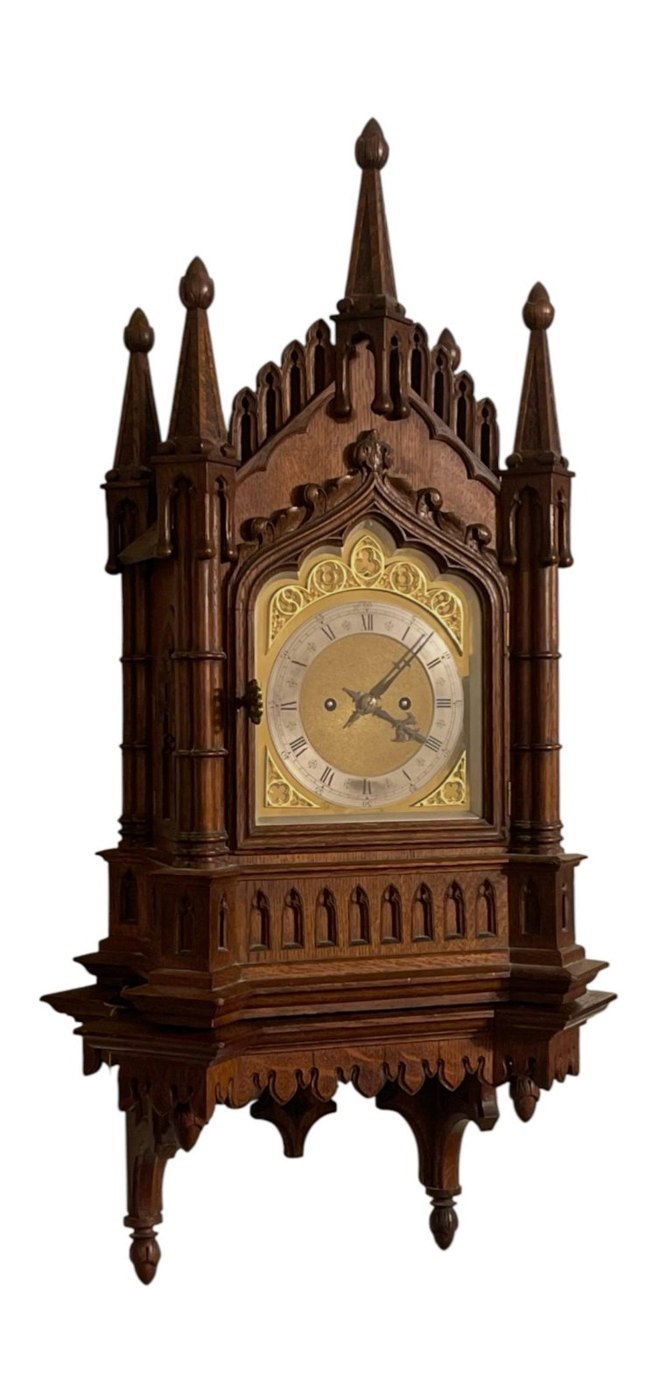
Winterhalder & Hofmeier Gothic Revival bracket wall clock with matching sconces

Partially verified

This late 19th-century bracket wall clock by Winterhalder & Hofmeier is constructed from walnut and features a case design inspired by a miniature cathedral façade. The structure is characterized by a central spire and auxiliary turrets, each finished with lancet arches and Gothic tracery. The dial is set behind a door flanked by clustered colonettes, consisting of a silvered chapter ring with Roman numerals and a central gilt section, matched with pierced hands and gilt spandrels. The sides are fitted with traceried windows backed by red fabric. The clock operates via an eight-day chain fusee movement capable of playing full Westminster chimes. It rests on a matching carved wall bracket with pendant finials. The suite includes corresponding wall sconces.

Winterhalder & Hofmeier Gothic Revival bracket wall clock with matching wall bracket, featuring a cathedral-style walnut case, Gothic tracery, and silvered Roman numeral dial.
Winterhalder & Hofmeier Gothic Revival bracket wall clock with matching wall bracket, featuring a cathedral-style walnut case, Gothic tracery, and silvered Roman numeral dial. — Stevens Auction Company, via Invaluable. Rights pending — permission not yet requested. Original source

Catalogue identity

Source
orbiscollectibles.com
Category
Clock · Bracket clock
Maker / attribution
Winterhalder & Hofmeier
Reference
No. 147
Catalogue / lot identifier
Source URL identifies the listing
Source-reported date
Late 19th Century
Source-reported place
Germany

Source-reported attribution and specifications are not independent authentication. A listing does not establish present ownership, current display, availability or permission to reproduce.

Object description

Case and Aesthetic Design

The clock is housed in a walnut case designed to resemble a small-scale cathedral. The vertical emphasis is achieved through a tall central spire flanked by subsidiary turrets, all of which incorporate lancet arches and detailed Gothic tracery. The main body of the case features clustered colonettes that support a pointed arch above the dial door.

The sides of the clock are decorated with windows containing Gothic tracery, which are finished with a red fabric backing. The entire assembly sits upon a matching carved wall bracket that features turned pendant finials. This architectural theme is further echoed in the matching wall sconces included with the piece, ensuring a unified decorative appearance consistent with the Gothic Revival style.

Evidence for this section
  • “features a highly detailed walnut case designed in the style of a miniature cathedral façade”
  • “The architectural structure is adorned with a central spire and subsidiary turrets, each featuring lancet arches and intricate Gothic tracery.”
  • “The sides of the case incorporate Gothic tracery windows with red fabric backing.”

Dial and Movement

The circular dial is set within the primary door of the case. It comprises a silvered chapter ring displaying Roman numerals, centered by a gilt decorative panel. The time is indicated by pierced hands, and the dial is further embellished with gilt spandrels.

Internally, the timepiece is powered by an eight-day chain fusee movement. This mechanical system is equipped to perform full Westminster chimes. The combination of the chime complication and the fusee power source reflects the functional standards of late 19th-century horology within the Winterhalder & Hofmeier production range.

Evidence for this section
  • “The dial door, framed by clustered colonettes under a pointed arch, contains a circular dial with a silvered Roman numeral chapter ring and a gilt center, accompanied by pierced hands and gilt spandrels.”
  • “Eight-day chain fusee”
  • “Full Westminster chimes”

Attribution and Documentation

The clock is attributed to the manufacturer Winterhalder & Hofmeier. Documentation for this specific model exists in the maker's own literature, where it is identified as model number 147 in their 1890 and 1901 catalogues.

The provided description confirms that the suite consists of the bracket clock and associated matching sconces.

Evidence for this section
  • “This exceptional late 19th-century Gothic Revival bracket wall clock, produced by Winterhalder & Hofmeier”
  • “This piece was documented in the maker's 1890 and 1901 catalogs as No. 147.”
  • “The suite includes matching Gothic Revival wall sconces that echo the decorative motifs of the clock case.”

Open research questions

  • What is the specific nature of the original red fabric backing inside the traceried windows?
  • Are there variations in the woodwork detailing observed between the 1890 and 1901 catalogue examples of No. 147?

Source evidence

Recorded claims and source quotations for Winterhalder & Hofmeier Gothic Revival bracket wall clock with matching sconces
FieldSource-reported valueSource quotation
MakerWinterhalder & Hofmeier“Winterhalder & Hofmeier”
MaterialWalnut“walnut case”
Movement typeEight-day chain fusee“Eight-day chain fusee”
Dimensions36 in. H, 15 in. W, 11 in. D“36 inches in height, 15 inches in width, and 11 inches in depth.”
Catalog ReferenceNo. 147“This piece was documented in the maker's 1890 and 1901 catalogs as No. 147.”
ComplicationFull Westminster chimes“Full Westminster chimes”

Visible details

  • Central spire and subsidiary turrets
  • Gothic tracery on the case sides
  • Silvered chapter ring with Roman numerals
  • Carved wall bracket with turned finials

Research qualifications

  • Condition of the movement is not detailed in the source
  • Verifiability of the red fabric backing origin is not specified

Photograph identity and source facts were screened before import; rights clearance remains pending.

Terms in this record

Glossary explanations for terms named in this object’s record.