
Skip to content
The Encyclopedia of Horology

Clock · Bracket clock

William III ebonised repeating double fusee bracket clock

Partially verified

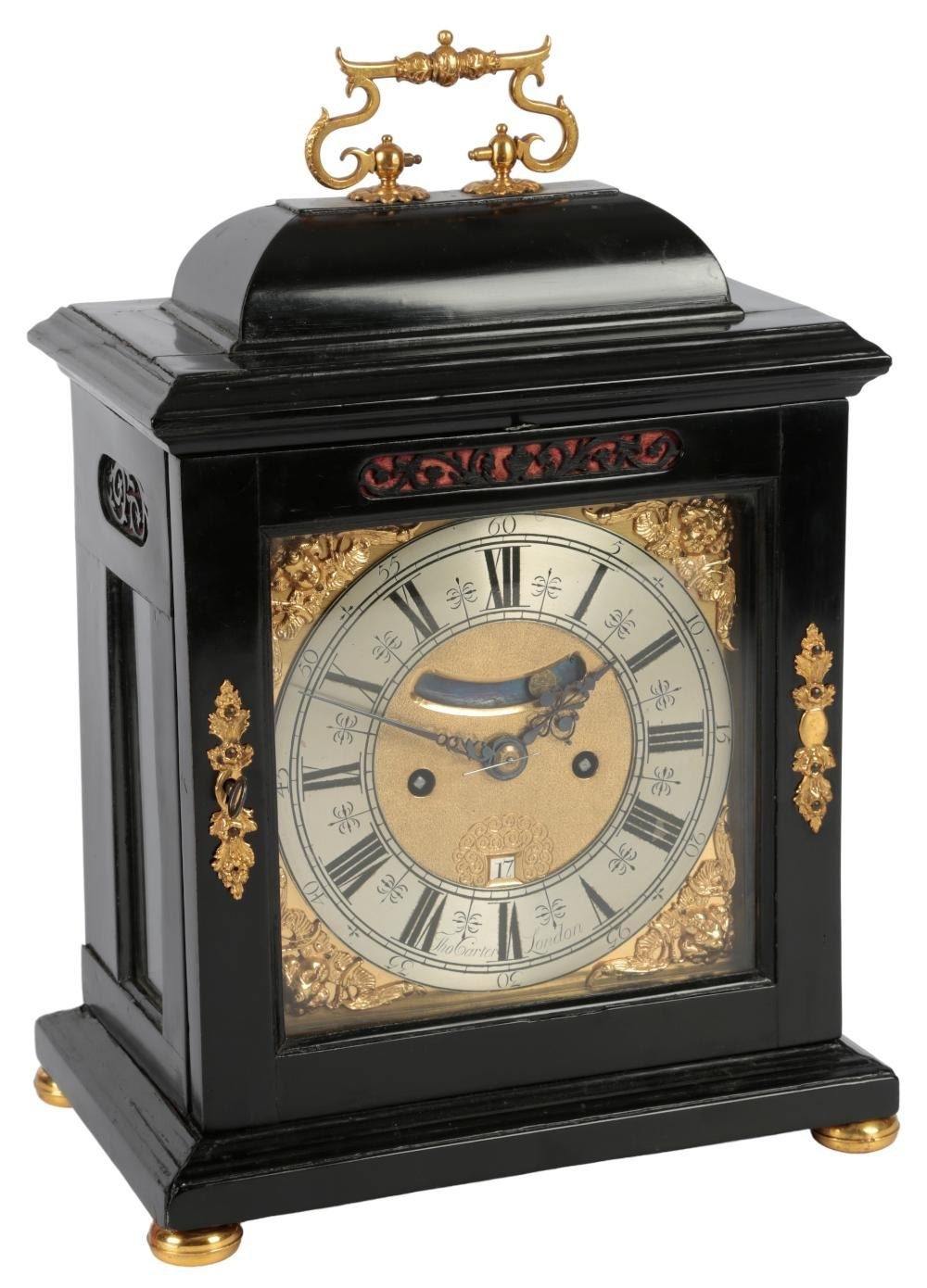
This William III period bracket clock is an ebonised wooden timepiece attributed to the London maker Thomas Carter, dated to approximately 1695. The clock features a caddy-top case mounted with gilt brass elements, including a carrying handle, bun feet, and escutcheons. The case design incorporates lined fretwork panels positioned above the glazed side and door sections. Internally, the clock is powered by a six-pillar verge escapement movement that utilises a double fusee system. The mechanism provides a repeating function, striking on a bell while chiming on four additional bells. The gilt brass dial is set with a silvered chapter ring featuring Roman hour numerals and Arabic minutes, complemented by angel spandrels. Additional dial elements include a date aperture and a false pendulum opening with a pear-shaped bob. The clock stands 33.5 cm high excluding the handle and includes its original brass winding key.

Three-quarter view showing the ebonised case, gilt brass mounts, and the gilt brass dial with angel spandrels and silvered chapter ring.
Three-quarter view showing the ebonised case, gilt brass mounts, and the gilt brass dial with angel spandrels and silvered chapter ring. — Auction house “Gorringes”, via Invaluable. Rights pending — permission not yet requested. Original source

Catalogue identity

Source
orbiscollectibles.com
Category
Clock · Bracket clock
Maker / attribution
Thomas Carter
Reference
Not recorded
Catalogue / lot identifier
Source URL identifies the listing
Source-reported date
c.1695
Source-reported place
London

Source-reported attribution and specifications are not independent authentication. A listing does not establish present ownership, current display, availability or permission to reproduce.

Object description

Case and Exterior Details

The clock is housed in an ebonised caddy-top case. It is fitted with gilt brass furniture, which includes a carrying handle at the top and bun-style feet at the base. Decorative gilt brass escutcheons are also present on the sides of the case.

The structure of the case includes glazed panels on the door and sides, accompanied by lined fretwork sections placed above these areas.

Evidence for this section
  • “ebonised caddy-top case adorned with gilt brass mounts, including a handle, escutcheon, and bun feet”
  • “The case incorporates lined fretwork panels above the glazed sides and on the door”

Dial and Timekeeping Display

The dial is constructed from gilt brass and is set with a silvered chapter ring. The time is indicated by Roman hour numerals and Arabic minute markers. The corners of the dial are embellished with gilt angel spandrels.

Further dial functions include a centrally placed date window and a false pendulum aperture with a visible pear-shaped bob. The maker's signature, Thomas Carter of London, is positioned on the dial.

Evidence for this section
  • “dial is made of gilt brass, accented with gilt angel spandrels and a silvered chapter ring displaying Roman hour numerals and Arabic minutes”
  • “Additional features include a date window, a false pendulum aperture, and a pear-shaped bob”
  • “The signature of the clockmaker, Thomas Carter of London, is present on the dial”

Movement and Mechanism

The movement of the clock is built around a six-pillar frame and utilizes a verge escapement. Power is transmitted through a double fusee system. The backplate features engraving in a foliate pattern.

The clock includes a repeating function, which is designed to strike on a single bell while simultaneously chiming on a set of four bells. The maker's signature is also repeated on the backplate of the movement.

Evidence for this section
  • “six-pillar verge escapement movement equipped with a double fusee system”
  • “features a decorated backplate with foliate engraving”
  • “The signature of the clockmaker, Thomas Carter of London, is present on the dial and the backplate”

Open research questions

  • Are there records of other known clocks by Thomas Carter to compare the movement architecture?
  • Is the fretwork backing original or a later restoration?

Source evidence

Recorded claims and source quotations for William III ebonised repeating double fusee bracket clock
FieldSource-reported valueSource quotation
MakerThomas Carter“Thomas Carter of London”
Datecirca 1695“dating the piece to approximately 1695”
MovementSix-pillar verge escapement with double fusee“six-pillar verge escapement movement equipped with a double fusee system”
Height33.5 cm excluding handle“The clock measures 33.5 cm in height, excluding the handle”
Case materialsEbonised wood and gilt brass“ebonised caddy-top case adorned with gilt brass mounts”
Striking mechanismRepeating function, single bell, and four chimes“repeating function, striking on a bell and chiming on a further four bells”

Visible details

  • Silvered chapter ring with Roman hours and Arabic minutes
  • Gilt brass angel-pattern corner spandrels
  • Caddy-top case structure with gilt brass handle
  • Date aperture visible at the 6 o'clock position

Research qualifications

  • The source classifies the record status as partial
  • Authenticity is not verified beyond the auction-house listing

Photograph identity and source facts were screened before import; rights clearance remains pending.

Consulted source

William III ebonised repeating double fusee bracket clock by Thomas Carter, London

Reviewed 2026-11-02 · Record 987c7679b6

Terms in this record

Glossary explanations for terms named in this object’s record.