
Skip to content
The Encyclopedia of Horology

Clock · Bracket clock

William Haycock Walnut Bracket Clock

Partially verified

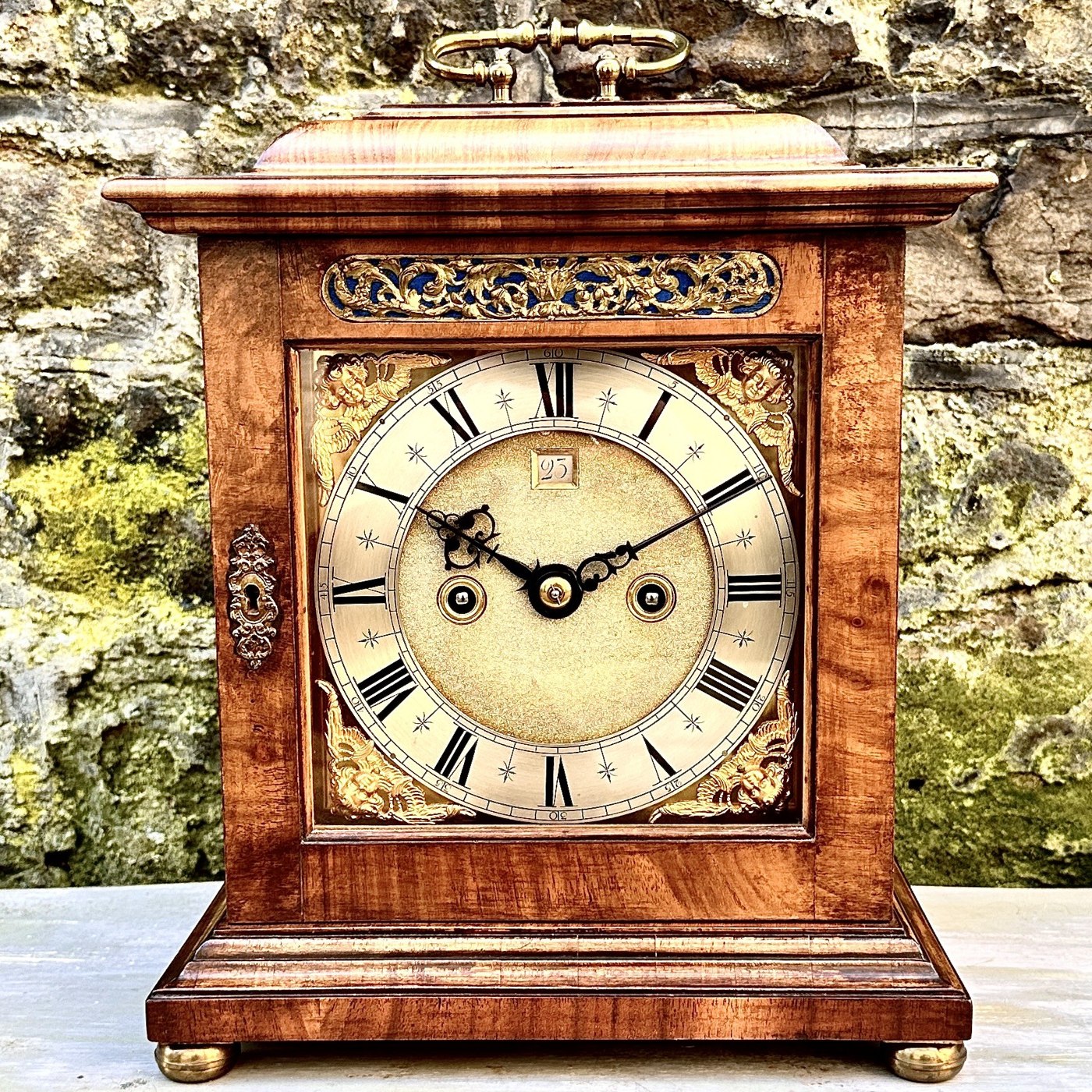
This 20th-century bracket clock is crafted from solid walnut in a style based on the Queen Anne period. The timepiece is signed by William Haycock of Ashbourne, Derbyshire, The clock features a caddy top with a gilt-brass carrying handle and side glass viewing panels. The front door includes a brass lock plate and an ornate gilt-brass fretwork panel. Its 6.5-inch dial displays winged-angel spandrels, a silvered chapter ring with Roman numerals, and a matted brass center with a date aperture. The movement is an eight-day, twin-fusee mechanical mechanism with five pillars, striking the hour on an internal bell. The backplate bears the engraved inscription "Wm Haycock, Asbourne 1679". Measuring 35.5 cm in height, 27.5 cm in width, and 20 cm in depth, the clock is reported by the auction description to have undergone a full mechanical overhaul.

Front view of the William Haycock bracket clock, showing the dial, gilt fretwork, and walnut case.
Front view of the William Haycock bracket clock, showing the dial, gilt fretwork, and walnut case. — Chequers Antiques. Rights pending — permission not yet requested. Original source

Catalogue identity

Source
zamanito.com
Category
Clock · Bracket clock
Maker / attribution
William Haycock
Reference
1679
Catalogue / lot identifier
Source URL identifies the listing
Source-reported date
circa 1979
Source-reported place
England

Source-reported attribution and specifications are not independent authentication. A listing does not establish present ownership, current display, availability or permission to reproduce.

Object description

Case and Dial Design

The clock features a solid walnut case with a caddy top design, finished with a gilt-brass carrying handle. The side panels are fitted with glass windows, while the front door includes an ornamental gilt-brass fretwork panel above the dial and a brass lock plate. The clock rests on four small brass feet.

The 6.5-inch dial is composed of a matted brass center surrounded by a silvered chapter ring, featuring Roman numeral hour markers and detailed minute tracks. The corners are decorated with gilt-brass spandrels in the form of winged angel figures. The hour and minute hands are constructed from pierced, blued steel, and a date aperture is located at the top center of the dial.

Evidence for this section
  • “بدنه ساعت از چوب گردوی یکپارچه”
  • “بخش بالایی ساعت دارای سقف برآمده با شیب ملایم (Caddy Top)”
  • “گوشه‌نماهای برنجی زراندود به طرح چهره فرشتگان بالدار”

Movement and Mechanical Details

The timepiece is powered by an eight-day mechanical movement utilizing a twin-fusee system with five pillars. This mechanism is designed to provide consistent force to the gear train. The clock includes a striking mechanism that sounds the hour on an internal metallic bell.

The backplate of the movement is embellished with decorative engraving and includes the specific inscription "Wm Haycock, Asbourne 1679." The movement is visible through the glass door located at the rear of the clock case.

Evidence for this section
  • “این موتور مجهز به سیستم نواختن زنگ در سر هر ساعت روی کاسه زنگ فلزی است”
  • “صفحه پشت موتور با طرح‌های قلم‌زنی تزئین شده”

Provenance and Condition

The clock is attributed to the workshop of William Haycock, located in Ashbourne, Derbyshire, with history cited back to 1826. The auction description reports that the clock is in excellent condition, with the case appearing free of damage and the gilt-brass components maintaining their finish.

The movement is stated to have undergone a complete service and overhaul.

Evidence for this section
  • “توسط کارگاه شناخته‌شده William Haycock در اشبورن (Ashbourne) داربی‌شر تولید شده”
  • “موتور ساعت سرویس کامل و بازآماد (Overhaul) شده”
  • “برای خریداران و مجموعه‌داران توصیه می‌شود تنظیمات آونگ و مکانیزم کوک فیوزی ساعت را پس از حمل‌ونقل بررسی کرده”

Open research questions

  • Does the 1679 date on the backplate signify a specific historical model reference used by the Haycock workshop?
  • What is the full recorded history of the William Haycock workshop in Ashbourne beyond its 1826 origin?

Source evidence

Recorded claims and source quotations for William Haycock Walnut Bracket Clock
FieldSource-reported valueSource quotation
MakerWilliam Haycock“توسط کارگاه شناخته‌شده William Haycock”
Datecirca 1979“حدود ۱۹۷۹”
Movement8-day twin-fusee mechanical“موتور این ساعت از نوع مکانیکی کوکی هشت‌روزه دارای پنج ستون و دو حلزونی (Twin Fusee)”
InscriptionWm Haycock, Asbourne 1679“«Wm Haycock, Asbourne 1679» بر روی آن حک شده است”
Dial Diameter6.5 inches“صفحه ساعت به ابعاد ۶٫۵ اینچ”
Dimensions35.5 x 27.5 x 20 cm“ارتفاع ۳۵٫۵ سانتی‌متر، عرض ۲۷٫۵ سانتی‌متر و عمق ۲۰ سانتی‌متر”
Case MaterialSolid walnut“بدنه ساعت از چوب گردوی یکپارچه”

Visible details

  • Case features natural walnut grain patterning
  • Blued steel pierced hands
  • Four gilt-brass bun feet
  • Gilt-brass winged-angel corner spandrels

Research qualifications

  • The 1679 date on the movement is presented as part of the maker's inscription, potentially referencing a period style rather than manufacture date
  • The functional accuracy of the calendar and strike mechanisms requires independent verification by the purchaser

Photograph identity and source facts were screened before import; rights clearance remains pending.

Consulted source

A Queen Anne Style Walnut Bracket Clock

Reviewed 2026-11-02 · Record 56091275b6

Terms in this record

Glossary explanations for terms named in this object’s record.