
Skip to content
The Encyclopedia of Horology

Clock · Longcase clock

William Cattell Marquetry Longcase Clock

Partially verified

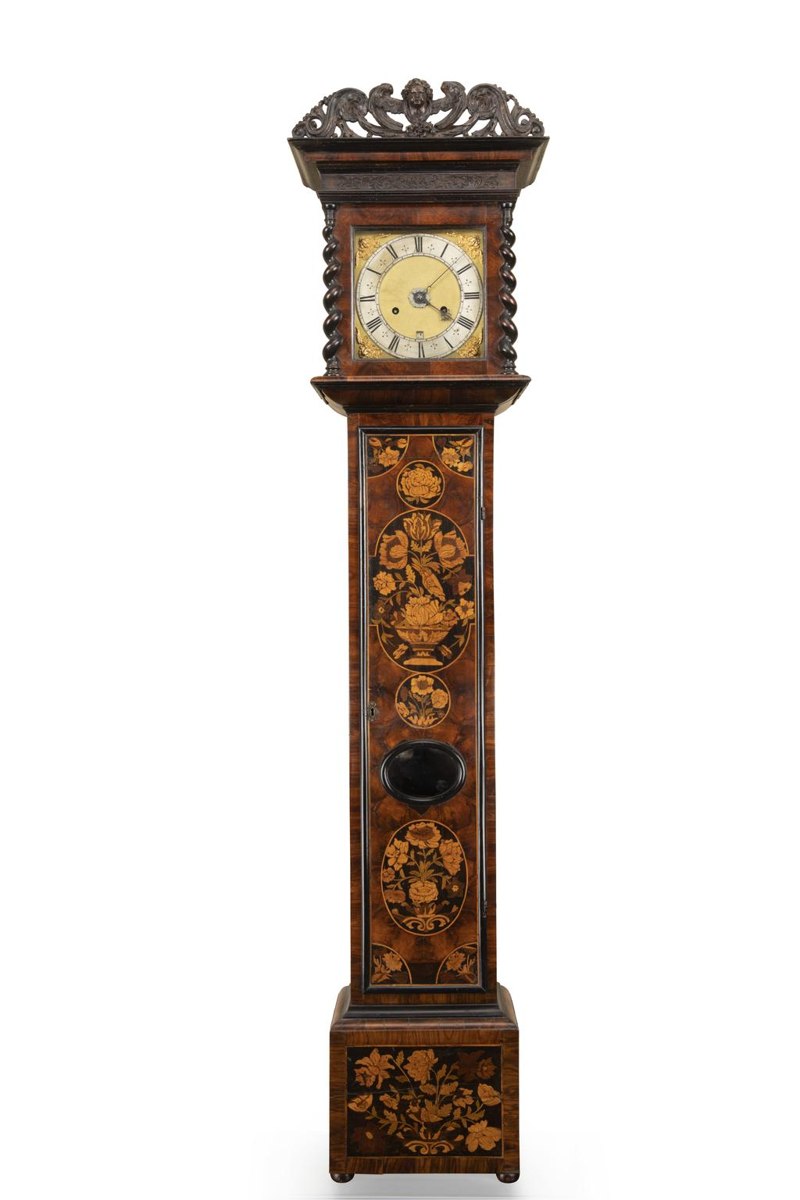
Dating to circa 1675–1685 in London, this longcase clock is attributed to William Cattell. The case is veneered with bird and flower marquetry in walnut and olivewood 'oysters', complemented by ebonised mouldings, spiral barley-twist hood pillars, and an openwork carved cresting. An oval glass lenticle is set into the trunk door. The 10-inch brass dial features a matted centre, date aperture, central alarm disc, applied silvered chapter ring, cherub corner spandrels, and pierced steel hands. The source reports an eight-day movement with an anchor escapement, internal count wheel striking, and alarm-work, signed 'Wm Cattell in Fleete Streete' beneath the chapter ring.

Full-length front view of the William Cattell marquetry longcase clock
Full-length front view of the William Cattell marquetry longcase clock — Science Museum Group/The Clockmakers' Museum © The Board of Trustees of the Science Museum. Rights pending — permission not yet requested. Original source

Catalogue identity

Source
collection.sciencemuseumgroup.org.uk
Category
Clock · Longcase clock
Maker / attribution
William Cattell
Reference
Not recorded
Catalogue / lot identifier
L2015-4221
Source-reported date
1675-1685
Country
United Kingdom

Source-reported attribution and specifications are not independent authentication. A listing does not establish present ownership, current display, availability or permission to reproduce.

Object description

Case Construction and Marquetry

The longcase clock features an exterior veneered with bird and flower marquetry, executed in walnut and olivewood 'oysters'. The case incorporates ebonised mouldings and pillars.

The trunk door includes a glass lenticle. Further decorative elements and structural details are noted in the source documentation.

Evidence for this section
  • “Case veneered with bird and flower marquetry in walnut and olivewood 'oysters', with ebonised mouldings and pillars.”
  • “The trunk door has a glass lenticle.”

Dial and Signature

The 10-inch brass dial features a matted centre, a date aperture, and a central alarm disc. It includes an applied silvered chapter-ring and cherub spandrels in the corners, with pierced steel hour and minute hands.

The dial is signed 'Wm Cattell in Fleete Streete' at the base, located underneath the chapter ring.

Evidence for this section
  • “The 10 inch brass dial has a matted centre with a date aperture, alarm disc to centre, an applied silvered chapter-ring and cherub spandrels in each corner.”
  • “Pierced steel hour and minute hands.”
  • “The dial is signed ‘Wm Cattell in Fleete Streete’ at the base, underneath the chapter ring.”

Movement and Technical Details

The clock contains an eight-day movement with an anchor escapement. It features alarm-work and count wheel striking, with the count wheel positioned on the inside of the movement.

These technical details are provided as museum documentation for the object.

Evidence for this section
  • “The movement has an anchor escapement, alarm-work, and count wheel striking.”
  • “The count wheel is located on the inside of the movement.”
  • “Eight day duration.”

Open research questions

  • Are the specific components of the marquetry and cresting contemporary to the 1675–1685 date range?
  • Does the internal mechanism show signs of alteration or replacement since the item's original construction?

Source evidence

Recorded claims and source quotations for William Cattell Marquetry Longcase Clock
FieldSource-reported valueSource quotation
Maker SignatureWm Cattell in Fleete Streete“The dial is signed ‘Wm Cattell in Fleete Streete’ at the base, underneath the chapter ring.”
Movement DurationEight day duration“Eight day duration.”
EscapementAnchor escapement“The movement has an anchor escapement, alarm-work, and count wheel striking.”
Dial Size10 inch brass dial“The 10 inch brass dial has a matted centre with a date aperture, alarm disc to centre, an applied silvered chapter-ring and cherub spandrels in each corner.”
Museum Inventory NumberClockmakers' Museum No. 1311“Clockmakers' Museum No. 1311”
Maker HistoryApprenticed 1665 to Edward Staunton, became freeman 1672“Cattell was apprenticed in 1665 to Edward Staunton and became a freeman of the Clockmakers’ Company in 1672.”

Visible details

  • Carved openwork cresting featuring scrolls and a central mask surmounts the hood.
  • Barley-twist wooden pillars frame the square glazed hood door.
  • The trunk door features multiple floral marquetry panels interspersed with an oval glass pendulum lenticle.
  • The plinth base is decorated with a matching floral marquetry panel and rests on small feet.

Research qualifications

  • Internal movement, weight-driven components, and signature beneath the chapter ring are not visible in this full-length exterior photograph.
  • Technical movement characteristics are reported by the museum and cannot be independently confirmed from the closed case image.

Photograph identity and source facts were screened before import; rights clearance remains pending.

Terms in this record

Glossary explanations for terms named in this object’s record.