
Dial and Mechanism
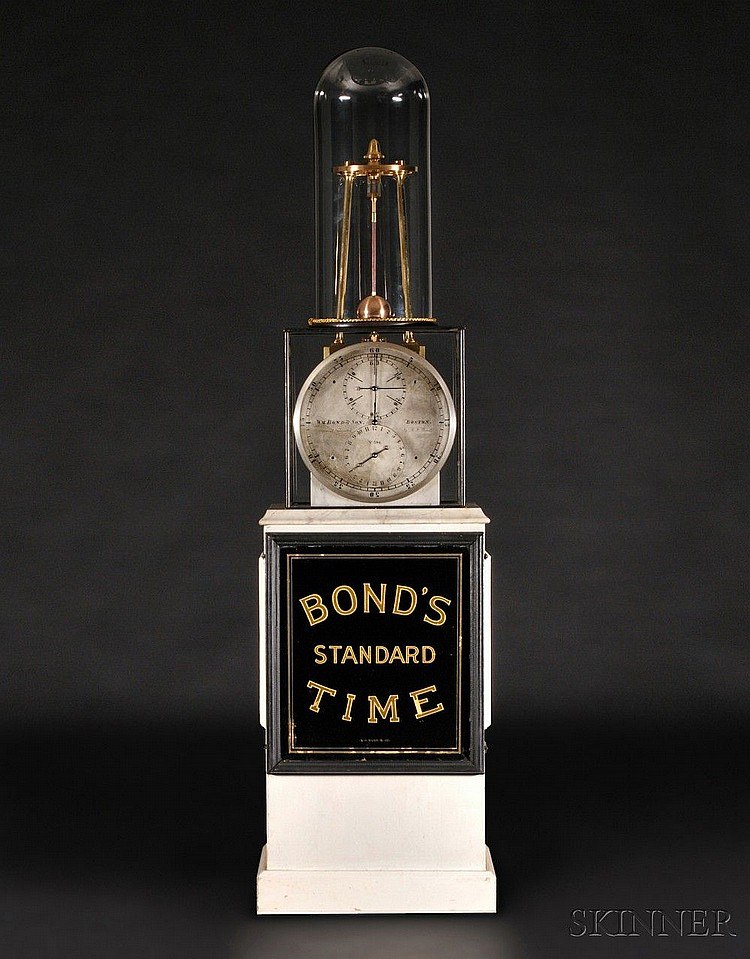
The instrument features a 12-inch diameter silvered brass dial signed 'Wm. Bond & Son, Boston', 'Escapement Invented by R. F. Bond', and 'No. 396'. The dial displays outer Arabic minutes, a subsidiary seconds dial divided into two-second increments positioned at the top, and hours indicated on a lower subsidiary dial.
The movement is constructed with two trains and six pillars, incorporating a top-mounted conical pendulum under a glass dome to provide a constant-force remontoire. The single-arm gravity escapement impulses a seconds-beating pendulum originally designed for mercury temperature compensation. A break-circuit provision is situated on the upper right corner of the backplate marked 'Break', 'Close', and 'Break and Close', though the auction condition report records that the break-close device itself is no longer present.
Evidence for this section
- “12-inch diameter silvered brass dial signed Wm. Bond & Son, Boston , Escapement Invented by R. F. Bond and No. 396, outer Arabic minutes, seconds dial divided in two-second increments at the top and hours on the lower dial”
- “the two train, six pillar movement with top mounted conical pendulum under a glass dome providing a constant force remontoire, single arm gravity escapement providing impulse to the seconds beating mercury-filled temperature compensated pendulum”
- “break-circuit provision on upper right corner of backplate and marked Break , Close and Break and Close , powered by a lead weight”
- “The "Break-Close" device once mounted on the back plate is now gone, with clear evidence of position and original bridges.”