
Skip to content
The Encyclopedia of Horology

Clock · Astronomical regulator

Charles Frodsham Astronomical Regulator Clock

Partially verified

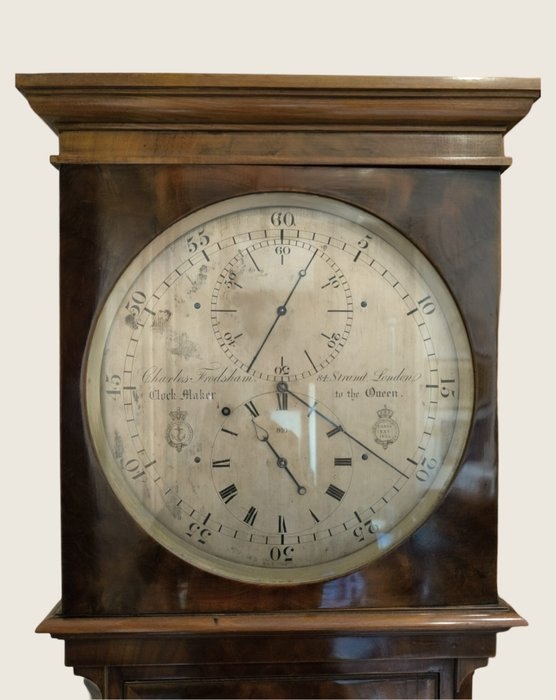
This astronomical regulator clock attributed to Charles Frodsham features a silvered metal regulator dial set in a mahogany case. The dial layout includes an outer minute track calibrated in five-minute Arabic increments, a subsidiary seconds dial marked in ten-second divisions above, and an eccentric lower hour dial. Engravings on the dial face attribute the piece to 'Charles Frodsham Clock Maker' at '84 Strand, London to the Queen'. Medallions below the center mention a royal appointment and a gold medal from the 1855 Paris Exhibition.

Hood and silvered regulator dial of the Charles Frodsham astronomical clock
Hood and silvered regulator dial of the Charles Frodsham astronomical clock — Catawiki. Rights pending — permission not yet requested. Original source

Catalogue identity

Source
www.catawiki.com
Category
Clock · Astronomical regulator
Maker / attribution
Charles Frodsham
Reference
Not recorded
Catalogue / lot identifier
94375634
Source-reported date
Circa 1855 or later
Source-reported place
United Kingdom

Source-reported attribution and specifications are not independent authentication. A listing does not establish present ownership, current display, availability or permission to reproduce.

Object description

Dial Configuration and Inscriptions

The clock displays a circular silvered metal regulator dial with an outer circumference marked in Arabic numerals at five-minute intervals. Two eccentric subsidiary dials, described as 12 cm in diameter, indicate seconds in ten-second divisions on the upper register and hours numbered from 1 to 24 on the lower register.

Engravings in Gothic lettering flank the lower subsidiary register. The left side is inscribed 'CHARLES FRODSHAM Clock Maker' below a cartouche displaying an anchor encircled by 'By appointment to the Queen'. The right side reads 'N° 84, STRAND, LONDON To the Queen' beneath a second anchor cartouche inscribed 'Paris Exn 1855' at the center and 'Gold Medal of Honour' along the perimeter.

Evidence for this section
  • “Il quadrante, in metallo argentato, è diviso in minuti, segnati di cinque in cinque, in numeri arabi, sulla parte esterna.”
  • “Due piccoli quadranti eccentrici, di 12 cm di diametro, segnano, rispettivamente, il superiore i secondi, di dieci in dieci, e l’inferiore le ore, da 1 a 24.”
  • “sul quadrante a sinistra CHARLES FRODSHAM Clock Maker (in gotico) sormontata da un piccolo cartiglio raffigurante un’ancora, circondata dalla scritta “By appointment to the Queen””
  • “sul quadrante a destra N° 84, STRAND, LONDON To the Queen (in gotico) sormontata da un cartiglio raffigurante un'ancora, con al centro la scritta ” Paris Exn 1855″, e all’intorno “Gold Medal of Honour”.”

Case Construction and Movement Details

The case is constructed from mahogany with a glass front door, with the hood displaying a flared cornice moulding in visual observation. Although internal mechanism components are not verified by visible imagery in the record, the text describes the instrument as a 'Pendolo cronografico di Frodsham' utilizing a deadbeat escapement with mercury compensation.

According to the source description, the pendulum bob consists of a steel cylinder filled with mercury to counteract temperature expansion along the suspension rod. Adjustment is reported via screwing or unscrewing the cylinder using a small handlebar on the rod, with a graduated upper rim and a pointer at the bottom moving against an index scale.

Evidence for this section
  • “La cassa è in mogano con sportello anteriore in vetro”
  • “Mahogany hood with flared cornice moulding”
  • “Pendolo cronografico di Frodsham”
  • “L’orologio ha lo scappamento a riposo con compensazione a mercurio; la lente è cioè costituita da un recipiente cilindrico di acciaio riempito di mercurio che, con la sua dilatazione termica, compensa la dilatazione della verga di sospensione.”
  • “Può essere regolato svitando o riavvitando la cisterna, aiutandosi con un piccolo manubrio sull’asta. Il bordo superiore della cisterna è opportunamente graduato. La cisterna termina in basso con una punta che scorre di fronte ad una scala graduata.”

Cataloguing Discrepancies and Operating Status

The auction title catalogues the clock to the date period '1800-1850'. However, the engraved inscription referencing the 'Paris Exn 1855' and the 'Gold Medal of Honour' conflicts with an attribution preceding 1855.

Conflicting statements also surround the functional status reported by the seller. The instrument is described as perfectly functioning, yet an accompanying asterisked note qualifies that it has currently been stopped for a long time after previously operating.

Evidence for this section
  • “Antique Glass, Steel, Wood - 1800-1850”
  • “con al centro la scritta ” Paris Exn 1855″, e all’intorno “Gold Medal of Honour”.”
  • “lo strumento è perfettamente funzionante * Attualmente l'orologio è fermo da tempo, ma prima di fermarlo funzionava”

Open research questions

  • What movement serial number or maker marks are stamped on the movement plates behind the dial?
  • Can direct examination verify whether the movement and pendulum assembly are original to the 84 Strand case and dial?
  • Why did the cataloguer assign an 1800–1850 date span despite the dial's explicit 1855 Paris Exhibition inscription?

Source evidence

Recorded claims and source quotations for Charles Frodsham Astronomical Regulator Clock
FieldSource-reported valueSource quotation
Case MaterialMahogany with glass front door“La cassa è in mogano con sportello anteriore in vetro”
Left Dial InscriptionCHARLES FRODSHAM Clock Maker“sul quadrante a sinistra CHARLES FRODSHAM Clock Maker”
Right Dial InscriptionN° 84, STRAND, LONDON To the Queen“sul quadrante a destra N° 84, STRAND, LONDON To the Queen”
Exhibition InscriptionParis Exn 1855 Gold Medal of Honour“con al centro la scritta ” Paris Exn 1855″, e all’intorno “Gold Medal of Honour”.”
Subsidiary Dial Diameter12 cm“Due piccoli quadranti eccentrici, di 12 cm di diametro”
Hour Scale1 to 24 hours“l’inferiore le ore, da 1 a 24”
Listing Escapement DescriptionDeadbeat escapement with mercury-compensated pendulum“L’orologio ha lo scappamento a riposo con compensazione a mercurio”

Visible details

  • Silvered circular regulator dial with central minute hand and two vertically arranged subsidiary dials
  • Mahogany hood with flared cornice moulding
  • Engraved royal cartouches flanking the lower subsidiary dial, including a reference to Paris Exn 1855
  • Outer track numbered in five-minute intervals from 5 to 60

Research qualifications

  • The auction title lists the date range as 1800-1850, which conflicts directly with the engraved inscription referencing the 1855 Paris Exhibition.
  • Internal movement and pendulum mechanism are not shown in the image.

Photograph identity and source facts were screened before import; rights clearance remains pending.

Terms in this record

Glossary explanations for terms named in this object’s record.