
Skip to content
The Encyclopedia of Horology

Clock · Astronomical regulator

E. Howard and Company Astronomical Regulator

Partially verified

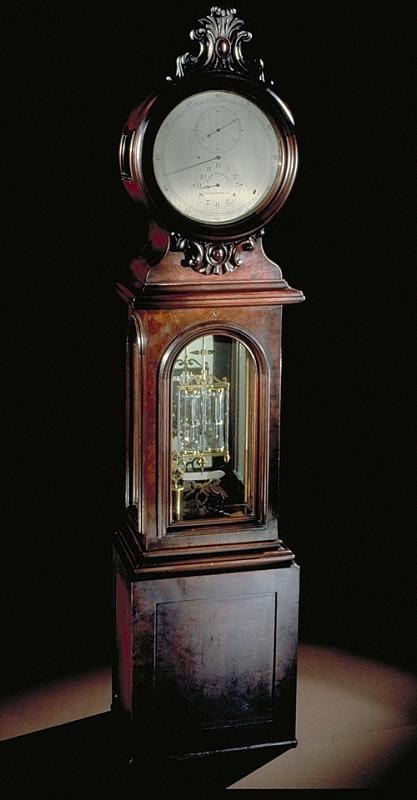
This astronomical regulator was made by E. Howard & Co. in Boston between 1855 and 1859. Constructed for precision timekeeping rather than domestic decoration, it omits standard complications such as striking or calendar trains. The clock is fitted with a sixteen-inch silvered regulator dial that indicates hours, minutes, and seconds on separate tracks. For thermal compensation, its steel pendulum rod carries two glass jars filled with mercury. Around 1855, the regulator was sold to the Charleston, South Carolina, jewelry firm James Allan and Company. Except for repair at the Howard factory following the 1886 Charleston earthquake, it remained with the Allan family business until entering the Smithsonian collection in 1977.

E. Howard & Co. astronomical regulator clock, circa 1855–1859.
E. Howard & Co. astronomical regulator clock, circa 1855–1859. — National Museum of American History. Rights pending — permission not yet requested. Original source

Catalogue identity

Source
americanhistory.si.edu
Category
Clock · Astronomical regulator
Maker / attribution
E. Howard & Co.
Reference
Not recorded
Catalogue / lot identifier
ME.335723
Source-reported date
1855-1859
Country
United States

Source-reported attribution and specifications are not independent authentication. A listing does not establish present ownership, current display, availability or permission to reproduce.

Object description

Object Identity and Construction

This E. Howard & Co. astronomical regulator is an American-made precision timepiece dating to 1855-1859. Standing 93 inches tall, the clock is constructed from wood and brass. The design excludes nonessential complications, such as striking mechanisms, calendar work, and moon dials, as it was designed exclusively for keeping time.

The clock features a tall standing wooden case with carved cresting above a circular dial bezel. It includes an arched glazed trunk door, which displays the mercury jar pendulum and the driving weight.

Evidence for this section
  • “1855-1859 (Date made)”
  • “Nonessential complications like striking mechanisms, calendar work, and moon dials are omitted.”
  • “Tall standing wooden case with carved cresting above a circular dial bezel”
  • “Arched glazed trunk door displaying a mercury jar pendulum and driving weight”

Dial and Compensation Mechanism

The clock is equipped with a sixteen-inch silvered dial that indicates hours, minutes, and seconds separately. The source records that the name of the original retailer, James Allan and Company, is engraved on the dial.

For thermal stability, the steel pendulum rod carries two glass jars filled with mercury. The expansion and contraction of the mercury compensates for changes in the rod's length as the room temperature rises and falls.

Evidence for this section
  • “This particular clock has a sixteen-inch silvered dial that indicates hours, minutes, and seconds separately.”
  • “James Allan and Company, a Charleston, South Carolina, jewelry firm whose name is engraved on the dial.”
  • “The steel pendulum rod carries two glass jars filled with mercury. The expansion and contraction of the mercury compensates for changes in the rod's length as the room temperature rises and falls.”

Provenance and Historical Context

About 1855, E. Howard and Company sold the clock to the Charleston, South Carolina jewelry firm James Allan and Company. The regulator remained in the same Allan family store—later referred to as the Charles Kerrison Company after 1960—from 1865 until it came to the Smithsonian in 1977.

On August 31, 1886, the regulator fell over when an earthquake rocked Charleston. Following this event, the clock was briefly returned to the Howard factory for repairs.

Evidence for this section
  • “About 1855, E. Howard and Company sold this clock to James Allan and Company”
  • “The regulator stood in the same Allan family store (called Charles Kerrison Company after 1960) from 1865 until it came to the Smithsonian in 1977”
  • “On August 31, 1886, the regulator fell over when an earthquake rocked Charleston, and it briefly returned to the Howard factory for repairs.”

Open research questions

  • Do records at the Smithsonian or E. Howard archives identify the specific shop order number or internal movement caliber?
  • To what extent do the post-1886 repairs at the Howard factory impact the original configuration of the internal mechanism?

Source evidence

Recorded claims and source quotations for E. Howard and Company Astronomical Regulator
FieldSource-reported valueSource quotation
ManufacturerE. Howard & Co.“E. Howard & Co. (manufacturer)”
Place MadeBoston, Massachusetts, United States“United States: Massachusetts, Boston (place made)”
Date Made1855-1859“1855-1859 (Date made)”
Dial DescriptionSixteen-inch silvered dial displaying hours, minutes, and seconds separately“This particular clock has a sixteen-inch silvered dial that indicates hours, minutes, and seconds separately.”
Pendulum ConstructionSteel rod with two mercury-filled glass jars“The steel pendulum rod carries two glass jars filled with mercury.”
Overall Clock Height93 in (236.22 cm)“overall: clock: 93 in x 22 1/4 in x 14 1/2 in; 236.22 cm x 56.515 cm x 36.83 cm”
Overall Height93 inches (236.22 cm)“overall: clock: 93 in x 22 1/4 in x 14 1/2 in; 236.22 cm x 56.515 cm x 36.83 cm”
MaterialsWood and brass“Physical Description wood (overall material), brass (overall material)”

Visible details

  • Tall standing wooden case with carved cresting above a circular dial bezel
  • Regulator dial format with independent subsidiary hour and seconds displays
  • Arched glazed trunk door displaying a mercury jar pendulum and driving weight

Research qualifications

  • Internal movement mechanism is not directly visible behind the dial
  • Engraving of James Allan and Company noted in the text is not clearly legible at current image resolution

Photograph identity and source facts were screened before import; rights clearance remains pending.

Consulted source

E. Howard and Company Astronomical Regulator | National Museum of American History

Reviewed 2026-10-25 · Record 8c7c4f6edd

Terms in this record

Glossary explanations for terms named in this object’s record.