
Skip to content
The Encyclopedia of Horology

Clock · Lantern clock

Weight-driven wall pendulum lantern clock

Partially verified

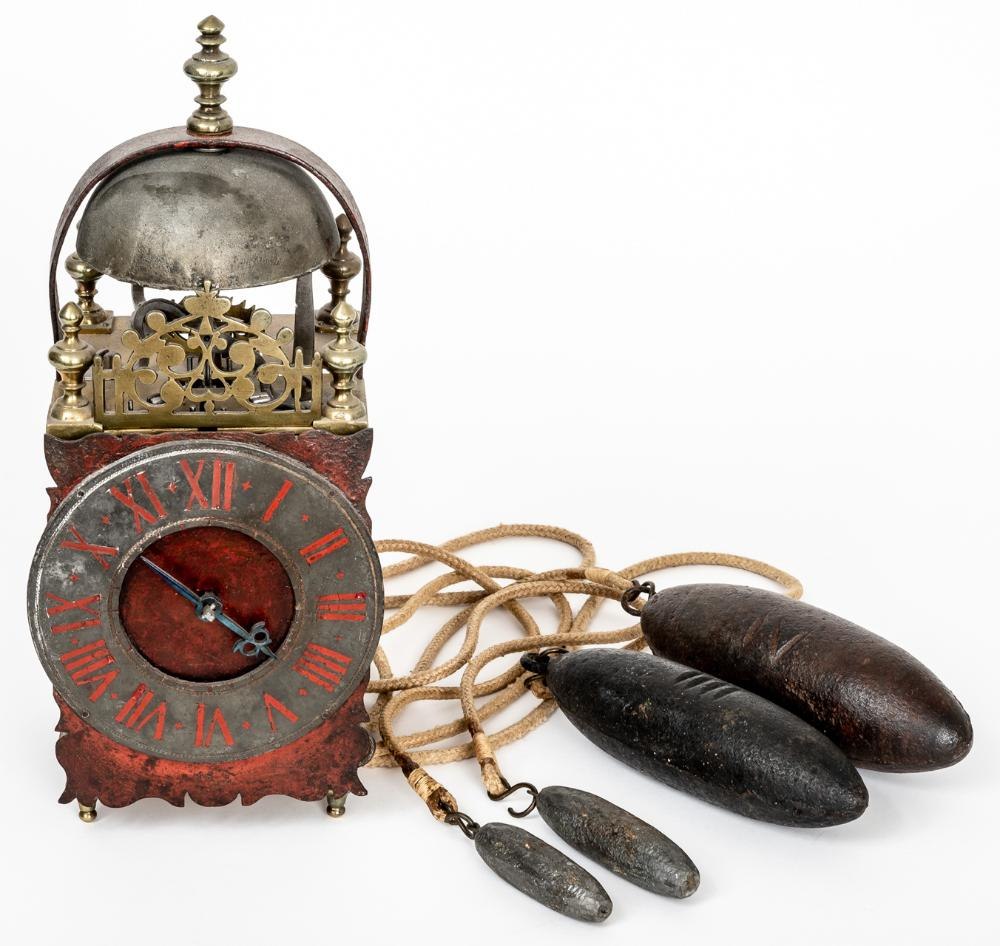
Reported as dating to circa 1650, this weight-driven wall pendulum clock measures approximately 35 cm in height. It features a brass lantern-style movement with cylindrical pillars resting on four spool-shaped feet. The movement exposes two gear trains sharing a single central pillar, operating with a verge arbor and a short rear pendulum. An openwork cut-brass grille is mounted on the front above the dial, surmounted by an overarching frame holding a painted iron bell with a brass apex finial. The dial presents painted red Roman numerals and dot markers with a single steel hand. Power is provided by two large suspended weights and counterweights on braided cords.

Front view of the weight-driven lantern clock showing the dial, cut-brass cresting, bell, and weights
Front view of the weight-driven lantern clock showing the dial, cut-brass cresting, bell, and weights — LOERKE KUNSTAUKTIONEN AG. Rights pending — permission not yet requested. Original source

Catalogue identity

Source
www.invaluable.com
Category
Clock · Lantern clock
Maker / attribution
Not established
Reference
Not recorded
Catalogue / lot identifier
314
Source-reported date
c. 1650
Country
Not established

Source-reported attribution and specifications are not independent authentication. A listing does not establish present ownership, current display, availability or permission to reproduce.

Object description

Construction and Movement

The clock is a weight-driven wall pendulum clock measuring approximately 35 cm in height. The brass lantern-style movement features slightly curved cylindrical pillars and is raised on four spool-shaped feet.

The movement consists of two gear trains sharing a single central pillar and lacks doors on the sides or back, rendering the mechanism fully visible. The striking train includes a mainspring barrel, stop wheel, retarder wheel, and fly, with release levers and a hammer of substantial, square cross-section.

Evidence for this section
  • “Weight-driven wall pendulum clock, c. 1650 H: approx. 35 cm”
  • “Brass lantern-style movement with slightly curved cylindrical pillars, raised on four spool-shaped feet.”
  • “There is no door on the sides or back; the movement is fully visible.”
  • “The movement consists of two gear trains sharing a single central pillar.”
  • “The striking train is reduced to a simple configuration: mainspring barrel, stop wheel, retarder wheel, and fly.”
  • “The release levers and the hammer have a square cross-section and are very substantial.”

Dial and Timekeeping

Timekeeping is provided by a short pendulum fixed to the verge arbor at the rear of the movement. A gear wheel on the extension of the mainspring barrel arbor drives the hour wheel, which carries a single steel hand and is rigidly attached to a release star.

The clock features an openwork cut-brass grille on the front. An arched frame, supported by five spool-like pivots, houses a painted iron bell surmounted by a brass apex finial.

Evidence for this section
  • “A short pendulum is fixed to the verge arbor and positioned behind the movement.”
  • “A gear wheel is mounted on the extension of the mainspring barrel arbor and drives the hour wheel, which carries the single steel hand”
  • “The front features a cut-brass grille.”
  • “The top features four spool-like pivots, plus a fifth at the apex to support the painted iron bell.”

Associated Components and Condition

Power is supplied by two large main weights and two smaller counterweights on braided cords. Beneath the movement plate, there are four forged iron rings.

The clock is documented as requiring restoration. A certificate is provided by Prof. André Curtit.

Evidence for this section
  • “Two large weights power the trains.”
  • “Beneath the movement plate are four forged iron rings.”
  • “The clock requires restoration.”
  • “Certificate: Prof. André Curtit.”

Open research questions

  • What is the specific nature of the restoration required for this timepiece?
  • Does the 'painted iron' description of the bell accurately reflect the current physical state, or is there significant surface oxidation?

Source evidence

Recorded claims and source quotations for Weight-driven wall pendulum lantern clock
FieldSource-reported valueSource quotation
Datec. 1650“Weight-driven wall pendulum clock, c. 1650”
Heightapprox. 35 cm“H: approx. 35 cm”
Movement constructionBrass lantern-style movement with cylindrical pillars“Brass lantern-style movement with slightly curved cylindrical pillars, raised on four spool-shaped feet.”
BellPainted iron bell“plus a fifth at the apex to support the painted iron bell”
Hand configurationSingle steel hand“drives the hour wheel, which carries the single steel hand”
Escapement and pendulumShort pendulum on verge arbor“A short pendulum is fixed to the verge arbor and positioned behind the movement.”
ConditionRequires restoration“The clock requires restoration.”
CertificateProf. André Curtit“Certificate: Prof. André Curtit.”

Visible details

  • Circular chapter ring with red-painted Roman hour numerals and dots.
  • Overhead bell mounted within an arched strap surmounted by a brass finial.
  • Openwork cut-brass fretwork cresting positioned above the dial frame.
  • Accompanied by two substantial elongated main weights and two small counterweights attached to braided cords.

Research qualifications

  • Maker and geographic origin are not specified in the auction listing.
  • The auctioneer notes that 'The clock requires restoration.'
  • Source notes a 'painted iron bell', although visible surfaces show weathered metallic patina.

Photograph identity and source facts were screened before import; rights clearance remains pending.

Consulted source

At Auction: (211) IRON CLOCK

Reviewed 2026-10-25 · Record 85ef9c6d4d

Terms in this record

Glossary explanations for terms named in this object’s record.