
Skip to content
The Encyclopedia of Horology

Clock · Bracket clock

Twin Fusee Verge Bracket Clock by George Morris

Partially verified

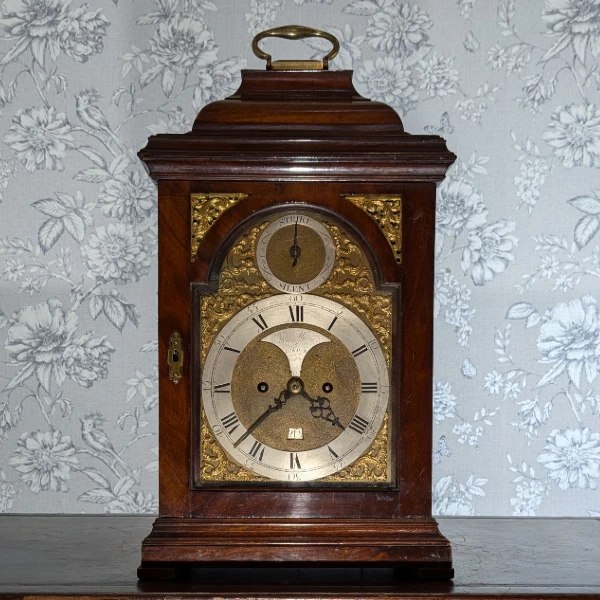
This bracket clock was made by George Morris of London, circa 1810. It features an 8-day, two-train, five-pillar fusee movement with a verge escapement. The clock strikes the full hours on a bell via a rack and pinion system and includes a repeat function. The 6 1/2 inch arched brass dial contains a strike/silent subsidiary dial positioned above a silvered chapter ring with Roman numerals and outer minute markings. The dial features a finely matted center, an applied signature plaque, and a date aperture. The mechanism is housed in a mahogany caddy-top case equipped with a brass carry handle, glazing on the sides and rear door, and original locks and keys for the doors. The back plate is engraved with foliate scrolls. The clock measures 52cm in height, 28cm in width, and 19cm in depth.

Front view of the Twin Fusee Verge Bracket Clock by George Morris, showing the caddy top and arched dial.
Front view of the Twin Fusee Verge Bracket Clock by George Morris, showing the caddy top and arched dial. — W J Morris Clocks. Rights pending — permission not yet requested. Original source

Catalogue identity

Source
wjmorrisclocks.co.uk
Category
Clock · Bracket clock
Maker / attribution
George Morris
Reference
Not recorded
Catalogue / lot identifier
Source URL identifies the listing
Source-reported date
circa 1810
Source-reported place
England

Source-reported attribution and specifications are not independent authentication. A listing does not establish present ownership, current display, availability or permission to reproduce.

Object description

Movement and Dial Construction

The clock is powered by an 8-day, two-train movement utilizing five pillars and fusees. The timekeeping mechanism is regulated by a verge escapement. For audible signaling, the clock strikes the full hours on a bell, employing a rack and pinion system. Additionally, the movement includes a repeat function to chime the hour on demand.

The 6 1/2 inch arched brass dial serves as the visual interface. It features a strike/silent subsidiary dial located in the arch. Below this, a silvered chapter ring displays Roman numerals with outer minute tracks surrounding a finely matted center. The dial is completed by an applied signature plaque and a date aperture.

Evidence for this section
  • “8 Day two train five pillar fusee movement, verge escapement.”
  • “6 1/2 inch arched brass dial with strike/silent subsidiary over silvered chapter ring, Roman numerals with minutes to the outer, finely matted centre”
  • “Striking the full hours to a bell on rack and pinion.”

Case and Exterior

The housing consists of a mahogany caddy-top case. Accessibility to the internal components is provided by glazed panels on the sides and a glazed rear door. For transportation or movement, a brass carry handle is mounted on the top.

The security of the internal mechanism is managed by the original locks and keys, which are present for both doors.

Evidence for this section
  • “Stunning mahogany caddy top case with brass carry handle”
  • “Glazing to the sides and rear door”
  • “Original locks & key to both doors.”

Back Plate and Attribution

The rear of the movement is fitted with a fully engraved back plate. The decoration consists of foliate scrolls framed within a single line border.

The clock is attributed to the maker George Morris of London, with a date estimation of circa 1810.

Evidence for this section
  • “Fine fully engraved back plate with foliate scrolls within a single line border.”
  • “Outstanding English bracket clock by George Morris of London, circa 1810.”

Open research questions

  • Does the applied signature plaque show signs of replacement or modification?
  • Is there any evidence of movement restoration or replacement parts to the verge escapement?

Source evidence

Recorded claims and source quotations for Twin Fusee Verge Bracket Clock by George Morris
FieldSource-reported valueSource quotation
MakerGeorge Morris“George Morris of London”
Datecirca 1810“circa 1810”
Movement8 Day two train five pillar fusee“8 Day two train five pillar fusee movement, verge escapement.”
Height52cm“Height 52cm”
Dial6 1/2 inch arched brass dial“6 1/2 inch arched brass dial with strike/silent subsidiary over silvered chapter ring”
EscapementVerge“verge escapement”
FunctionsStriking and repeat“Striking the full hours to a bell on rack and pinion. Repeat function”

Visible details

  • Mahogany caddy top case with brass handle
  • Arched brass dial with strike/silent indicator
  • Engraved foliate scroll decoration on the back plate
  • Original locks and key reported for both doors

Research qualifications

  • Clock movement details not verified by internal inspection photos
  • Exact date and attribution depend on auction house records

Photograph identity and source facts were screened before import; rights clearance remains pending.

Consulted source

Twin Fusee Verge Bracket clock by George Morris.

Reviewed 2026-11-02 · Record 972657b640

Terms in this record

Glossary explanations for terms named in this object’s record.