
Skip to content
The Encyclopedia of Horology

Tool · German astrolabe

Tobias Volckmer Astrolabe

Partially verified

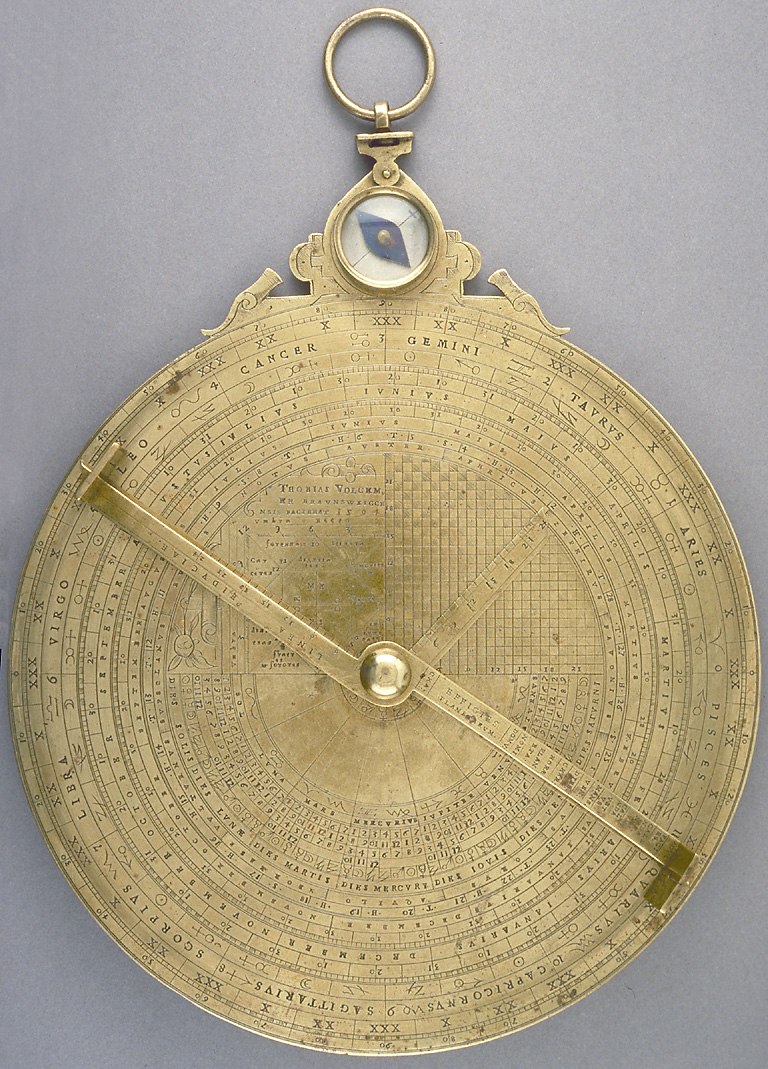
This 1594 astrolabe, crafted from brass and measuring 200 mm in diameter, is signed by Tobias Volckmer of Brunswick. The instrument is distinguished by a mater structured as a flat disc lacking a traditional rim and the absence of movable plates. The throne incorporates a circular table listing weekdays, their associated numbers, and planetary symbols, while a compass bowl is riveted to the back. The rete displays 30 Latin star names, later supplemented with Arabic names in a cursive script, and an ecliptic marked with zodiacal signs. The back of the instrument is densely engraved with multiple concentric circular scales including altitude, zodiacal, Gregorian and Julian calendars, lunar mansions, and winds. A bottom segment houses planetary house sections, and a top quadrant accompanies the signature cartouche. The alidade and rule feature specific scales for declination and linear calculations, reflecting the instrument's complex design and intended use for detailed astrological and astronomical measurement.

Rear view of the brass astrolabe, showing the concentric scales and the signature cartouche of Tobias Volckmer.
Rear view of the brass astrolabe, showing the concentric scales and the signature cartouche of Tobias Volckmer. — British Museum, London. Rights pending — permission not yet requested. Original source

Catalogue identity

Source
www.mhs.ox.ac.uk
Category
Tool · German astrolabe
Maker / attribution
Tobias Volckmer
Reference
MLA 1888,12-1.280
Catalogue / lot identifier
MLA 1888,12-1.280
Source-reported date
1594
Source-reported place
Germany

Source-reported attribution and specifications are not independent authentication. A listing does not establish present ownership, current display, availability or permission to reproduce.

Object description

Construction and Mater

The astrolabe is manufactured from brass and measures 200 mm in diameter. Its primary structure is defined by the mater, which takes the form of a disc without a rim. The outer perimeter of this mater is marked with a 360-degree altitude scale, numbered by 10 degrees, and a 24-hour scale.

The throne serves as an extension of the mater, featuring a circular table that maps the Latin names of the weekdays to their corresponding numbers and planetary symbols. A compass bowl is mounted to the rear of the throne, providing a secondary utility for orientation.

Evidence for this section
  • “This astrolabe has the unusual feature of the mater being in the form of a disc without rim and the absence of movable plates”
  • “The throne is just an extension of the mater with a circular table with the Latin names of the weekdays”

Back Plate and Scales

These include concentric scales for altitude, the zodiacal signs, and dual calendars for both the Gregorian and Julian systems. Additional circular scales represent the 28 lunar mansions, marked with their respective qualities, and the Latin names of the winds.

The bottom section of the instrument's back is dedicated to planetary house sections. This area is divided into seven segments representing the planets, with each section subdivided into columns associated with specific times and planetary influence. A quadrant is positioned on the top right, while a signature cartouche and a shadow scale appear on the left.

Evidence for this section
  • “The back of the instrument bears several circular scales as follows”
  • “The bottom half of the vacant space inside these circles is divided into the seven sections of the planetary houses”

Signatures and Inscriptions

The maker's mark is contained within a cartouche on the back of the instrument, reading 'THOBIAS VOLCKMER BRAUNSWEIGGENSIS FACIEBAT 1594'. It is reported that the date in this signature appears to have been filled with red pigment at some stage. The instrument contains further internal markings, such as a horoscope schema, which also retains traces of red.

The rete features 30 Latin star names, which include corresponding magnitudes and planetary temperaments. In a separate, more cursive script, Arabic star names have been added to the rete, indicating later additions or revisions to the instrument's original engraving.

Evidence for this section
  • “The left hand side contains in a cartouche the signature and the date 'THOBIAS VOLCKMER BRAUNSWEIGGENSIS FACIEBAT 1594'.”
  • “In a more cursive script the corresponding 'Arabic' star names have been added.”

Open research questions

  • Does the presence of the cursive Arabic star names imply they were added by the maker himself or by a later owner?
  • What was the intended purpose of the red pigment applied to the date and the horoscope schema?

Source evidence

Recorded claims and source quotations for Tobias Volckmer Astrolabe
FieldSource-reported valueSource quotation
MakerTobias Volckmer“Signed by Tobias Volckmer”
Place of manufactureBrunswick“Brunswick”
Date1594“Dated 1594”
Diameter200 mm“200 mm in diameter”
Inventory numberMLA 1888,12-1.280“Registration no. MLA 1888,12-1.280”
ProvenanceBequeathed by Octavius Morgan“The instrument was bequeathed to the Museum in 1888 by Octavius Morgan”

Visible details

  • Compass bowl riveted to the top throne
  • Signature cartouche reads 'THOBIAS VOLCKMER BRAUNSWEIGGENSIS FACIEBAT 1594'
  • Red pigment traces visible in the 1594 date and horoscope schema
  • Back scales include concentric Gregorian and Julian calendars

Research qualifications

  • The date 1594 appears to have been filled with red pigment after production
  • The Arabic star names are described as being added in a different, more cursive script than the original markings

Photograph identity and source facts were screened before import; rights clearance remains pending.

Consulted source

Astrolabe

Reviewed 2026-10-26 · Record 2535fc2471

Terms in this record

Glossary explanations for terms named in this object’s record.