
Skip to content
The Encyclopedia of Horology

Pocket watch · Open-face fusee pocket watch

Tobias London silver open face fusee pocket watch

Partially verified

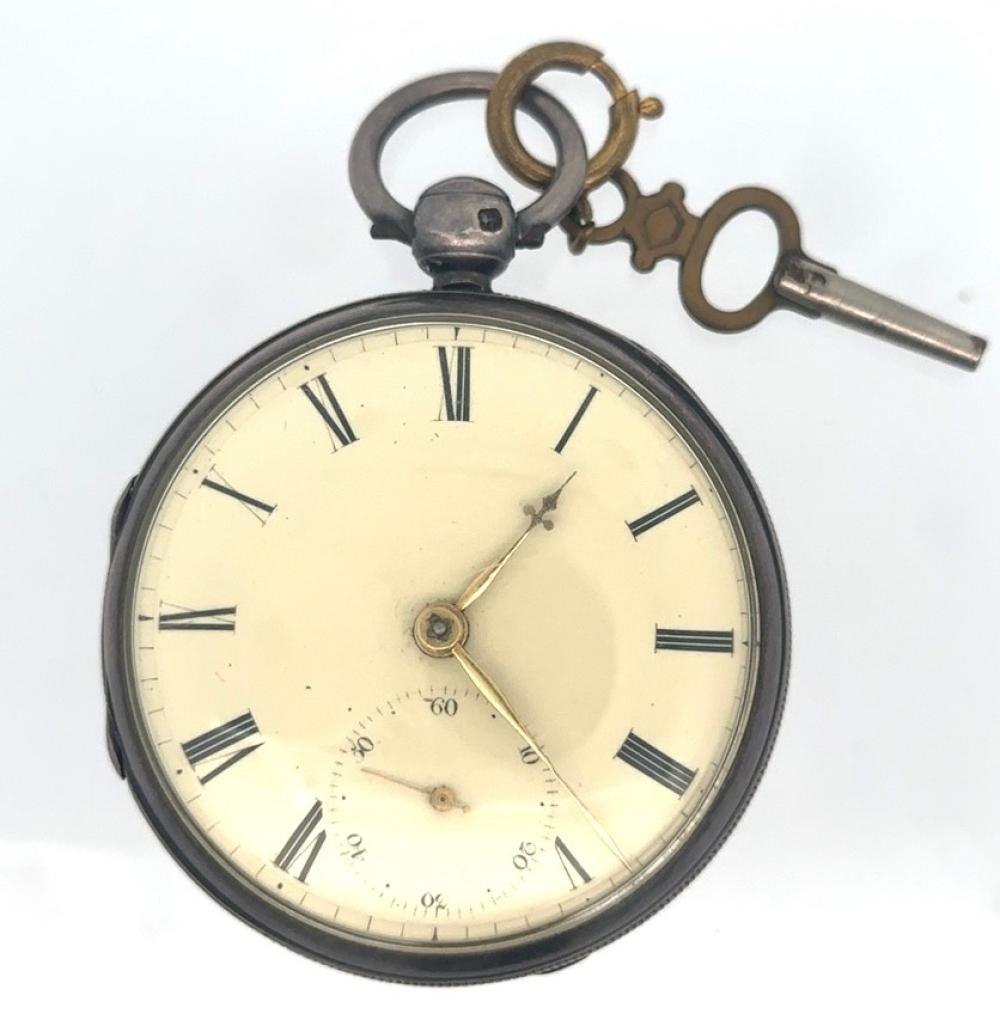
This 19th-century open face pocket watch, attributed to Tobias London, is dated to circa 1834. The timepiece is housed in a silver case, which bears Birmingham hallmarks for 1834. Internally, the watch utilizes a full-plate movement equipped with a detached lever escapement and a fusee power transmission system. It is operated via key-wind and key-set mechanisms, with an associated winding key included. The dial is composed of white porcelain, featuring black Roman numerals for the hours and a recessed subsidiary seconds dial at the six o'clock position. The balance cock is inscribed with the technical designation "Detached Lever," while the movement is signed "Tobias London." The watch has an approximate diameter of 48mm and a total weight of 97.4 grams. The movement currently exhibits some balance motion but is described as not fully functional and may require maintenance.

Front view of the silver open face pocket watch showing the white porcelain dial, subsidiary seconds, and the included winding key.
Front view of the silver open face pocket watch showing the white porcelain dial, subsidiary seconds, and the included winding key. — Luxe Auctioneers. Rights pending — permission not yet requested. Original source

Catalogue identity

Source
orbiscollectibles.com
Category
Pocket watch · Open-face fusee pocket watch
Maker / attribution
Tobias London
Reference
Not recorded
Catalogue / lot identifier
Source URL identifies the listing
Source-reported date
1834
Source-reported place
United Kingdom

Source-reported attribution and specifications are not independent authentication. A listing does not establish present ownership, current display, availability or permission to reproduce.

Object description

Case and Dial

The watch is housed in an open face case constructed from silver, which features Birmingham hallmarks dating to 1834. The casing shows signs of historical use, including light surface scratches and the absence of a movement-retaining tube and pin.

The dial is manufactured from white porcelain, presenting a clean surface with black Roman numerals marking the hours. A subsidiary seconds dial is integrated at the six o'clock position. The auction description reports that the porcelain dial remains in good condition without visible damage.

Evidence for this section
  • “The watch is housed in a silver case hallmarked in Birmingham in 1834.”
  • “The silver case exhibits minor signs of wear, including light surface scratches and the absence of a movement-retaining tube and pin.”
  • “The dial is crafted from white porcelain and displays black Roman numerals for the hours, accompanied by a subsidiary seconds dial.”
  • “The porcelain dial remains in good condition without visible damage.”

Movement and Mechanism

Internally, the timepiece features a full-plate movement design that incorporates a fusee power transmission system and a detached lever escapement. This mechanism is key-wound and key-set, requiring the use of an associated key for operation.

The balance cock displays an engraving specifying the escapement type. The movement is signed with the maker's name, "Tobias London," and includes an individual serial number. Although the movement demonstrates some balance motion, the current assessment indicates that it is not functioning and may require servicing.

Evidence for this section
  • “The movement is a full-plate design, key-wound and key-set, and is signed "Tobias London" with an individual serial number.”
  • “The balance cock is engraved with the inscription "Detached Lever.”
  • “The movement, while showing good balance motion, is not currently functioning and may require servicing.”

Documentation and Attribution

The object is catalogued as a 19th-century pocket watch. It is associated with the name "Tobias London," which is documented on the movement. Documentation for this object is based on a single auction-house record which provides specific details regarding its physical properties, dimensions, and current condition.

The record notes that while the watch carries specific signatures, the classification of the piece as a standard example of its type is noted as "probable" rather than fully established, based on the documentation provided in the auction listing.

Evidence for this section
  • “This is a 19th-century open face pocket watch featuring a detached lever fusee movement.”
  • “The movement is a full-plate design, key-wound and key-set, and is signed "Tobias London" with an individual serial number.”
  • “Credible evidence exists but classification is not fully established.”

Open research questions

  • What is the specific movement serial number to allow for better identification of the Tobias London serial sequence?
  • Can the movement-retaining tube and pin be replaced during a service to restore full case integrity?

Source evidence

Recorded claims and source quotations for Tobias London silver open face fusee pocket watch
FieldSource-reported valueSource quotation
MakerTobias London“signed "Tobias London”
Date1834“hallmarked in Birmingham in 1834”
Case Materialsilver“silver case hallmarked in Birmingham in 1834”
EscapementDetached lever“balance cock is engraved with the inscription "Detached Lever.”
Dimensions48mm diameter“measures approximately 48mm in diameter”
Weight97.4g“weight of 97.4 grams”
Winding/SettingKey wind and set“key-wound and key-set”

Visible details

  • Associated winding key present
  • Porcelain dial with black Roman numerals
  • Subsidiary seconds dial at the six o'clock position
  • Open face silver case design

Research qualifications

  • Movement is reported as not currently functioning
  • Absence of a movement-retaining tube and pin

Photograph identity and source facts were screened before import; rights clearance remains pending.

Consulted source

Tobias London silver open face fusee pocket watch, 1834

Reviewed 2026-11-02 · Record f949ade65a

Terms in this record

Glossary explanations for terms named in this object’s record.