
Skip to content
The Encyclopedia of Horology

Pocket watch · Open-face fusee pocket watch

Francis Bryant Adams 18k gold fusee and chain pocket watch

Partially verified

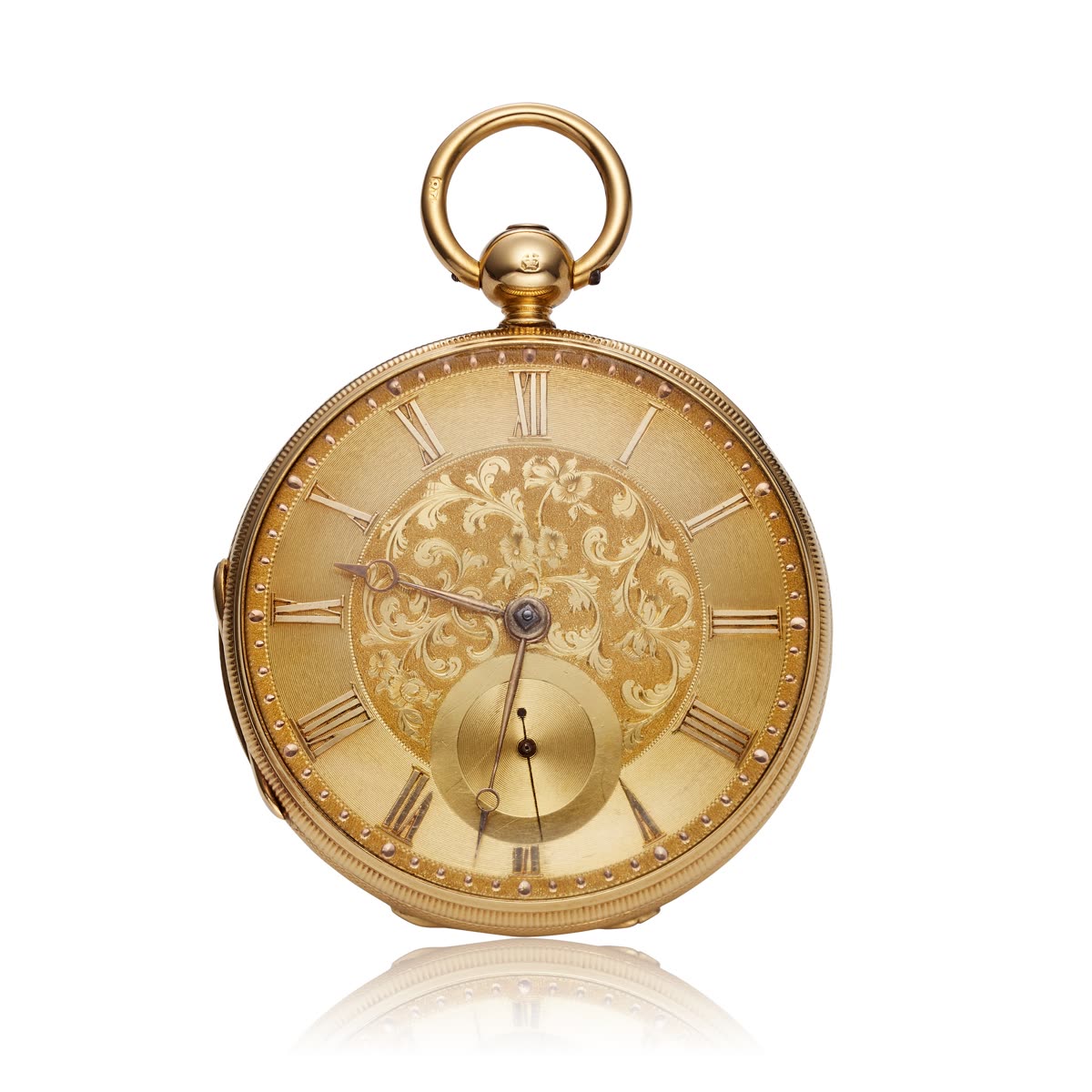
This open-face pocket watch, dated circa 1850 and attributed to Francis Bryant Adams, Jr., features an 18k gold consular case made by casemaker William Francis. Measuring 41 mm in diameter, the watch is fitted with a solid gold dial decorated with centrally engraved flowers and scrolling on a matted ground, applied gold Roman numerals on an engine-turned chapter ring, and gold Breguet-style hands. According to the auction description, the fire-gilded manual-wind movement incorporates a fusee and chain, Harrison's safety maintaining power, an English lever escapement with ruby pallets, a diamond end-stone, and an engraved balance bridge with a theatrical mask.

Dial and front view of the 18k gold Francis Bryant Adams pocket watch
Dial and front view of the 18k gold Francis Bryant Adams pocket watch — Christie’s. Rights pending — permission not yet requested. Original source

Catalogue identity

Source
onlineonly.christies.com
Category
Pocket watch · Open-face fusee pocket watch
Maker / attribution
Francis Bryant Adams, Jr.
Reference
Not recorded
Catalogue / lot identifier
308
Source-reported date
circa 1850
Country
United Kingdom

Source-reported attribution and specifications are not independent authentication. A listing does not establish present ownership, current display, availability or permission to reproduce.

Object description

Case Construction and Exterior Markings

The watch is housed in an 18k gold consular case measuring 41 mm in diameter, credited by the auction description to casemaker William Francis. The construction integrates the dust cover into the case band to ensure sturdiness, with a spring-loaded back cover providing access to winding apertures.

Externally, the case includes a suspension bow mounted above a pendant. The auction condition report notes that hallmarks are visible on the inside of the case back as well as at the base of the bow and on the bow itself.

Evidence for this section
  • “The gold consular case was made by a master casemaker William Francis, with the dust cover as a part of the band to assure sturdiness of the case.”
  • “The back cover is spring-loaded for easy access to the winding apertures.”
  • “The hallmark to the base of the bow and bow are visible. The hallmarks are visible to the inside of the case back.”

Dial Architecture and Visible Features

The timepiece features a solid gold dial decorated centrally with engraved flowers and scrolling on a matted ground. An engine-turned chapter ring displays applied gold Roman numerals, paired with gold Breguet-style hands.

Visual inspection of the front confirms the central floral and scroll engraving on the matted gold ground, applied Roman numeral hour markers on the engine-turned chapter ring, and Breguet moon-tipped hour and minute hands accompanied by a sunken sub-seconds register at 6 o'clock.

Evidence for this section
  • “The dial is solid gold with the center engraved with flowers and scrolling on a matted ground. There are applied gold Roman numerals on the engine turned chapter ring. The hands are gold Breguet (moon) style.”
  • “Centrally engraved floral and scroll patterns on a matted gold ground”
  • “Applied Roman numeral hour markers on an engine-turned chapter ring”
  • “Breguet moon-tipped hour and minute hands with a sunken sub-seconds register at 6 o'clock”

Inscriptions, Attributions, and Recorded Condition

Christie's dates the watch to circa 1850 and attributes the manufacture to Francis Bryant Adams, Jr., noting he became a master in 1848 and was the son of Francis Bryant, also a London watchmaker.

A subsequent engraving on the dust cover reads 'J. Wallace, July 20, 1857', accompanied by an arrow drawn in marker. The cataloger stated the movement was in working order at the time of cataloging but had not been tested for accuracy.

Evidence for this section
  • “CIRCA: 1850”
  • “Francis Bryant Adams, Jr. became master only two years before making this watch, in 1848. He was a son of Francis Bryant, also a well-known watchmaker in London.”
  • “There is an arrow drawn in marker to the dust cover and an engraving that reads, "J. Wallace, July 20, 1857."”
  • “The movement is in working order at the time of cataloging, consistent with the age of the watch. The movement has not been tested for accuracy.”

Open research questions

  • What specific assay office, purity, and date letter stamps are legible in the hallmarks on the bow and case back?
  • Is there a signature or serial number engraved on the movement top plate or barrel bridge?
  • Can the identity or location of J. Wallace referenced in the 1857 dust cover inscription be identified through historical London records?

Source evidence

Recorded claims and source quotations for Francis Bryant Adams 18k gold fusee and chain pocket watch
FieldSource-reported valueSource quotation
Case Material18k gold“CASE MATERIAL: 18k gold”
Case Diameter41mm“CASE DIAMETER: 41mm”
Movement MechanismFire gilded fusee and chain“The movement is fire gilded with a fusee and chain equalizing power source”
CasemakerWilliam Francis“The gold consular case was made by a master casemaker William Francis”
EscapementEnglish type lever escapement with ruby pallets“English type lever escapement with fork with inserted ruby pallets”
Maker Mastership Date1848“Francis Bryant Adams, Jr. became master only two years before making this watch, in 1848.”
Dust Cover InscriptionJ. Wallace, July 20, 1857“There is an arrow drawn in marker to the dust cover and an engraving that reads, "J. Wallace, July 20, 1857."”
Dust Cover MarkingArrow drawn in marker“There is an arrow drawn in marker to the dust cover”
Back Cover ActionSpring-loaded“The back cover is spring-loaded for easy access to the winding apertures.”

Visible details

  • Centrally engraved floral and scroll patterns on a matted gold ground
  • Applied Roman numeral hour markers on an engine-turned chapter ring
  • Breguet moon-tipped hour and minute hands with a sunken sub-seconds register at 6 o'clock
  • Large round suspension bow mounted above a spherical pendant with visible hallmark

Research qualifications

  • Internal movement details, balance bridge, and dust cover are not visible in the photograph; descriptions rely on the auction house report.
  • Source notes a later inscription on the dust cover reading 'J. Wallace, July 20, 1857' and an arrow drawn in marker.

Photograph identity and source facts were screened before import; rights clearance remains pending.

Terms in this record

Glossary explanations for terms named in this object’s record.

Other open-face fusee pocket watch records