
Skip to content
The Encyclopedia of Horology

Movement · Pocket-chronometer movement

Thomas Earnshaw Pocket-Chronometer Movement Signed Robert Tomlin

Partially verified

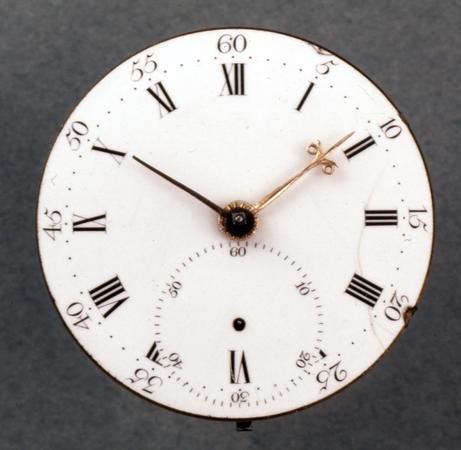
This pocket chronometer movement was constructed by Thomas Earnshaw circa 1783 and features a backplate signature reading 'Robert Tomlin Watch Maker to the King London No 1400'. Created during the licensing arrangement linked to Thomas Wright's 1783 patent, it incorporates an early version of Earnshaw's spring detent escapement. The mechanism employs a full-plate brass frame with turned pillars, maintaining power, gilded gear work, and jewelled escapement pivots. The white enamel dial features black Roman hour numerals, Arabic five-minute calibrations, and an inset subsidiary seconds register at 6 o'clock.

Dial view of British Museum chronometer movement 1958,1201.1752 by Thomas Earnshaw signed Robert Tomlin.
Dial view of British Museum chronometer movement 1958,1201.1752 by Thomas Earnshaw signed Robert Tomlin. — British Museum. Rights pending — permission not yet requested. Original source

Catalogue identity

Source
www.britishmuseum.org
Category
Movement · Pocket-chronometer movement
Maker / attribution
Thomas Earnshaw
Reference
1958,1201.1752
Catalogue / lot identifier
Source URL identifies the listing
Source-reported date
1778-1788 (circa 1783)
Country
United Kingdom
Source-reported serial
1400

Source-reported attribution and specifications are not independent authentication. A listing does not establish present ownership, current display, availability or permission to reproduce.

Object description

Historical Context and Production

This pocket chronometer movement was constructed by Thomas Earnshaw, dating to approximately 1783. The movement is linked to a patent agreement (No. 1354) taken out by Thomas Wright in May 1783, under which Earnshaw produced movements for other watchmakers to recover patent costs.

The back plate is signed 'Robert Tomlin Watch Maker to the King London No 1400'. It is noted as one of two known examples produced under this specific agreement to bear the required stamp, the other being signed 'Jessop Southampton' (No. 19, in the Time Museum, Rockford U.S.A.).

Evidence for this section
  • “Made by Thomas Earnshaw (1749-1829), c. 1783”
  • “Signature: On the back plate 'Robert Tomlin Watch Maker to the King London No 1400'.”
  • “This watch signed 'Robert Tomlin' is one of two examples known that is stamped in this way and made under this particular agreement.”

Movement Construction

The movement features a full-plate construction with turned pillars, lacking a barrel bridge, and possesses an unusual pierced and engraved balance bridge. The fusee includes maintaining power with a brass ratchet wheel, and the setting-up work is located under the barrel, described as an unusual feature in a chronometer.

The escapement is an early form of Thomas Earnshaw's design. Adjustments are provided by three screws on the back plate, which control the detent position, height, and spring tension, respectively.

Evidence for this section
  • “Full plate construction, turned pillars. No barrel bridge, unusual pierced and engraved balance bridge”
  • “Setting-up-work by worm and wheel under the barrel, an unusual feature in a chronometer.”
  • “A very early form of Thomas Earnshaw's escapement.”

Dial and Condition

The flat white enamel dial features Roman hour numerals and Arabic five-minute numerals. The minute hand is recorded as not original and poorly repaired; the seconds hand is missing from its subsidiary track.

The balance and spring exhibit signs of deterioration. The spring is pinned to an overhanging stud, and as it projects through the stud for a quarter of a turn, the museum catalogue suggests it may not be original. The detent is described as deteriorated, and the steel banking pin displays signs of rust.

Evidence for this section
  • “Flat enamel dial with subsidiary seconds, Roman hour numerals and Arabic five minute numerals.”
  • “Minute hand not original, seconds hand missing.”
  • “The spring projects through the stud for a quarter of a turn and so may not be original.”

Open research questions

  • What specific archival records confirm the purpose of the 'T.W' and 'PT' ebauche marks found on the back plate?
  • Are there diagnostic methods to confirm which specific components of the escapement assembly are original versus later replacements?

Source evidence

Recorded claims and source quotations for Thomas Earnshaw Pocket-Chronometer Movement Signed Robert Tomlin
FieldSource-reported valueSource quotation
EscapementSpring detent escapement“SUBSIDIARY SECONDS POCKET-CHRONOMETER MOVEMENT WITH SPRING DETENT ESCAPEMENT AND BRIDGE-COCK.”
Movement MakerThomas Earnshaw“Movement made by: Thomas Earnshaw”
Backplate SignatureRobert Tomlin Watch Maker to the King London No 1400“Signature: On the back plate 'Robert Tomlin Watch Maker to the King London No 1400'.”
Dial Diameter44.60 mm“Diameter: 44.60 millimetres (dial)”
ProvenanceCourtenay Adrian Ilbert Collection“Previous owner/ex-collection: Courtenay Adrian Ilbert”
Ebauche MarksT.W over PT over 34“Ebauche marks on the underside of the back plate (T.W over PT over 34.”
Frequency18,000 beats per hour“Beats per hour: 18,000”
Back-plate Diameter39.30 mm“Diameter: 39.30 millimetres (back-plate)”

Visible details

  • Flat white enamel dial with Roman hour numerals and outer Arabic five-minute chapter ring
  • Subsidiary seconds track positioned at 6 o'clock with no seconds hand fitted
  • Visible hairline cracks extending through the upper right sector and edge chipping near the 20-minute mark
  • Centrally mounted hour and minute hands, with the minute hand displaying an ornate piercing

Research qualifications

  • The museum catalogue notes that the minute hand is not original and has been poorly repaired, while the seconds hand is missing.
  • Only the dial side of the movement is visible in the photograph.

Photograph identity and source facts were screened before import; rights clearance remains pending.

Consulted source

chronometer watch | British Museum

Reviewed 2026-10-25 · Record e8ab3e95f5

Terms in this record

Glossary explanations for terms named in this object’s record.