
Skip to content
The Encyclopedia of Horology

Tool · Arabic-inscribed astrolabe, Iran

The Hunter's Astrolabe

Partially verified

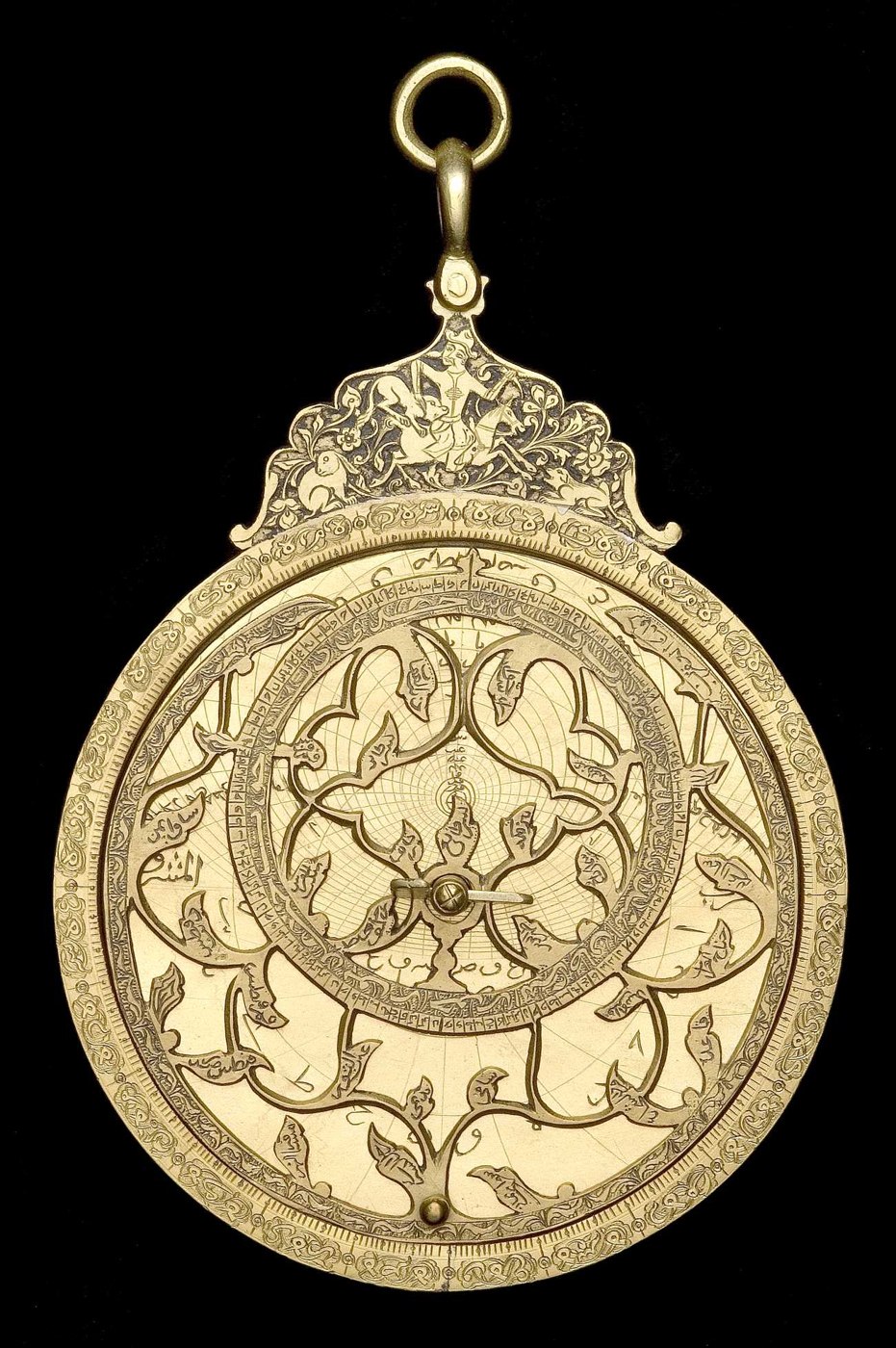
This 17th-century brass astrolabe, identified as inventory number 54607, is held by the History of Science Museum at the University of Oxford. Known as 'The Hunter's Astrolabe' due to the distinctive hunting scene engraved on its Indo-Persian style throne, the instrument was presented by Lewis Evans in 1924. The device consists of a mater and limb constructed in one piece, with a tab positioned at the bottom to secure internal plates. The instrument features a foliate-style rete without marked stars, and includes five plates covering latitudes from 29°0' to 40°0'. The back of the instrument features an alidade, which is double-ended and original to the piece.

Front view of the astrolabe showing the rete and the hunting scene on the throne.
Front view of the astrolabe showing the rete and the hunting scene on the throne. — History of Science Museum, University of Oxford. Rights pending — permission not yet requested. Original source

Catalogue identity

Source
www.mhs.ox.ac.uk
Category
Tool · Arabic-inscribed astrolabe, Iran
Maker / attribution
Not established
Reference
54607
Catalogue / lot identifier
1924-0/2005
Source-reported date
17th century
Source-reported place
Persia

Source-reported attribution and specifications are not independent authentication. A listing does not establish present ownership, current display, availability or permission to reproduce.

Object description

Throne and Exterior Construction

The astrolabe features an Indo-Persian style throne, characterized by its engraved decoration. A focal point of the design is the front of the throne, which displays an intricate hunting scene. This imagery is set amidst foliate ornamentation, a common motif in Persian astrolabe design, often used alongside calligraphic elements.

The suspension mechanism is composed of a simple, round cross-section ring attached to an omega-shaped shackle. These components, like the main body of the instrument, are crafted from brass. The mater and limb are built as a single-piece construction, and a tab located at the bottom of the limb serves to prevent the internal plates from rotating during use.

Evidence for this section
  • “The throne is of the indo-persian, engraved type”
  • “The front of the throne is decorated with a hunting scene.”
  • “The mater and limb are of one-piece construction.”

Rete and Internal Components

The rete is executed in a foliate, single-knob style and serves to display the zodiacal signs, which are labeled in Arabic script. Notably, there are no stars indicated on the rete with bulb pointers. The rete is secured to the mater using a simple pin and horse assembly.

Five internal plates are provided, which accommodate various latitudes ranging from 29°0' to 40°0'. These plates are held in a fixed position by a tab at the base of the mater. The limb features a degree scale marked from 0 to 360 degrees, with divisions every five degrees.

Evidence for this section
  • “The rete is of the foliate (single knob) type.”
  • “The rete is attached using a pin & horse. This is a simple horse.”
  • “There are 5 plates with latitudes ranging from 29°0' to 40°0' .”

Alidade and Provenance

The original double-ended alidade is rigid and features simple, un-notched sights. It is engraved with sine/cosine scales ranging from 0 to 60 units of the quadrant radius, as well as an unequal hour scale ranging from 1 to 12.

The instrument, accessioned under number 1924-0/2005, was acquired by Lewis Evans from a London dealer named Garcia around 1880. It was later formally presented to the museum in 1924. R. T. Gunther provided the moniker 'The Hunter's Astrolabe' in his 1932 publication, The Astrolabes of the World, observing that the decorative theme suggests the specific interests of its original owner.

Evidence for this section
  • “Alidade Double-ended.”
  • “Evans bought it from Garcia, a London dealer, about 1880”
  • “Gunther dubbed it 'The Hunter's Astrolabe'”

Open research questions

  • Does the hunting scene correlate to specific historical figures or royal workshops in 17th-century Persia?
  • Why does the rete lack the typical star markings found on contemporary instruments of this type?

Source evidence

Recorded claims and source quotations for The Hunter's Astrolabe
FieldSource-reported valueSource quotation
Inventory Number54607“Inventory no. 54607”
Date17th century“Date 17th century”
Place of ManufacturePersia“Place Persia”
MaterialBrass“Material Brass”
Throne TypeIndo-Persian, engraved“The throne is of the indo-persian, engraved type”
AcquisitionPresented by Lewis Evans in 1924“Presented by Lewis Evans in 1924”
Latitude Range29°0' to 40°0'“latitudes ranging from 29°0' to 40°0'”
Shackle TypeOmega“Shackle of the omega type”

Visible details

  • Hunting scene engraved on the throne
  • Foliate-style rete with Arabic zodiacal labels
  • Double-ended alidade with sine/cosine scales
  • One-piece mater and limb construction

Research qualifications

  • The exact identity of the original patron remains unverified
  • The specific Persian workshop or maker is not recorded

Photograph identity and source facts were screened before import; rights clearance remains pending.

Consulted source

Astrolabe, inventory 54607 (Persia, 17th century)

Reviewed 2026-10-26 · Record 596ae06dc9

Terms in this record

Glossary explanations for terms named in this object’s record.